The short answer: choose IWRC (independent wire rope core) for cranes, multi-layer drums, heavy loads and anything warm; choose fiber core (FC) for light winches and hand-operated equipment where flexibility and a built-in grease reservoir matter more than strength; WSC sits between the two and mostly appears in small-diameter and stationary rope. The core is the part of the rope you never see, and it is the first thing that decides how the rope carries load, how it survives the drum, and how it dies.
In eleven years of quoting ropes I have lost count of the enquiries that read “6×36WS, 24 mm, 200 m” and stop there. That is not a specification. In EN 12385-4 notation everything after the plus sign is the core — 6×36WS+FC, 6×36WS+IWRC — and the two ropes are not interchangeable. They differ in breaking force by roughly seven percent, in stretch by roughly double, and in how long they live on a multi-layer drum by months or years. This guide explains what each core actually does, what the numbers look like, and how I choose between them in daily practice.
What the Core Actually Does
The core is the foundation the strands are laid around, and it does four jobs at once:
- Supports the strands. It holds the strands in their geometry so the rope stays round and the wires share load instead of biting into each other.
- Carries part of the load. In a straight pull and especially in bending over a sheave, the core is a load-bearing element, not just packing.
- Stores lubricant. A fiber core is a sponge that feeds grease to the internal wires for the life of the rope.
- Sets the rope’s character. Crush resistance, heat tolerance, constructional stretch and bending stiffness are all decided at the core before a single outer wire sees wear.
There are three core types in industrial practice, and every rope datasheet will name one of them. A fuller quick-reference version of this summary also lives on our wire rope core types page; below is the version I use when a customer asks which one to buy.
The Three Core Types in Plain Language
Fiber core (FC)
Natural fibers (sisal, manila) or synthetic fibers (polypropylene, polyester) twisted into a soft center. FC gives the most flexible rope for a given construction: it bends easily around small sheaves, cushions internal wire contact, and holds grease like a reservoir, feeding lubrication to the strands from the inside out. It is also the lightest and cheapest option.
The limits are structural. Fiber carries no tension of its own, so an FC rope gives up roughly 7% breaking force against the same rope on an IWRC. It crushes — on a multi-layer drum the first layers flatten and the outer strands lose their seating. It fears heat: natural fiber is commonly limited to around 100 °C, and synthetic cores can soften below that. And a natural fiber core rots if water gets in and the grease has dried out.
Wire strand core (WSC)
A single steel strand — not a full rope — as the center. WSC is stronger than FC and cheaper than IWRC, but it is a compromise on both axes: it does not support the strands as well as an independent rope, and it cannot be lubricated internally the way fiber can. You meet it in small-diameter ropes, guy and mast rope, control cable and other applications where the rope is stationary or lightly loaded and full IWRC support would be money spent for nothing.
Independent wire rope core (IWRC)
A complete small rope — typically a 6×7 construction with its own lay — inside the main rope. The IWRC is itself load-bearing, so the rope gains roughly 7% breaking force at the same diameter and grade, keeps its shape under the crushing of multi-layer spooling, tolerates temperatures that would carbonize a fiber core, and stretches about half as much in its first weeks of work. The trade-offs: the rope is a little stiffer, slightly heavier, and a few percent more expensive.
For almost everything that hoists, this is the default. Crane makers specify IWRC for hoist and boom ropes, sling standards expect it for heavy service, and mine hoist rope without a steel core is not a thing I have ever quoted.
Table 1 — The three core types at a glance
| Core type | Made of | Relative breaking force | Flexibility | Crush resistance | Practical heat limit | Typical duty |
|---|---|---|---|---|---|---|
| FC | Sisal or polypropylene fiber | Baseline | Best | Poor | About 100 °C | Light winches, hand hoists, general service |
| WSC | One steel strand | About +5–10% vs FC | Moderate | Moderate | Limited by internal lubrication | Small-diameter, guy and stationary rope |
| IWRC | A small independent 6×7 rope | About +7–10% vs FC | Good | Best | Highest (grease-limited) | Cranes, mining, heavy slings, multi-layer drums |

IWRC vs Fiber Core: The Numbers That Matter
Strength first, because it is the number everyone asks about. The catalogs of every serious maker list the same construction both ways, and the gap sits between 7% and 10% depending on construction and grade. Where the extra metal goes matters as much as how much: under a crushing load — the first layers of a multi-layer drum, a kelly bar, a sheave running slightly out of true — a fiber core collapses long before the outer wires are worn, while an IWRC keeps the strand geometry and keeps lifting.
Table 2 — Approximate minimum breaking force, 6×36WS class, grade 1960, FC vs IWRC (certificate values govern; see breaking force and safety factor)
| Rope diameter | 6×36WS+FC (approx.) | 6×36WS+IWRC (approx.) | Difference |
|---|---|---|---|
| 20 mm | 260 kN | 279 kN | +7% |
| 22 mm | 313 kN | 337 kN | +8% |
| 24 mm | 373 kN | 401 kN | +8% |
| 26 mm | 438 kN | 470 kN | +7% |
| 28 mm | 508 kN | 545 kN | +7% |
| 32 mm | 664 kN | 712 kN | +7% |
| 36 mm | 837 kN | 900 kN | +8% |
Then stretch. A new FC rope beds in at roughly 0.5% constructional elongation; an IWRC rope at roughly half that. On a 200 m reeving that is a metre of adjustment you do not have to make — and re-tensioning a crane rope at height is nobody’s favourite job. Full background is in the elongation and stretch guide.
Then temperature. Sisal scorches and loses its supporting section well before the outer wires are troubled; common guidance puts fiber core out of its depth above roughly 100 °C. An IWRC keeps its geometry far beyond that — the practical ceiling becomes the lubricant, not the core, and for foundry or ladle duty you move to special high-temperature greases or dedicated constructions.
Finally fatigue. On generous D/d ratios — the sheave sizes serious machines already have — an IWRC rope matches or beats FC life because the steel core supports the strands and internal wire-on-wire wear stays low. FC only wins the fatigue contest on small sheaves with light loads, which is exactly the small-winch duty it is meant for. Sheave sizing, if you need to check it, is in the sheave and drum guide.

Crush Resistance: Where Cores Live or Die
Multi-layer drum winding is the most destructive thing a rope does for a living. Every upper layer sits in the valleys of the layer below, and at each crossover the rope takes a localized squeeze that adds up over thousands of cycles. A fiber core rope gradually squashes oval; the strands lose their seating, the wire contact stresses climb, and broken wires appear at the layer crossings first. An IWRC resists the same pressure and keeps its section, which is why every crane manufacturer that winds multiple layers specifies a steel core — and why an FC rope that lasted years on a single-layer winch can be dead in weeks on a tower-crane style multi-layer drum.
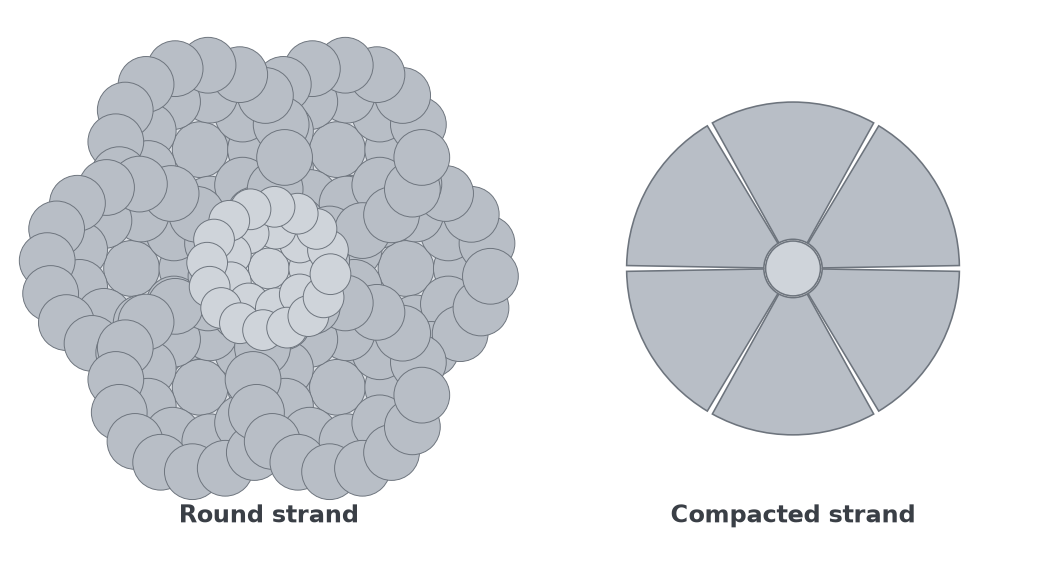
Compaction raises the ceiling further. Compacting the strands flattens the wires against each other, raising the metallic area by roughly 10% at the same diameter and producing a smoother, denser outer surface that shrugs off layer-crossing pressure. Where duty is heavy I specify a compacted IWRC rope before I specify a bigger diameter — often it is the only answer that still fits the drum.
EPIWRC: The Core Upgrade Worth Asking For
Between the core and the strands there is a hidden wear surface, and on rotation-resistant ropes the internal contact pressures are high. Plastic impregnation — EPIWRC in the datasheet — fills the gaps around the core with a tough plastic layer: it cushions every internal wire-to-wire contact, locks grease inside the rope, and seals water and abrasive dust out. In the field it shows up as dramatically longer intervals between internal lubrication and a rope that still looks new inside when you cut it for termination.
That is why our rotation-resistant crane and drilling ropes are standard on this construction — 35WXK7-EPIWRC for crawler and truck cranes, 6×K36WS-EPIWRC and 8×K26WS-EPIWRC for the main winches of rotary drilling rigs. If the enquiry says “EPIWRC”, nothing else in the specification is doing more work per letter.
When Fiber Core Is Still the Right Answer
None of this makes FC obsolete; it makes FC specific. I still recommend it where the rope’s life is defined by flexibility rather than load: hand winches and small shop hoists, guide and tail ropes, anything where the drum is single-layer, the sheaves are small, and the loads are a fraction of the rope’s capacity. Fiber core also remains the economical choice for general utility rope where nobody is measuring fatigue life.
And there is one heavyweight exception worth knowing: STS container crane traction ropes such as 4V×39S+5FC are built around fiber elements by design — the construction trades a little strength for extreme flexibility over the traction sheave, which is what that duty actually consumes. Core selection is about matching the failure mode, not maximizing one number.
What the Core Means for Inspection
Core damage is internal damage, and internal damage is the kind ISO 4309 inspection exists to catch. The signs I teach crews to read:
- Diameter loss. A reduction of about 10% of nominal on a six-strand IWRC rope — and less on rotation-resistant constructions — usually means the core has collapsed, even if the outer wires look fine. Measure across the crowns, two directions, and log it.
- Low spots and waviness. A flattened side or a wave in the lay is the surface signature of a crushed core.
- Dry core on an FC rope. If the fiber has dried out, the rope is wearing from the inside — and a wet, rotted sisal core on an outdoor rope is just as bad. Lubrication that actually reaches the core is the cure; see the lubrication guide.
- Internal broken wires. On an IWRC rope the core can shed wires you will never see without opening the rope — ISO 4309 requires internal inspection, and it matters most near the drum and the terminations.
One more consequence for fleet owners: because FC and IWRC ropes discard differently and carry different certificates, mixing them in one application muddies the inspection record. Pick one core per duty and stay with it.
How I Specify the Core, Duty by Duty
Table 3 — Core selection by application, as I quote it
| Application | Typical construction | Core I specify |
|---|---|---|
| Tower crane hoist, single or two fall | 18×K7 / 35×K7 rotation-resistant | IWRC (steel core as per construction) |
| Truck and crawler crane main hoist | 35×K7 / 35WXK7 | IWRC, EPIWRC preferred |
| Rotary drilling rig main and kelly winch | 35WXK7; 6×K36WS / 8×K26WS on heavy rigs | IWRC, EPIWRC preferred |
| Overhead and gantry crane, multi-layer drum | 6×36WS class, compacted where duty is high | IWRC |
| STS container crane traction | 4V×39S+5FC / AL FLEX-7 | Fiber elements by design |
| Small shop winch, hand hoist, light utility | 6×19 / 6×36 class | FC acceptable |
| Guy, mast and stationary rope | Small-diameter strand-based constructions | WSC |
| Heavy-duty wire rope slings | 6×36WS class | IWRC (expected for heavy service) |
What Goes on the Order
A core is one word on the order and the difference between a rope that suits the machine and one that merely fits it. When you enquire, write the full designation — diameter, construction, core, lay, finish, length — or just send the application and let us close the specification for you. A rope quoted without its core is a rope quoted twice.
Aulone is a professional manufacturer and supplier of steel wire ropes, wire rope slings, synthetic ropes and rigging hardware for lifting, marine, mining, construction and industrial applications. We have made rope for more than twenty years, with 200,000 tons of annual capacity, stock availability on common crane and sling sizes, and certification to EN 12385-4, ISO 9001, BV, ABS, DNV, RMRS and CE. Custom assemblies — swaged eyes, sockets, matched pairs, exact lengths — are routine, and third-party testing can be arranged before shipment.
Send the application details and we will confirm the core, the construction and the certificate: info@wireropes.net.
Frequently Asked Questions
How much stronger is IWRC than fiber core?
Roughly 7% higher minimum breaking force at the same diameter and grade, rising toward 10% on some constructions. Under crushing — multi-layer drums, poor sheave alignment — the effective advantage is larger, because a fiber core collapses while an IWRC keeps the strand geometry.
Can I replace a fiber core rope with an IWRC rope on the same machine?
Usually yes, and it is usually an upgrade: same drum capacity at the same diameter, higher breaking force, less stretch. Check the machine manual first — the rope gets marginally stiffer and heavier, and a few machines specify FC for a reason. Confirm sheave condition before the change; a grooved-out sheave will eat a new IWRC rope just as fast as the old one.
What temperature can a fiber core rope handle?
About 100 °C is the practical ceiling for natural fiber cores, and synthetic cores have their own softening limits. Above that the core loses its supporting section even though the outer wires look healthy. For hot duty specify IWRC — the limiting factor then becomes the lubricant, and special greases extend the range further.
What does EPIWRC mean?
Plastic-impregnated IWRC: a tough plastic layer fills the gaps around the core, cushioning internal wire contacts, locking lubricant in and keeping water and abrasive out. It is standard on our rotation-resistant crane and drilling-rig ropes such as 35WXK7-EPIWRC, and it is the single highest-value upgrade in most heavy-duty hoist specifications.
How can I tell if a rope’s core has failed?
Measure the diameter across the strand crowns in two directions and compare with nominal: a loss approaching 10% (less on rotation-resistant ropes) usually means core collapse. Flattened sides, a wave in the lay, and soft spots under hand pressure are the visible companions. All are discard conditions under ISO 4309.
Is WSC just a cheaper IWRC?
It is a different tool. WSC is one steel strand, cheaper and slightly stronger than fiber, but it cannot support and lubricate the strands the way a complete small rope does. It belongs in small-diameter and stationary rope — guys, control lines, light general service — not under a crane hoist.