35×K7 vs 19×7 Wire Rope: Which Rotation-Resistant Rope Do You Actually Need?
By Andri — Technical Writer & Crane Rope Specialist, Aulone (www.wireropes.net)
Direct answer: Both 19×7 (18×7) and 35×K7 are rotation-resistant ropes, but they solve different problems. 19×7 is the flexible, economical choice for moderate lift heights and light-to-medium tower crane duty. 35×K7 — compacted and built with more outer strands — delivers roughly 15–20% higher breaking force, far better drum-crushing resistance, and longer life under heavy, high-cycle hoisting, which is why it is the default main-hoist rope on modern mobile, crawler and offshore cranes. Choose 19×7 for flexibility and cost; choose 35×K7 when breaking force, spooling stability and service life matter more.
If you buy crane ropes for a living, this comparison lands on your desk sooner or later. Your tower crane supplier quotes 19×7, your rope supplier recommends 35×K7, and the price difference makes you wonder whether the upgrade is marketing or engineering. I get this question almost every week, so let me settle it properly — structure by structure, number by number.

First, Why Rotation Resistance Matters at All
When a conventional 6-strand rope carries a load on a single fall, the tension unbalances the torque inside the rope and the load starts to spin. The consequences escalate quickly: the load rotates, the rope below the hook twists onto itself, loops form, and the next lift can kink the rope permanently — or drop the load.
Rotation-resistant ropes solve this with layered counter-rotating strands: inner strands laid in one direction, outer strands laid in the opposite direction, so torques cancel out. That is the family both 19×7 and 35×K7 belong to. Where they differ is how they achieve balance — and what they sacrifice for it.
The Structures, Side by Side
| Property | 19×7 (18×7 class) | 35×K7 (compacted rotation-resistant) |
|---|---|---|
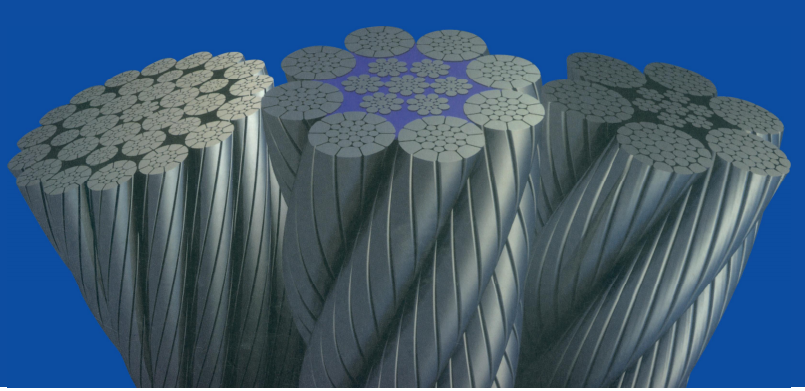
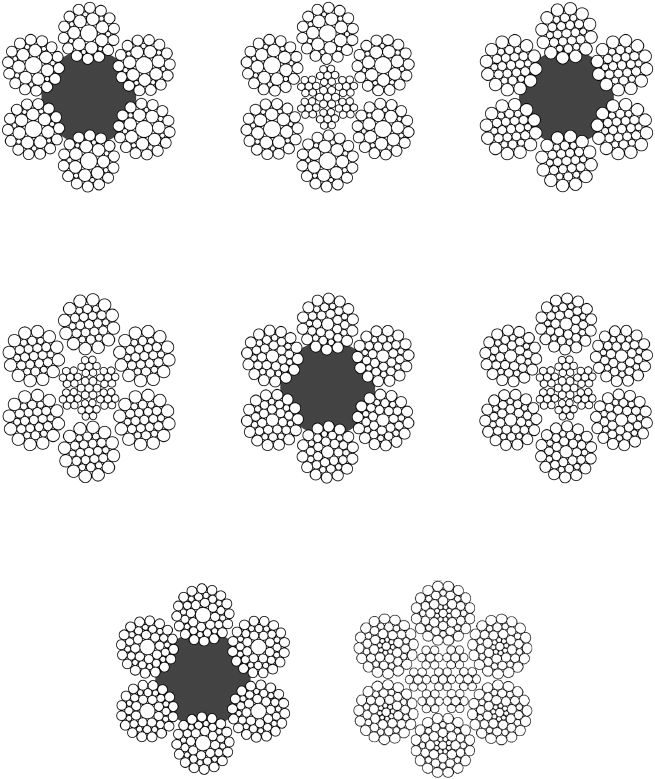
| Construction | 18 strands: 9 outer + 9 inner, around IWRC; often written 18×7 or 19×7 | 34–35 strands in 3 counter-rotating layers + IWRC, compacted outer strands |
| Outer wires per strand | Fewer, thicker wires | More wires per strand, compacted flat |
| Breaking force (same dia & grade) | Baseline | ~10–15% higher |
| Flexibility | Excellent — easier reeving, bends around smaller sheaves | Good, but stiffer than 19×7 |
| Drum-crushing resistance | Moderate — vulnerable in multi-layer spooling | Excellent — the compacted outer layer resists inter-layer crushing |
| Rotation resistance | Good for moderate heights | Outstanding — the best torque balance in the class |
| Sensitivity to misuse | Sensitive to shock loads and tight fleet angles | Sensitive too, but more tolerant of poor spooling |
| Relative price | Lower | Higher — justified by life in heavy duty |
| Typical best use | Tower crane hoist, moderate heights; auxiliary hoists; older crane designs | Main hoist on mobile, crawler, offshore cranes; high lift heights; multi-layer drums |
Note on naming: 19×7, 18×7 and 18×K7 describe the same family (18 load-carrying strands; some standards count the core as the “19th” strand). 35×K7 belongs to the 35×7 / 34×7 class; the K marks compacted strands, and Aulone’s 35WXK7 variant adds a thick outer wire profile for even better wear life on drums.
Where 19×7 Is Still the Right Answer
I always push back when a buyer assumes the bigger rope is automatically better. 19×7 earns its place in three situations:
- Moderate lift heights. Below roughly 60–80 m of hook travel, load spin is manageable and 19×7’s torque balance is fully sufficient.
- Small sheaves and tight reeving. Its flexibility means lower bending stress where D/d ratios are modest — common on older or compact tower cranes.
- Budget-driven light duty. For a crane that lifts occasionally, not thousands of cycles a day, paying for compacted rope rarely pays back.
Where 35×K7 Pulls Ahead
Now the other side. Three mechanical facts drive the difference:
- More outer strands carrying load. Load is distributed over more wires, so contact pressure at each wire is lower — wear spreads instead of concentrating.
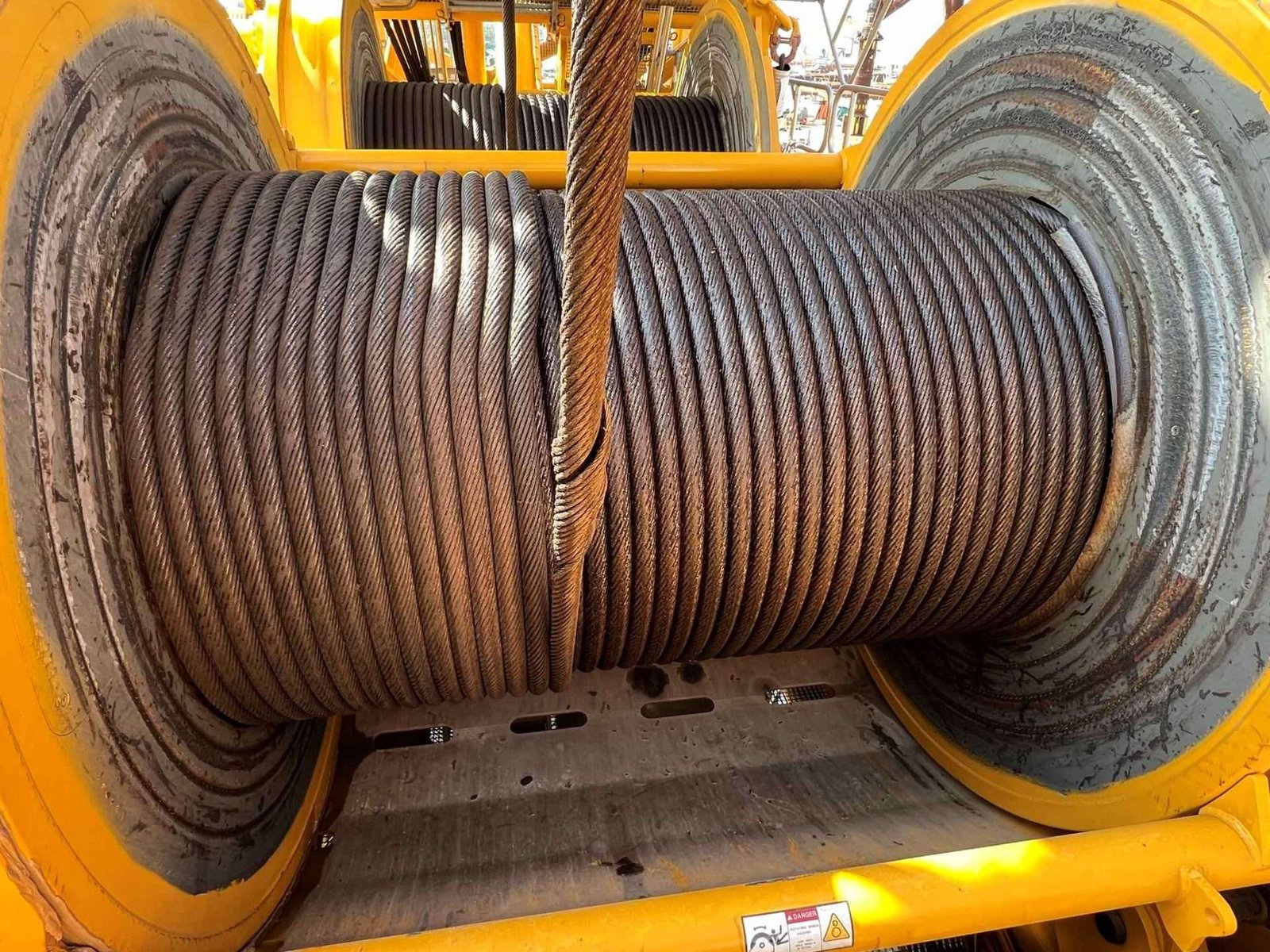
- Compaction. The die-drawn outer strands present a flatter, denser surface: +10–15% metallic area, less abrasion, and dramatically better resistance to being crushed under upper layers on a multi-layer drum.
- Superior torque balance at height. With three counter-rotating layers, 35×K7 keeps loads steady on tall lifts — offshore pedestal cranes and high-rise tower cranes rely on this.
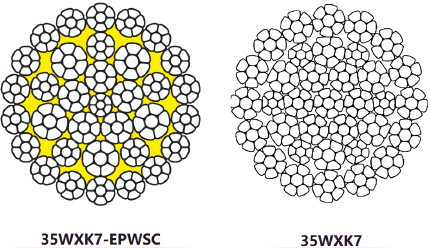
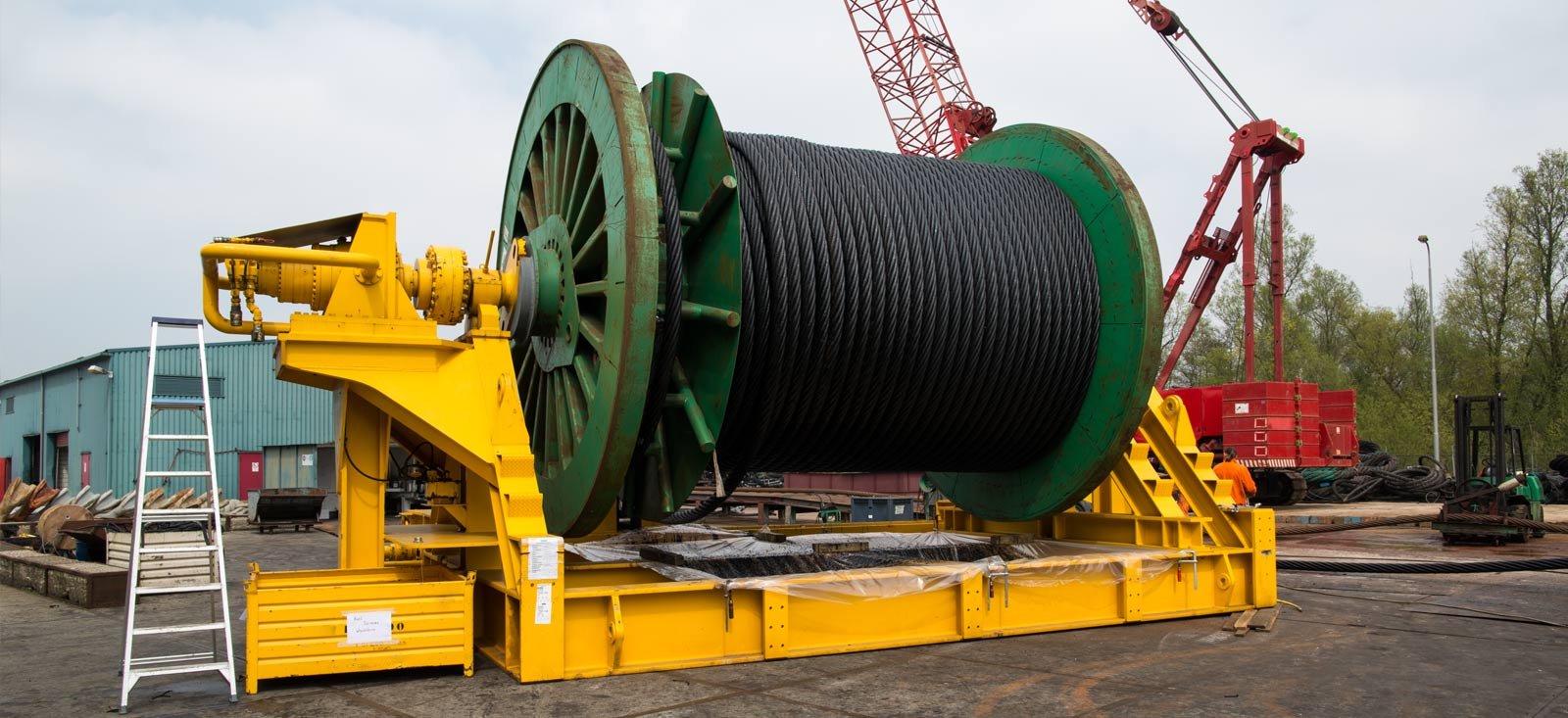
In practice this means: on a truck crane or crawler crane main hoist with a multi-layer drum, a 35×K7 rope commonly delivers 1.5–2× the service life of a 19×7 in the same duty. On a rotary drilling rig — where shock loads and spooling abuse are routine — 35WXK7 has become the industry default for exactly these reasons.
The Numbers That Decide It: Breaking Force Comparison
Typical minimum breaking forces (1960 MPa, IWRC) — always confirm against the manufacturer’s certificate for your exact diameter:
| Diameter | 19×7 MBF (kN, approx.) | 35×K7 MBF (kN, approx.) | Advantage |
|---|---|---|---|
| 13 mm | ~105 | ~125 | +19% |
| 16 mm | ~160 | ~190 | +19% |
| 20 mm | ~250 | ~295 | +18% |
| 26 mm | ~415 | ~490 | +18% |
What that means commercially: with 35×K7 you can either lift more on the same diameter, or downsize the diameter at equal strength — saving drum space, sheave weight and winch torque. On new crane designs this is exactly why engineers specify compacted rotation-resistant rope from the start.
Handling Rules That Apply to Both
Whichever you choose, rotation-resistant ropes share two non-negotiables:
- Never shock-load them. Torque-balanced structures can gap internally between layers when jerked; the damage is invisible until the rope birdcages.
- Respect fleet angle. Above roughly 1.5°, outer strands ride up and the inner layers distort. Check your drum and sheave alignment before ordering — and if your crane’s geometry is tight, tell your supplier, because that alone can rule out one construction.
Installation discipline matters as much as selection: rope off the reel under controlled tension, cut with proper seizure, and bed in the first layers slowly.
My Recommendation as a Buyer’s Checklist
Before you decide, answer these five questions:
- Hook travel height — over ~80 m? Lean 35×K7.
- Multi-layer drum? Lean 35×K7, strongly.
- Duty cycle — high-frequency lifting near rated load? Lean 35×K7.
- Sheave sizes fixed and small? Lean 19×7 for flexibility.
- Budget per rope change vs downtime cost? If one unplanned stoppage costs more than the rope price difference, the decision makes itself.
FAQ
Q1: Is 35×K7 a direct replacement for 19×7?
Mechanically yes — same rotation-resistant family, and it will fit wherever the drum and sheaves accept the diameter. But verify sheave groove dimensions and D/d ratio first: 35×K7 is stiffer, and a marginal D/d ratio that suited 19×7 may shorten its life.
Q2: Why is 35×K7 more expensive — and is it worth it?
You pay for compacted strands and a more complex three-layer closing process. In heavy, high-cycle or multi-layer drum duty the longer service life typically repays the difference several times over. In light duty it usually does not.
Q3: Which rope should I use on a tower crane?
For typical building heights (up to ~60–80 m of hook travel), 18×7/19×7 class rope is the economical standard. For high-rise and heavy climbing cranes, 35×K7 gives better torque balance and drum-crushing resistance. Match the crane manufacturer’s specification where one exists.
Q4: What does the K in 35×K7 mean?
Compacted. After stranding, the rope is drawn through a die that flattens the outer wires, increasing metallic cross-section and breaking force, and creating a smoother surface that wears sheaves and drums more gently. 35WXK7 adds a shaped outer-wire profile for even better wear performance.
Q5: Can I mix the two ropes on one crane?
Only if the crane has separate hoist systems designed for each. Never mix constructions within one reeving system — different torques and stiffness will make them fight each other and wear abnormally.
Q6: How do I verify rotation resistance before buying?
Ask the manufacturer for the rotation value (rotation per meter under load) measured per EN 12385-4 and for bending fatigue test data. Aulone tests crane ropes on in-house bending fatigue machines and can supply these figures with your quotation — if a supplier cannot produce them, that tells you something too.
Get Both Options Quoted on Real Data
Aulone is a professional manufacturer and supplier of steel wire ropes, wire rope slings, synthetic ropes and rigging hardware for lifting, marine, mining, construction and industrial applications. We manufacture 19×7, 18×K7, 35×K7 and 35WXK7 rotation-resistant ropes — plus compacted and plastic-impregnated (EPIWRC) versions — under EN 12385-4 and ISO 9001, with BV, ABS, DNV and RMRS third-party testing available and 200,000 tons of annual capacity behind our stock.
Send me your crane model, drum and sheave dimensions, lift height and duty cycle, and I will quote both 19×7 and 35×K7 side by side — with breaking force and fatigue data — so you can decide on numbers, not on sales talk.
Request a quotation or technical support:
Email: info@wireropes.net
Website: www.wireropes.net