By Andri — Technical Writer & Crane Rope Specialist, Aulone (www.wireropes.net)
The short answer: rigging hardware is the rated connecting gear between your sling and the load — shackles, turnbuckles, thimbles, wire rope clips, hooks, master links and eye bolts — and in my experience it fails in service far more often than the rope itself. Get three things right and most of that risk disappears: pick each component by its marked working load limit (WLL) rather than by its size, respect the derating that comes with side loading and sling angles, and remove hardware on objective discard criteria instead of “it still looks fine to me”. This guide walks through each component the way I check them when I review a customer’s rigging list: what it is for, which standard governs it, how the rating really behaves, and when it goes in the scrap bin.
What Counts as Rigging Hardware — and Why It Fails First
Rope gets all the attention, but a lift is only as strong as its weakest connection. A typical wire rope sling assembly is a chain of components: rope eye, thimble, ferrule or splice, shackle or master link, and at the other end the hook or lifting point. The rope is engineered, tested and inspected to a 5:1 design factor — and then somebody connects it with a paint-dried, unmarked shackle bought from the back of a van. That shackle is the link that decides the outcome.
There is also a geometry problem people underestimate. Ratings are established for in-line tension. The moment you load hardware at an angle, the effective capacity drops: a two-leg bridle at 60° from horizontal puts 1.15 times the vertical load in each leg, at 45° it is 1.41 times, and at 30° each leg sees 2.0 times the static share. Side-load a bow shackle and you can lose half its rating before the sling even leaves the ground. I will put hard numbers on both effects below.
My rule on every assembly drawing: the lowest-rated, worst-loaded component defines the WLL of the whole assembly — not the rope, and not the certificate on the wall.
WLL, MBL and Proof Load: Reading the Numbers on the Tag
Three numbers appear on rated hardware, and mixing them up is the most common quoting error I see:
WLL is the maximum load the component may carry in normal use. Every calculation starts here. Minimum breaking load (MBL) is the laboratory number at which the part actually failed — never an operating figure. Proof load is the test load applied at the factory, typically 2 × WLL, to verify the part without damaging it. The relationship between MBL and WLL is the design factor, and it is set by the governing standard rather than by the seller’s marketing. We explain the full arithmetic in our wire rope sling safety factor guide.
| Component | Governing standard | Typical design factor (MBL : WLL) |
|---|---|---|
| Wire rope sling | ASME B30.9 / EN 13414-1 | 5:1 |
| Alloy steel chain sling | ASME B30.9 / EN 818-4 | 4:1 |
| Forged shackle | ASME B30.26 / EN 13889 | 5:1 minimum; 6:1 on most forged patterns |
| Forged turnbuckle | ASME B30.26 / DIN 1480 | 5:1 |
| Forged lifting hook | ASME B30.10 / DIN 15401 | ≈5:1 breaking, ≈3:1 yield |
| Webbing and round slings | ASME B30.9 / EN 1492 | 5:1 to 7:1 |
Table 1. Typical design factors by component — always confirm against the manufacturer’s certificate.
One more habit worth building: if the marking is illegible, the rating is unknown, and unknown means zero. A shackle with no readable WLL is scrap, whatever its colour or weight.
Shackles: Bow or Dee, Screw Pin or Bolt Type
The shackle is the workhorse of rigging hardware, and the first decision is shape. A bow (anchor) shackle has a larger, rounder body: it accepts multi-leg slings, allows the sling to move, and tolerates some in-plane side load at a reduced rating. A dee (chain) shackle is narrower and more efficient for a straight, in-line pull, but it will jam or bend if you force legs into it at angles. If the sling can move during the lift, use the bow.
The second decision is the pin. Screw-pin shackles are for temporary, low-vibration work where someone can check the pin before each lift. Bolt-type (safety) shackles — pin, nut and cotter — are mandatory anywhere the pin could back out: vibrating equipment, rotating loads, permanent installations, offshore. I have seen screw pins walk out of the bow on vibrating screen rigs in a single shift; it is not a theoretical failure mode.
Side Loading: Where Shackle Ratings Quietly Disappear
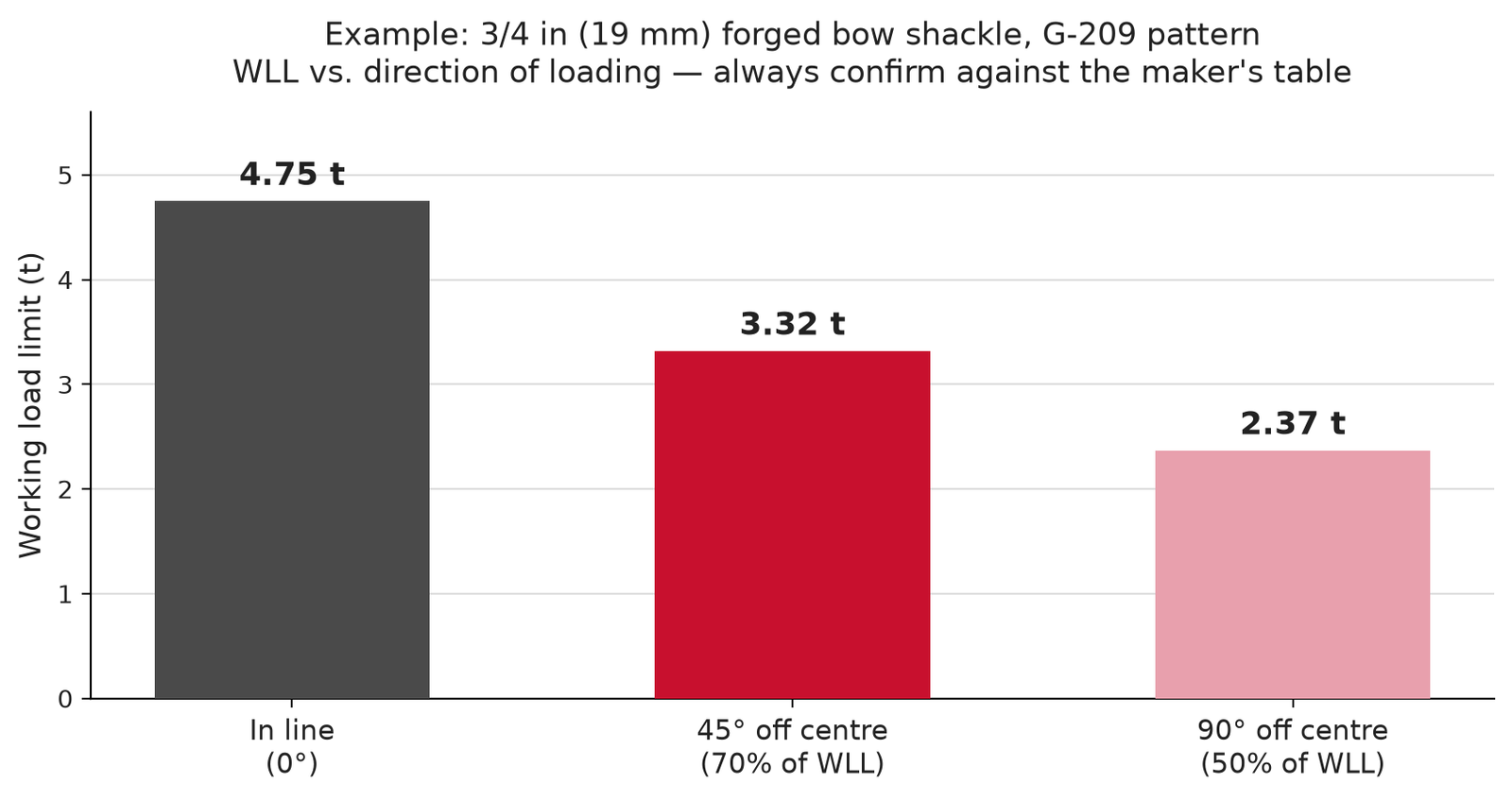
A bow shackle may take an off-axis load, but the maker’s derating applies — typically 70% of WLL at 45° off centre and 50% at 90°, and never any side load at all on a dee shackle. Table 2 shows the pattern most forged grade 6 carbon bow shackles follow (the Crosby G-209 family); your brand’s tag always governs.
| Nominal size | WLL in line (t) | 45° off centre (t) | 90° off centre (t) |
|---|---|---|---|
| 3/8 in (10 mm) | 1.0 | 0.7 | 0.5 |
| 1/2 in (13 mm) | 2.0 | 1.4 | 1.0 |
| 5/8 in (16 mm) | 3.25 | 2.3 | 1.6 |
| 3/4 in (19 mm) | 4.75 | 3.3 | 2.4 |
| 7/8 in (22 mm) | 6.5 | 4.6 | 3.3 |
| 1 in (25 mm) | 8.5 | 6.0 | 4.3 |
| 1-1/4 in (32 mm) | 12 | 8.4 | 6.0 |
| 1-1/2 in (38 mm) | 17 | 11.9 | 8.5 |
| 2 in (50 mm) | 35 | 24.5 | 17.5 |
Table 2. Typical forged grade 6 bow shackle ratings by loading direction — verify against the maker’s certificate.
Same Size, Different Steel
The most expensive shackle mistake is assuming one 3/4 in shackle equals another. At the same nominal size, a commercial-grade carbon shackle, a forged grade 6 pattern and a grade 8 alloy shackle differ by a factor of three or more: roughly 3.3 t, 4.75 t and 7 t respectively at 3/4 in. Stainless shackles are lower still — about 2 t at 3/4 in — because the austenitic grades trade strength for corrosion resistance. Read the grade marking, not the pin diameter.
Turnbuckles: Tension Adjustment Without Surprises
Turnbuckles adjust tension in guys, stays, lashing systems and bridle legs. Choose the end fittings for the job: jaw and jaw where you need a pin through a clevis, eye and eye where the connection is a soft eye or thimble, and hook ends only for static, non-lifting duty — a hook end is never a lifting point. Forged bodies to DIN 1480 or the ASME B30.26 equivalent carry a 5:1 design factor.
Two details decide whether the rating is real. First, thread engagement: keep at least 1.5 times the nominal thread diameter engaged, and never let the fitting run past the end of the thread. Second, locking: lock nuts or lock wire on anything that sees vibration, because an unlocked turnbuckle unscrews itself one load cycle at a time. And remember the arithmetic — a 1/2 in turnbuckle is good for roughly 1 t in line, half of what a 1/2 in shackle carries. Matching hardware by size instead of by WLL is how turnbuckles end up overloaded.
Thimbles and Wire Rope Clips: Protecting the Eye
A thimble is cheap insurance. It keeps the sling eye’s radius, stops the rope crushing flat against the shackle pin, and can multiply eye life several times over in cyclic service. Use light-pattern thimbles for static lines and heavy-pattern (deep-groove) thimbles on slings and mooring lines where the eye works over a pin — to EN 13411-1 or the equivalent, matched to the rope diameter and the bearing surface it rides on.
Wire rope clips (U-bolt grips, EN 13411-5) build field eyes, and they earn their ~80% efficiency only when installed correctly: the correct number of clips, spaced about six rope diameters apart, torqued with a calibrated wrench, with the saddle on the live end — never saddle a dead horse. Then re-torque after the first significant loading, because the strands bed in and the rope diameter shrinks slightly. An under-torqued clip connection is a smooth, slow let-go, not a bang — which makes it more dangerous, not less. The full termination-by-termination comparison, including spelter and wedge sockets, is in our wire rope terminations and fittings guide.
Hooks, Master Links and Eye Bolts
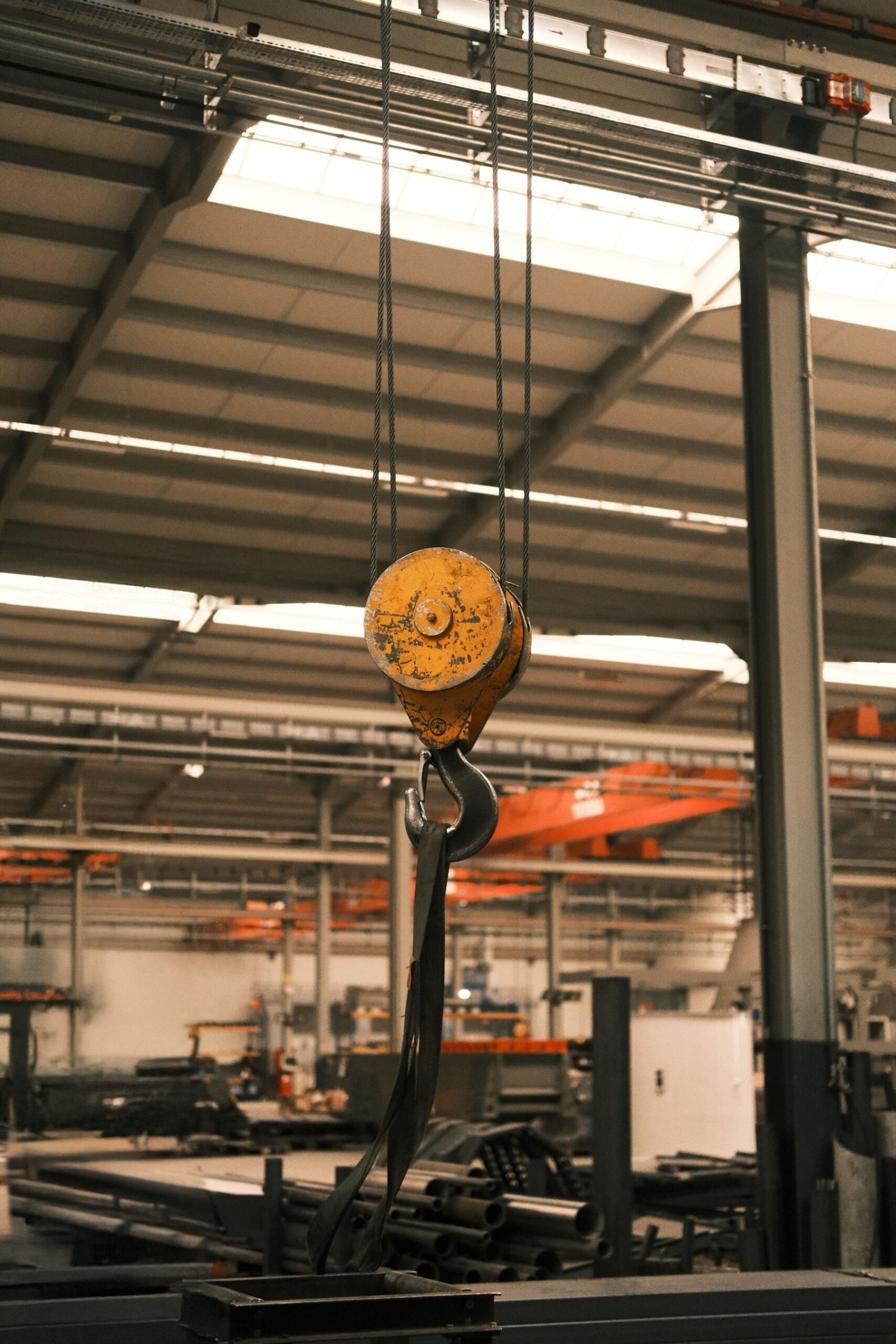
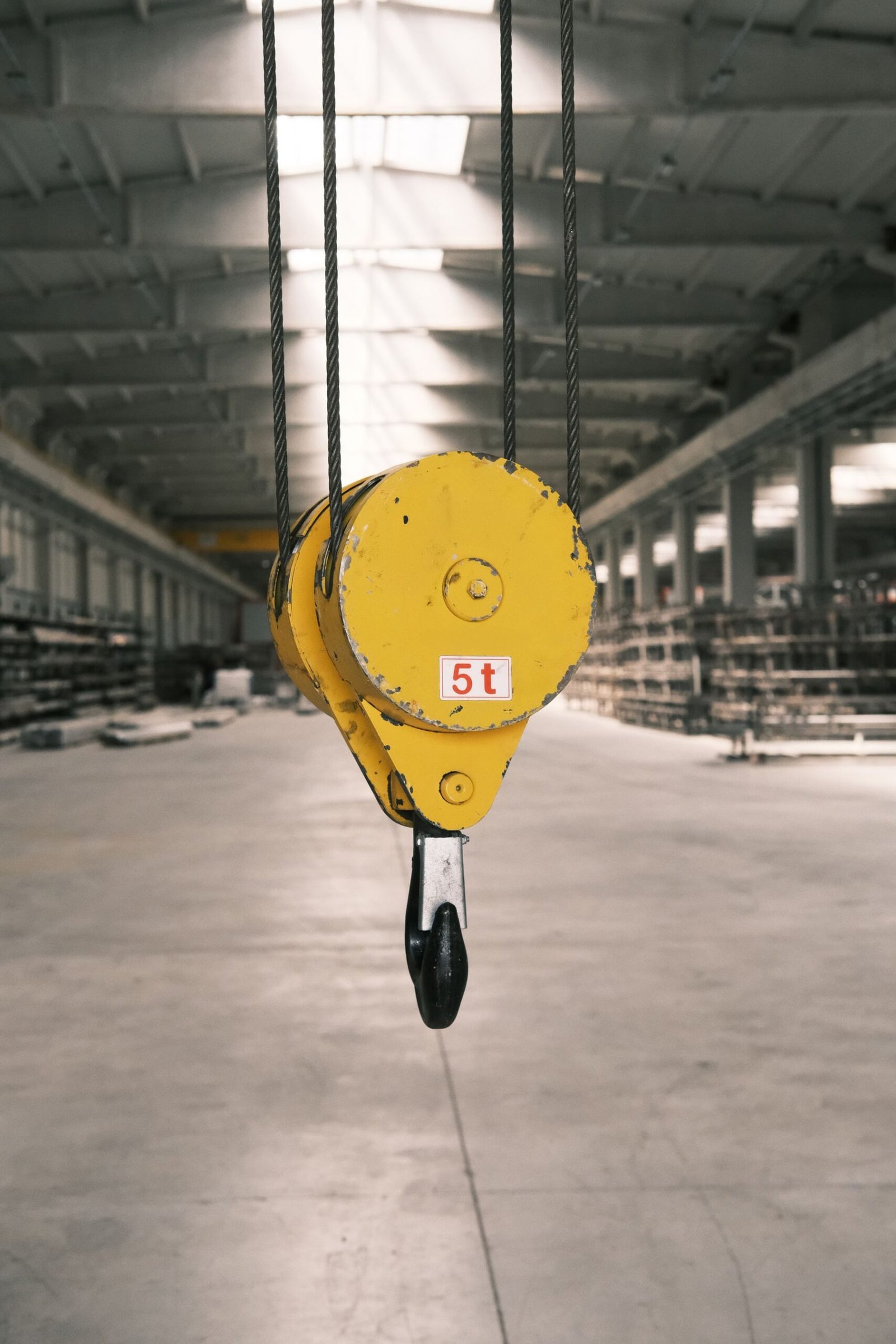
Hooks close the load path, and they are the component most often abused. Under ASME B30.10, a forged lifting hook carries roughly a 5:1 breaking design factor, must be loaded in the saddle of the bowl (never on the tip or the latch), and needs a working latch wherever a slack sling could jump out. Multi-leg slings belong in a master link or collecting ring — never more than two legs in a hook bowl, and never legs fighting each other at angles the hook was not designed for. Self-locking hooks are worth the money on any lift where people work under or beside the load.
Eye bolts are the other quiet trap. A plain (non-shouldered) eye bolt is for vertical in-line pulls only; a shouldered eye bolt may take limited angular pulls only when the shoulder seats flush against a flat, machined surface. Angular loading derates them severely — DIN 580 publishes separate F1/F2/F3 values for 0°, 45° and 90° — and if the geometry can move during the lift, use a shackle through the eye bolt instead of rigging directly.

Inspection: When to Take Hardware Out of Service
Rigging hardware fails by wear and deformation long before it fails by overload, and both are visible if you look. I recommend the standard three-tier regime: a visual check before each use, a documented periodic inspection by a qualified person (monthly in normal service, more often in severe service), and a thorough examination at least annually. The same discipline applies to the rope side of the assembly — our ISO 4309 discard criteria guide covers that in detail. Table 3 is the discard card I keep on my own desk.
| Component | Remove from service when… |
|---|---|
| Any rated hardware | Manufacturer’s ID, size or WLL marking is missing or illegible — no marking, no lift |
| Shackle | Wear exceeds 10% of original dimension at bow or pin; any visible bend, twist or crack; pin will not seat by hand; heat damage or welding arc strikes; nicks or gouges deeper than 10% of the section |
| Turnbuckle | Threads galled, stripped or badly corroded; body bent; full thread engagement no longer possible; end fittings distorted or elongated |
| Thimble | Cracked at the crown; groove worn deep enough to trap or cut the rope; flattened so the eye no longer holds its shape |
| Hook (ASME B30.10) | Throat opening increased more than 5% (max 6 mm); wear over 10% of the section; twist beyond 10°; any crack; latch missing, damaged or failing to close |
| Wire rope clip | Distorted U-bolt or crushed saddle; damaged threads; joint will not hold re-torque |
Table 3. Practical removal criteria — never weld, heat, bend or drill rated hardware back into shape.
Buying Rigging Hardware: What I Check Before Signing the PO
Most hardware failures I have been asked to investigate trace back to non-rated, untraceable product. Before I sign off a supplier, I want to see five things: permanent forged markings (manufacturer ID, size, WLL and, where applicable, grade); material traceability to EN 10204 3.1; proof-load testing at 2 × WLL with certificates; magnetic-particle inspection on critical batches; and hot-dip galvanizing to ASTM A153 where the hardware will live outdoors or at sea. For marine and offshore work, third-party witnesses from BV, ABS, DNV or RMRS on the proof tests are cheap insurance.
Aulone is a professional manufacturer and supplier of steel wire ropes, wire rope slings, synthetic ropes and rigging hardware for lifting, marine, mining, construction and industrial applications. With more than 20 years in the business, 200,000 tons of annual rope capacity and stock available for standard sizes, we supply to EN 12385-4 and ISO 9001 with BV, ABS, DNV, RMRS and CE certification, build custom sling assemblies with proof-load and third-party testing, and ship worldwide. If you want a second pair of eyes on a rigging list, send it to info@wireropes.net and I will review the load path, not just the prices.
FAQ: Rigging Hardware
What is rigging hardware?
Rigging hardware is the rated connecting equipment used between slings, ropes and loads: shackles, turnbuckles, thimbles, wire rope clips, hooks, master links, swivels and eye bolts. Unlike commodity fasteners, lifting-grade hardware is forged, proof-tested, marked with a working load limit and governed by standards such as ASME B30.26, B30.10, EN 13889 and DIN 1480.
What is the design factor of a shackle — 5:1 or 6:1?
ASME B30.26 requires a minimum 5:1 ratio of minimum breaking load to WLL, and most forged patterns are built to 6:1. Proof load is typically 2 × WLL. Either way, the WLL on the tag is the only number you may plan around — the breaking load is laboratory data, not operating margin.
Can you side-load a bow shackle?
Only at a reduced rating, and only within the plane of the bow. The common forged-pattern derating is 70% of WLL at 45° off centre and 50% at 90°. A dee shackle has no side-load rating at all. If the load direction can change during the lift, treat the shackle as in-line and swivel the connection instead.
Should I use a screw-pin or bolt-type shackle?
Screw-pin shackles suit temporary, low-vibration lifts where the pin can be checked before each use. Bolt-type shackles with nut and cotter are the right choice wherever the pin could back out: vibration, rotation, permanent or offshore installations, and anything left unattended between lifts.
How much thread engagement does a turnbuckle need?
At least 1.5 times the nominal thread diameter, with the end fitting never run past the end of the thread, plus lock nuts or lock wire in vibrating service. A turnbuckle is a tensioning device, not a lifting hook — never point-load it sideways or lift off a partially engaged thread.
How often should rigging hardware be inspected?
Visually before every use, with a documented periodic inspection by a qualified person at least monthly in normal service and more often in severe or continuous service, plus at least one thorough examination per year. Keep written records — date, inspector, findings and disposition — because after an incident the paper trail is part of the defence.
The Bottom Line
Rigging hardware is not the cheap end of the lift — it is the part where a two-dollar thimble or an unmarked shackle undoes a perfectly good rope. Rate every connection by its tag, derate honestly for angles and side loads, inspect on a schedule, and buy from people who can produce the certificates. Your rope will thank you by outliving the hardware that used to kill it.