Wire Rope Sling Safety Factor: How the 5:1 Design Factor Works and How to Calculate Sling WLL
By Andri — Technical Writer & Crane Rope Specialist, Aulone (www.wireropes.net)
The quick answer: the safety factor — more properly called the design factor — of a general-purpose wire rope sling is 5:1. That means the sling’s minimum breaking load (MBL) must be at least five times its working load limit (WLL), so a sling with an MBL of 25 tonnes is rated to lift 5 tonnes. This 5:1 factor is codified in OSHA 1910.184 and ASME B30.9 in North America and reflected in EN 13414-1 in Europe. But the number stamped on the tag is only the starting point: the actual safe capacity of a sling in the field is further reduced by the hitch type, the sling angle, and the bend ratio around the load. In this guide I’ll show you exactly how those reductions work, with the tables I keep pinned above my desk, so you can calculate real sling capacity instead of guessing.

Design Factor 101: MBL, WLL and the 5:1 Ratio
Three terms confuse everyone at first, so let me fix the vocabulary once and for all:
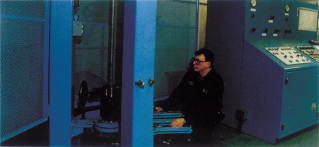
Minimum Breaking Load (MBL), sometimes written MBS or minimum breaking force, is the force at which a brand-new rope is expected to fail in a straight-line laboratory pull. It is verified by destructive testing of samples from the production batch. It is a manufacturer’s number, never a field number. Working Load Limit (WLL) is the maximum load a sling may carry in straight, vertical tension under normal service conditions. It is the number on the tag, the number the rigger works with, and it is derived by dividing: WLL = MBL ÷ 5 for standard wire rope slings. The design factor (5:1) is the ratio between the two — the deliberate gap between failure and permission.
A worked example from my own quality file: a 1-inch (25 mm) 6×36 IWRC EIPS rope has a nominal MBL of roughly 53 US tons (about 480 kN). Divided by 5, its certified vertical WLL is about 10.6 tons. If a rigger tells you “that rope broke at 40 tons so the sling was good for 40,” he has confused the two numbers — and that confusion is exactly what the design factor exists to absorb.
| Rope diameter | Representative MBL (EIPS, IWRC), US tons | WLL at 5:1 (US tons) | WLL at 5:1 (metric tonnes) |
|---|---|---|---|
| 1/4 in. (6 mm) | 3.5 | 0.70 | 0.64 |
| 3/8 in. (10 mm) | 7.8 | 1.56 | 1.42 |
| 1/2 in. (13 mm) | 13.8 | 2.76 | 2.50 |
| 5/8 in. (16 mm) | 21.4 | 4.28 | 3.88 |
| 3/4 in. (19 mm) | 30.5 | 6.10 | 5.53 |
| 1 in. (25 mm) | 53.0 | 10.60 | 9.62 |
Representative nominal values for 6×19/6×36 class EIPS IWRC rope. Always use the MBL and WLL certified by your sling manufacturer — grade, core and splice type all move these numbers. I cover the underlying rope strength in detail in my guide to wire rope breaking strength and safety factors.
Why 5:1 and Not 3:1 or 8:1?
The factor of five is not a round number someone liked — it is the settled result of decades of engineering analysis and, honestly, of accident investigation. The margin exists to absorb the things a lift plan cannot control precisely:
Dynamic loading. Snatching, braking and crane slewing can momentarily multiply static tension well beyond the load’s weight. Wear and fatigue. A sling begins losing metal the day it enters service; broken wires, abrasion and corrosion all shrink the effective cross-section. Manufacturing tolerance. Steel chemistry and lay geometry vary slightly between batches; the factor guarantees even a lower-bound sling performs. The human element. Estimated weights, unnoticed angle changes, imperfect rigging — 5:1 buys back some of these errors.
Note what the factor does not do: it is not spare capacity. Loading a 5-ton WLL sling with 8 tons “because it breaks at 25” consumes margin that may already be spent on shock loading and wear. Standards are blunt about this: OSHA and ASME B30.9 simply prohibit exceeding the rated load, whatever the rope’s actual strength.
The Hitch Changes Everything: Vertical, Choker and Basket
The tagged WLL assumes a straight vertical pull. Change how the sling wraps the load and the effective capacity changes — sometimes dramatically:
Vertical hitch: full rated capacity. Choker hitch: roughly 75–80% of vertical capacity, because the tightening noose bends the rope back on itself and adds crushing at the choke point. Basket hitch: up to twice the vertical capacity (the load is shared by two legs) — but only when the D/d ratio is at least 25:1 and the load sits squarely in the basket. And for choker hitches, the angle of choke (the internal bend where the noose closes on itself) must be 120° or greater; cinching the choke tighter than that is outside the rated tables.
| Rope diameter | Single-leg vertical (US tons) | Choker hitch (US tons) | Basket hitch, min. D/d 25:1 (US tons) |
|---|---|---|---|
| 1/4 in. (6 mm) | 0.65 | 0.48 | 1.3 |
| 3/8 in. (10 mm) | 1.4 | 1.1 | 2.9 |
| 1/2 in. (13 mm) | 2.5 | 1.9 | 5.1 |
| 5/8 in. (16 mm) | 3.9 | 2.9 | 7.8 |
| 3/4 in. (19 mm) | 5.6 | 4.1 | 11 |
| 1 in. (25 mm) | 9.8 | 7.2 | 20 |
| 1-1/4 in. (32 mm) | 15 | 11 | 30 |
| 1-1/2 in. (38 mm) | 21 | 16 | 42 |
Typical rated loads per OSHA 1910.184 style tables for 6×19/6×36 class EIPS IWRC slings with mechanical-splice or socket terminations. Hand-tucked splices are slightly lower. Your manufacturer’s tag governs.
Sling Angle: The Silent Capacity Killer
This is the one that genuinely hurts people. When sling legs leave the vertical, tension in each leg rises — the legs are not only lifting the load, they are also pulling it inward. The steeper the angle from horizontal, the worse it gets, and a two-leg bridle at a shallow angle can load each leg with more than the entire weight of the load.
| Horizontal angle of sling leg | Load multiplier per leg | Example: 5 t load, 2-leg bridle — tension per leg |
|---|---|---|
| 90° (vertical legs) | 1.000 | 2.50 t |
| 60° | 1.155 | 2.89 t |
| 45° | 1.414 | 3.54 t |
| 30° | 2.000 | 5.00 t |
Read that last row again: at a 30° horizontal angle, each leg of a two-leg bridle carries the full load weight. This is why standards refuse to rate sling angles below 30° from horizontal — and why I teach riggers the habit of mentally converting angle to multiplier before every lift. The same multipliers apply to three- and four-leg bridles, though four-leg slings are rated on the assumption that only three legs effectively carry (the fourth is balance insurance).
D/d Ratio, Eyes and Terminations
Bending a rope around anything tighter than the rated tables assume quietly removes strength before you ever load the sling. The key number is the D/d ratio — the diameter of the pin, hook or load the rope bends around (D) divided by the rope diameter (d). Rated basket capacities assume at least 25:1; below that, derate. The same logic applies to the sling’s own eyes: the pin in an eye must be no larger than the natural eye width and never smaller than the nominal rope diameter. Terminations matter too: swaged sleeves and poured sockets develop nearly full rope strength, mechanical (flemish-eye) splices slightly less, hand-tucked eyes less again — which is why the rating tables list them separately.
Choosing the Right Rope Inside the Sling
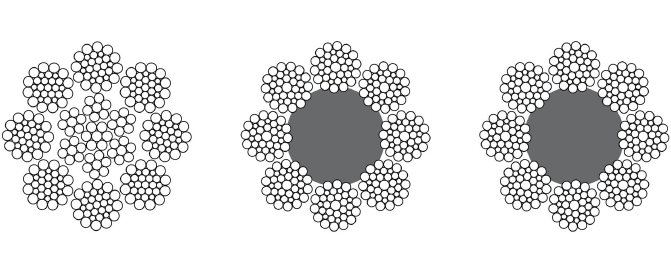
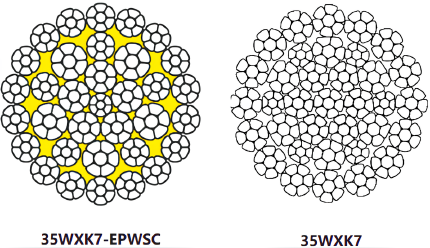
Two rope decisions move sling capacity and life more than anything else. First, the core: an IWRC gives about 7.5–10% more breaking force than a fibre core at the same diameter, plus far better crush and heat resistance — which is why serious lifting slings are IWRC unless flexibility is the only priority. Second, the construction: 6×36 class rope (more, thinner outer wires) is the sling standard for flexibility over sheaves and hooks, while 6×19 class offers better abrasion resistance for static, punishing duty. Compacted-strand ropes add 10–15% more breaking force in the same diameter — a legitimate way to raise WLL without growing the sling. I compare the options in my guides to 6×36 wire rope specifications and rope cores (FC, IWRC, WSC), and the compacted variants in my overhead crane rope guide.

What the Safety Factor Does Not Cover: Inspection
The 5:1 factor is calibrated for a sound sling. It does not protect against kinks, crushed strands, heat damage, a severed wire from snagging, or corrosion eating the core — those are what sling inspection is for. Slings must be inspected before each use and on a documented periodic schedule, and retired immediately when they fail the discard criteria: too many broken wires in one lay length, diameter reduction of 7% (steel core) or 10% (fibre core), visible corrosion, kinks, birdcaging, heat or weld-splash damage, or a missing or unreadable tag. I walk through the full criteria in my guide to wire rope inspection to ISO 4309 — the same principles apply to slings, with the tag and splice added to the checklist.
Buying Certified Slings: What I Would Ask the Supplier
A sling is only as honest as its certificate. Before you buy, ask for: the full specification (diameter, construction, core, grade, finish), the certified MBL and WLL per EN 13414-1 or OSHA/ASME B30.9 tables, a 3.1 mill test certificate per rope batch, and clarity on the termination type used for the rating. Ask whether they proof-test assemblies and permit third-party inspection before shipment. Lead time matters too — a supplier who stocks rope and ferrules can build custom lengths and eye sizes in days, not weeks. Aulone is a professional manufacturer and supplier of steel wire ropes, wire rope slings, synthetic ropes and rigging hardware for lifting, marine, mining, construction and industrial applications. With over 20 years in the industry, an annual capacity of 200,000 tons, EN 12385-4 certification, ISO 9001 quality management, class approvals including BV, ABS, DNV and RMRS, and CE marking, Aulone builds certified wire rope slings to EN 13414-1 with mechanical splice, swaged or socket terminations, in standard and custom configurations — and can arrange third-party testing on request. For a quotation or a review of your lift plan’s sling schedule, contact info@wireropes.net.
FAQ: Wire Rope Sling Safety Factor
What is the safety factor of a wire rope sling?
The standard design factor is 5:1: the sling’s minimum breaking load must be at least five times its working load limit. This applies to general-purpose slings under OSHA 1910.184 and ASME B30.9, and is mirrored in EN 13414-1. Some specialty or personnel-related applications specify stricter factors.
How do I calculate the WLL of a wire rope sling?
Divide the certified MBL by 5 for a vertical pull, then apply the reductions: multiply by about 0.75-0.8 for a choker hitch, by up to 2 for a basket hitch (only at D/d of at least 25:1), and divide by the sling angle multiplier for bridle legs (1.155 at 60 degrees, 1.414 at 45 degrees, 2.0 at 30 degrees from horizontal). The manufacturer’s tag always governs.
Why is the design factor 5:1 for wire rope slings but 4:1 for chain slings?
Wire rope degrades progressively and less predictably in service — broken wires, abrasion, internal corrosion — and is more sensitive to bending and shock. Chain is a more homogeneous, inspectable product. The larger margin compensates for the rope’s less-visible failure modes and its sensitivity to hitch geometry.
Does a basket hitch really double the capacity?
Only under the right conditions: the load must sit squarely in the basket, the D/d ratio must be at least 25:1, and both legs must share the load equally. On a small-diameter pin or an edge-loaded basket, capacity is far lower. Treat 2x vertical as a ceiling, not a promise.
Why can’t I use sling angles below 30 degrees from horizontal?
Because leg tension doubles at 30 degrees, the standard tables stop there. Below 30 degrees, tension rises steeply and small geometry errors cause large overload. If a shallower angle is unavoidable, a qualified person must calculate the rated load for the actual angle — or better, use longer slings, a spreader beam, or a different rigging method.
Where can I buy certified wire rope slings with test certificates?
Buy from a manufacturer who certifies MBL and WLL to EN 13414-1 or OSHA/ASME B30.9, supplies 3.1 mill certificates, and tags every sling. Aulone manufactures wire rope slings with mechanical-splice, swaged and socket terminations, keeps standard sizes in stock and builds custom assemblies with third-party testing available — contact info@wireropes.net.