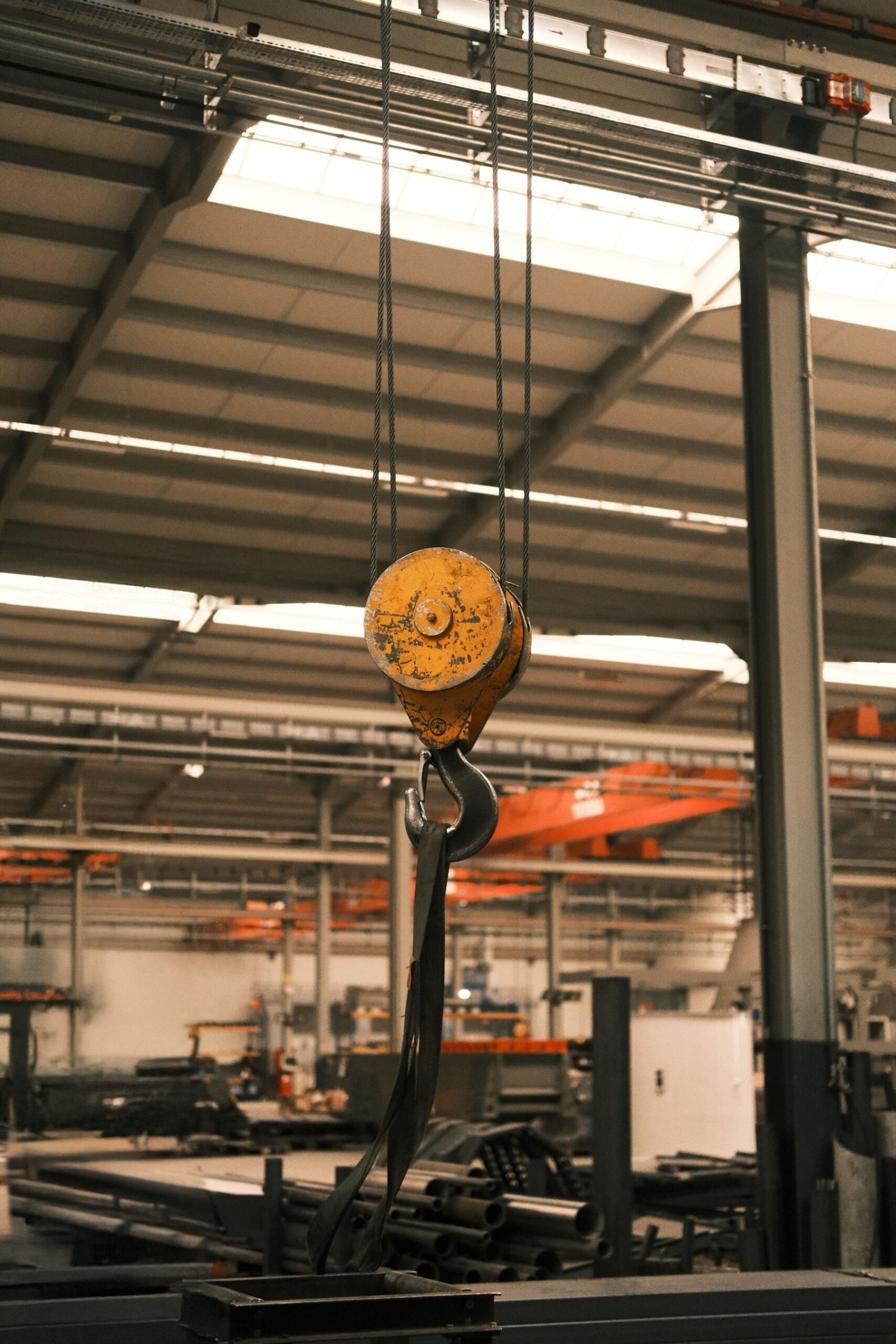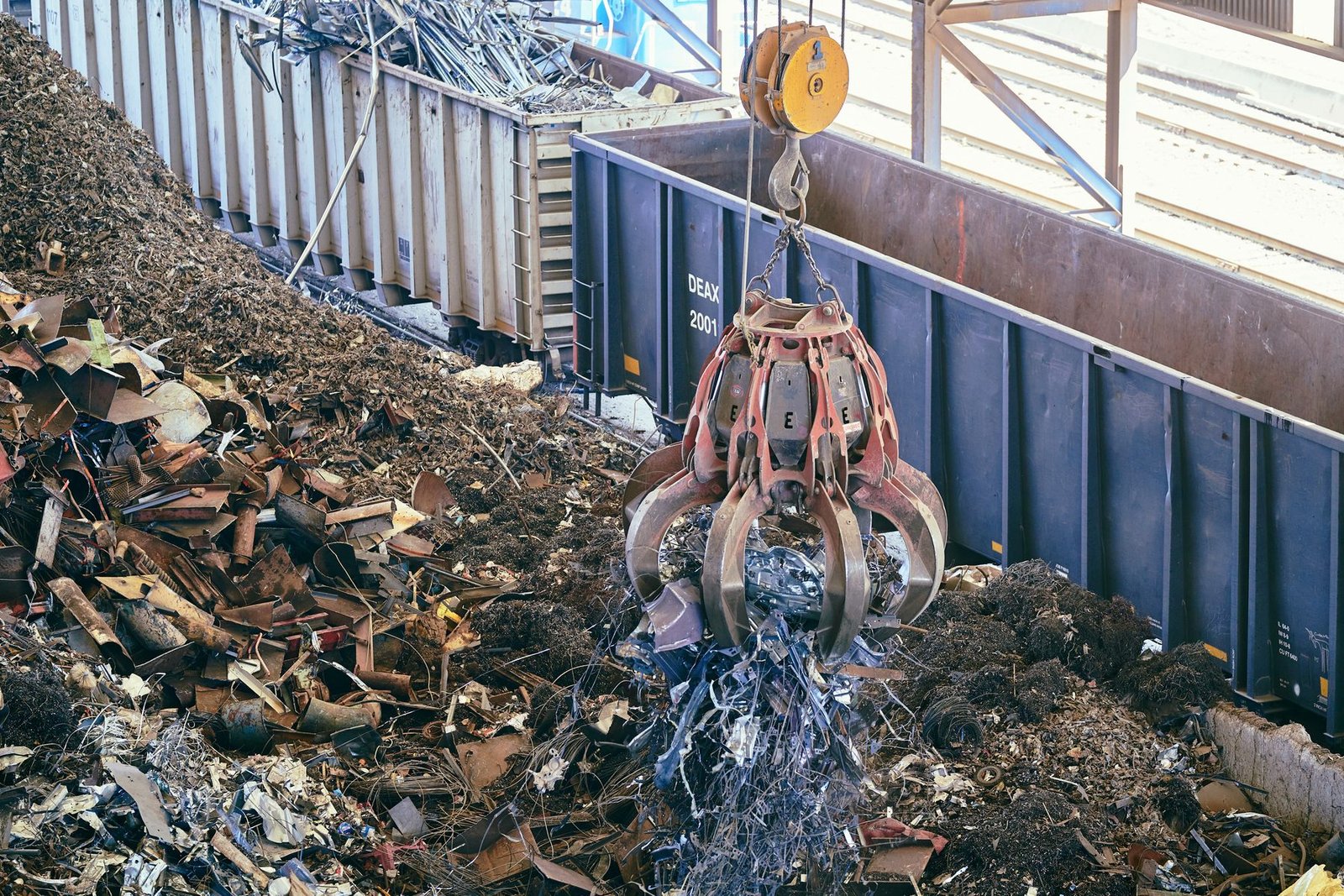
The short answer: the rope you need is not the rope you hoist. A four-part reeving system that lifts 20 m needs roughly 42–46 m of rope on the drum, and the difference between that and the naive figure is where most over-length orders come from. Get the length factor right and you order once, correctly, and the drum is right-sized at the same time. Get it wrong and you either run out of rope at full extension or pay for several metres of dead weight you never use.
Every crane enquiry that reaches me asks the same three questions: what construction, what diameter, and how long. The first two I can close from the machine. The third is where specifications go wrong, because “how long” is never just the lift height. It is the lift height multiplied by the number of parts of line, plus the dead ends at each end, plus what wraps the drum, plus enough reserve to keep the rope tensioned when the hook is at the bottom.
This guide sets out how the length factor actually works, what numbers I quote from, and how to check the answer before the rope is cut. It is the calculation I do before every crane rope order, and it takes about ten minutes.
What the Length Factor Actually Means
The length factor is simply the ratio of rope on the drum to rope actually hoisted. If the drum carries 45 m of rope and the hook travels 20 m, the length factor is 2.25. That factor is set by the reeving — how many parts of line connect the drum to the load — and it is not negotiable once the machine is built.
One part of line, meaning the rope runs from the drum straight to the hook block with no reeving, gives a length factor of 1.0. Two parts, where the rope passes over the boom tip sheave and back down to the hook, gives roughly 1.05 to 1.10 — only slightly more than 1.0, because the boom tip takes up only a small fraction of the vertical run. Four parts on the hook block gives about 2.10 to 2.30, and eight parts gives roughly 4.20 to 4.60.
Notice that the length factor is close to, but not exactly, the number of parts of line. The gap is the rope that is not lifting anything: the wraps on the drum, the dead ends, the length hanging below the hook block, and the tail you keep for tensioning.

The Three Components of the Total
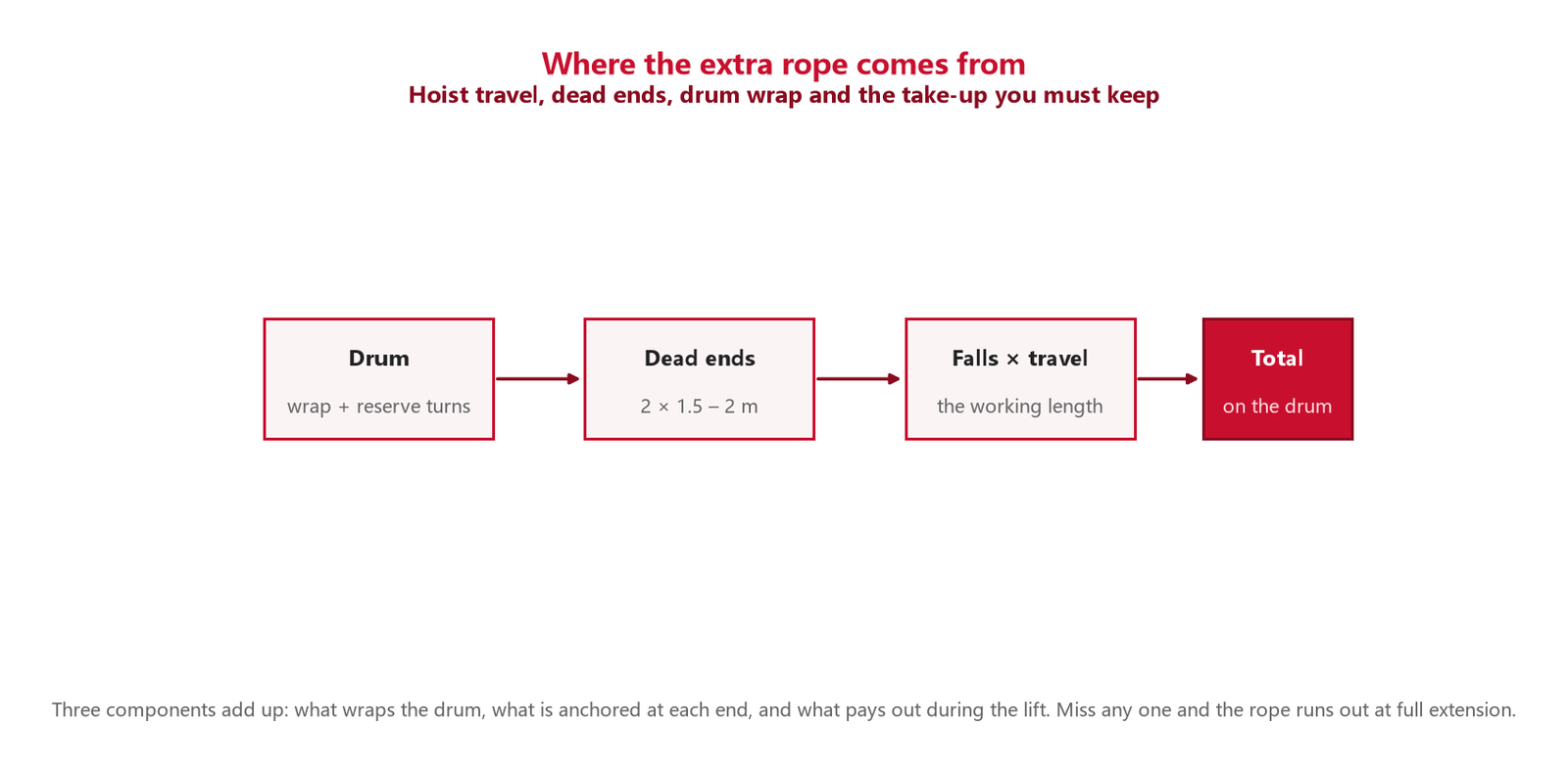
Every rope length is the sum of three things. Miss any one of them and the arithmetic fails at the worst possible moment, which is usually at full extension on the first lift.
- The working length. Parts of line multiplied by the hoist travel. Four parts over 20 m of travel means 80 m of rope paying out during the lift.
- The dead ends. Rope anchored at the drum and at the hook block. Each anchor typically needs 1.5 to 2 m beyond the last working position for the wedge, the clamp or the socket to grip — and the tail beyond the anchor is what you pull on to tension the system.
- The drum wrap and reserve. Rope still on the drum when the hook is fully extended, plus a few extra turns so the anchor wedge never sits on the last wrap where it could slip.
Worked Example: A Tower Crane at 60 m Under the Hook
This is the calculation I do most often, so it is worth walking through in full. A tower crane with a 60 m hook height, two-part reeving on the hook block, and a drum that must keep at least three reserve turns on it.
Table 1 — Tower crane two-part reeving, 60 m hook height
| Line | Calculation | Length |
|---|---|---|
| Working length | 2 parts × 60 m travel | 120.0 m |
| Drum dead end | Anchor plus tail | 2.0 m |
| Hook block dead end | Anchor plus tail | 2.0 m |
| Drum wrap and reserve | Turns still on the drum at full extension | 3.5 m |
| Total rope on the drum | 120 + 2 + 2 + 3.5 | 127.5 m |
Divide that 127.5 m by the 60 m of hook height and the length factor works out at 2.13 — comfortably inside the 1.05 to 1.10 band I quoted for two-part reeving only if you ignore the vertical run; for a tower crane whose boom tip is far above the hook, the effective factor is higher because the rope has to reach up to the tip and come back. This is why I always calculate from the machine geometry rather than quoting a table of factors blind.
On the same crane, a four-part reeving conversion for heavier loads would need roughly 4 × 60 m plus the same four metres of dead ends and reserve, so around 247.5 m — a completely different rope order, which is exactly why the reeving arrangement has to be fixed before the rope is specified.
Reeving Ratio and Length Demand at a Glance
Table 2 — Typical length factors by reeving arrangement
| Parts of line | Typical reeving | Length factor (approx.) | 20 m hoist travel needs | Worked example |
|---|---|---|---|---|
| 1 | Single fall, hook block on rope end | 1.00 | 20 m + 2 × 2 m dead ends | Tower crane, single-part hoist |
| 2 | Single fall, reeved through the boom tip | 1.05 – 1.10 | 21 m + dead ends | Tower crane, two-part reeving |
| 4 | Four-part reeving on the hook block | 2.10 – 2.30 | 42 – 46 m + dead ends | Mobile crane, 4 × 6 m falls |
| 8 | Multi-part, single-groove sheaves | 4.20 – 4.60 | 84 – 92 m + dead ends | Heavy lattice crane, multi-layer drum |
Two things in that table catch people out. First, the length factor is not the same as the number of parts of line — it is always a little higher, and the extra is what makes the difference between a rope that stays anchored and one that does not. Second, at eight parts the factor climbs above four, so a machine that lifts the same height on eight parts needs roughly twice the rope of the same machine on four parts. That is a rope cost line item that surprises procurement teams.
Mobile Cranes: Where the Geometry Changes Everything
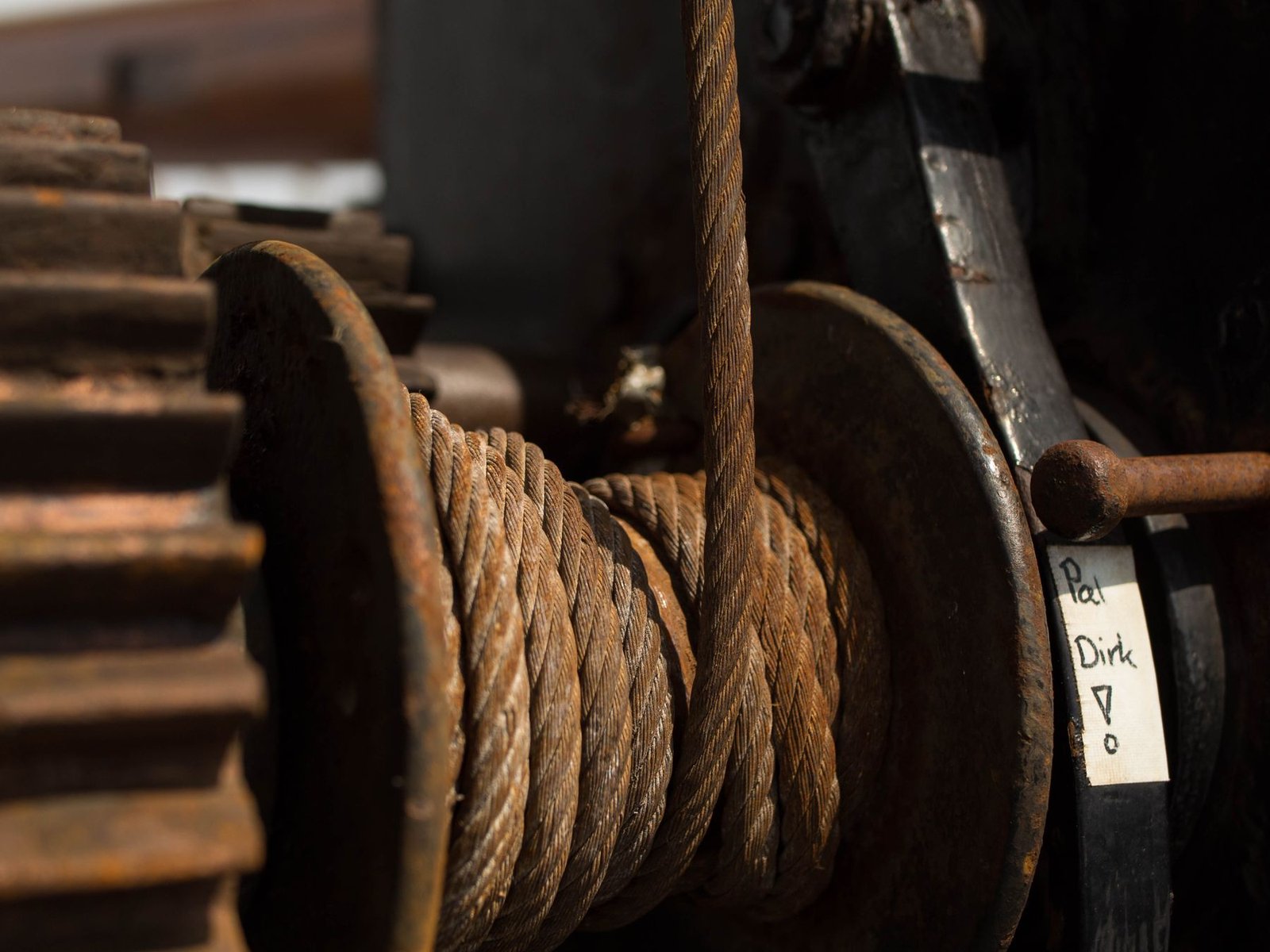
A tower crane has a fixed rope path, so its length factor is fixed for life. A mobile crane does not. The boom angle changes, the extension pieces come out, and the hook height at any given radius changes with both. This is where a length factor copied from another machine becomes expensive.
For a truck crane with a four-part reeving, the working length is four times the maximum hook height at the shortest radius with the boom fully extended — and the rope must reach that height at every radius, not just the one where the lift is planned. A common mistake is to calculate the rope for the specific lift being quoted today and then find the machine is short when the next job needs more height.
The safe method is to work from the manufacturer’s maximum hook height at the shortest radius with all boom sections fitted, then add the four metres of dead ends and reserve. If the crane is a luffing crane, the geometry changes again because the rope length varies with boom angle throughout the lift; in that case the drum capacity calculation has to be done with the rope fully extended at the lowest possible boom angle, which is usually the critical case. The drum capacity relationship itself is covered in our drum capacity guide.
How to Check the Answer Before the Rope Is Cut
Before I release a rope order for cutting, four things get verified:
- Drum capacity against the calculated length. Does the drum physically hold this much rope, at the right diameter, in the right number of turns? A drum that cannot take the calculated length will not hold the rope you need, whatever the calculation says.
- Groove geometry and layer count. The rope has to be able to spool in a single layer if the design assumes single-layer spooling, or the multi-layer drum must have enough capacity for the extra wraps that bring the length factor up. See the sheave and drum guide.
- Anchor positions. Where exactly is the rope anchored on the drum, and where on the hook block? Every metre between the last working point and the anchor is rope you cannot use, and a bad anchor position is a common reason a rope order comes back short.
- The take-up tail. Is there a way to tension the system after installation? A rope with no tail cannot be tensioned, and an untensioned rope on a multi-layer drum is a rope that will not spool properly and will wear unevenly from the first lift.
One more check that costs nothing and prevents a common failure: the rope must be long enough that the hook block cannot reach the drum. If the calculated length leaves the hook block sitting against the drum at full extension, the drum capacity is wrong, not the rope length.
Length and Sling Angle: The Other Place Numbers Multiply
Length factor is only half the arithmetic on a lift. The other half is the angle of the sling legs, which multiplies the load in the rope in exactly the same way reeving multiplies the rope length. Two legs at 45° carry about 41% more load per leg than two vertical legs; at 30° they carry double.
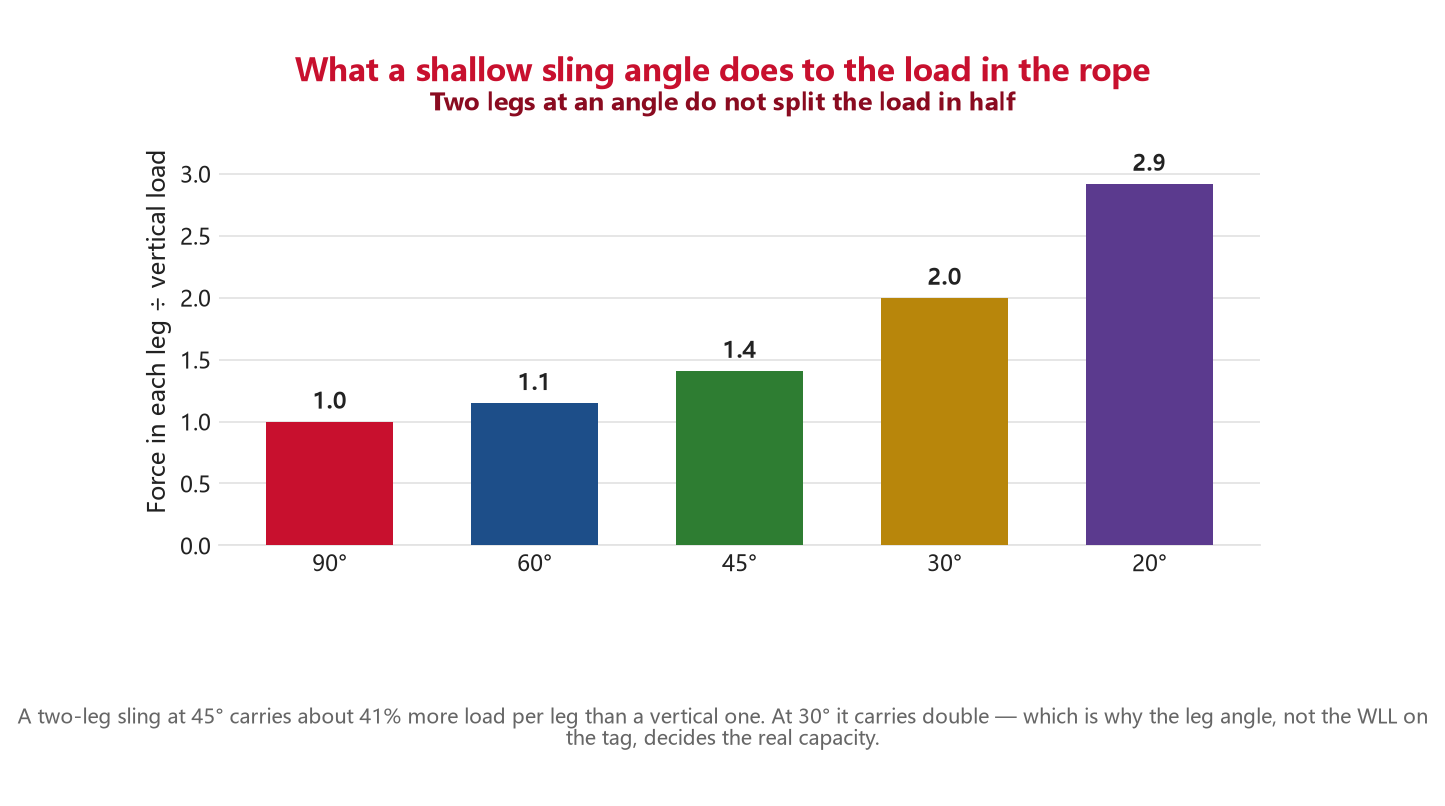
This matters when you specify both together: a four-part reeved hoist with a 30° sling angle puts roughly double the planned load into each of the four rope falls, which changes the fatigue life of the whole system. The sling angle rule of thumb and its effect on capacity are set out in detail in our sling safety factor guide.
What to Send Us for a Correct Quote
Send four things and the length comes back closed rather than estimated:
- Machine type and model — tower, truck, crawler, gantry, offshore pedestal.
- Maximum hook height and the radius at which it applies, or the boom length and the number of sections.
- Number of parts of line (the reeving), or the load you need to lift at the height you need to lift it.
- Drum diameter, groove type and barrel length, if the machine is a one-off or an older crane whose data is not on the plate.
With those, we can close the length, the construction, the diameter and the certification in one reply. And if you would rather not work out the reeving yourself, tell us the load and the height and we will specify the parts of line that make it work.
Aulone is a professional manufacturer and supplier of steel wire ropes, wire rope slings, synthetic ropes and rigging hardware for lifting, marine, mining, construction and industrial applications. With more than 20 years in the industry, 200,000 tons of annual capacity and production to EN 12385-4 under ISO 9001 — certified by BV, ABS, DNV, RMRS and CE — we cut rope to length, re-reel it, socket it and supply it ready to install. Common crane constructions are kept in stock for fast shipment, and third-party testing can be arranged before the rope leaves the works.
Send the machine details and we will confirm the length factor, the parts of line and the rope that fits it: info@wireropes.net.
Frequently Asked Questions
What is the length factor of a wire rope?
The ratio of the rope length on the drum to the rope actually hoisted. A single-part hoist has a length factor of about 1.0; four-part reeving gives roughly 2.10 to 2.30; eight-part reeving roughly 4.20 to 4.60. The figure is always slightly above the number of parts of line because it also includes the dead ends, the drum wrap and the reserve turns.
How do I calculate how much wire rope I need for a crane?
Multiply the maximum hook height by the number of parts of line, then add 1.5 to 2 m for the dead end at the drum, 1.5 to 2 m for the dead end at the hook block, and 3 to 4 m for the drum wrap and reserve. Use the maximum hook height at the shortest radius with all boom sections fitted, not the height of the lift you happen to be quoting for.
Does the length factor depend on the rope diameter?
Not directly, but indirectly yes. A larger diameter needs more groove space per metre, so for a given drum the maximum rope length falls. That is why the length and the diameter have to be checked together against drum capacity, and why a thicker rope can sometimes force a shorter length than the calculation asks for.
How much extra rope should I order beyond the calculated length?
At least three to four full reserve turns on the drum, plus the tail beyond the anchor needed to tension the system. This is not optional slack — a rope with no reserve cannot be anchored safely, and a drum with no reserve puts the anchor wedge where it can slip.
Does a longer rope affect the crane’s performance?
Yes, in ways worth noting. More rope on the drum means more mass to spool and more layers to build up, and on a multi-layer drum the lower layers carry more load than the upper ones. It also changes the drum’s turning ratio and therefore the hoist speed. This is why the drum capacity calculation comes before the rope length, not after.
What happens if the rope is too short?
At full extension the hook block reaches the drum, or the last turns pay out and the anchor wedge has nothing to grip. Both are unsafe: the rope can pull free of the anchor under load, and the block striking the drum damages the rope and the machine. It is also the most common reason a rope order has to be cut again and returned.
Can one rope length serve several machines?
Only if their length factors and drum capacities happen to match, and the rope is then cut and re-terminated for each. In practice, standard stock lengths suit single-part hoists with modest hook heights. For multi-part reeving, a specific cut length is the norm, and buying it pre-cut to the machine is cheaper than cutting on site.
Does the same calculation apply to offshore pedestal cranes and harbour cranes?
The method is identical — parts of line times travel, plus dead ends and reserve. The difference is that these machines often have very large drums, multi-layer spooling and a hoisting height that changes with tide and wave compensation, so the calculation is done against the full working envelope rather than a single height. Mobile harbour crane selection is covered in our harbour crane guide.