The short answer: in six real, publicly documented wire rope failures, every single rope told investigators the same story — the damage was there, findable, and the failure was preventable. One rope broke under grease that had never been scraped off. One broke at a socket nobody had cut-and-slipped in a year. One was still on the machine with half its strands broken because a trained operator wrote “worn” on a checklist and moved on. Reading failure case studies is the cheapest training a rope owner can get, so in this article I walk through six of them — from official investigations and published metallurgical analyses — and pull out the practical lesson each one paid for.
The Six Cases at a Glance
| # | Case | What happened | Root cause | The lesson |
|---|---|---|---|---|
| 1 | Vessel crane hoist wire, 69 t nacelle lift | Wire parted at 86% of rated capacity; load dropped into hold, US$3–5M damage | External and internal corrosion hidden under grease | Inspection means removing the lubricant — inside as well as outside |
| 2 | Offshore lift boat crane, fast line | Line failed at wedge socket entry; falling parts struck a diver | Internal corrosion at the socket; cut-and-slip maintenance missed | Terminations hide the worst corrosion — cut and slip on schedule |
| 3 | Cable percussion drilling winch, 16 mm rope | About 50% of strands broken at the thimble; rope still in service | Overtightened U-bolts + abrasion at the pinch point | Re-terminate to procedure, with a torque wrench, and inspect the thimble zone |
| 4 | Steel-mill ladle crane, 6×36 rope | Failed after 9 months; dry core, internal nicking, fatigue fractures | Lubrication never reached the core; fatigue life was ~6 months | Calculate fatigue life and set the replacement schedule to match it |
| 5 | Hot-metal ladle crane, 32 mm 1960 MPa rope | Failed after only 6 months of service | Wire-rod inclusions, surface defects, coating loss + cyclic bending | Wire quality upstream matters — buy from a mill that controls it |
| 6 | Workshop monorail hoist, twin hook | Rope replaced twice in six months on a one-year-old hoist | Side-pulling over ~3°; rope jumped the drum grooves and piled up | Operator behavior is a rope-life variable — train and inspect every shift |
Case 1: The Nacelle Lift — Corrosion Under Grease
A cargo vessel was offloading a 69-tonne wind turbine nacelle when its crane hoist wire parted. The load was 86% of the crane’s maximum rated capacity, two identical lifts had been completed without incident days before, and post-incident examination found no evidence of shock loading. The rope simply had less strength left in it than anyone knew. The load fell back into the cargo hold, damaging the nacelle and the vessel to the tune of US$3–5 million.
The investigation found significant external corrosion, roughness and pitting — and, more importantly, uniform corrosion of the internal surfaces of the rope. The killer detail: the visible corrosion only became fully apparent once the grease was removed, and the vessel’s planned maintenance system never required removing grease for inspection. Annual third-party surveys were visual-only, so internal corrosion could not be found by design. (source: NTSB, Safer Seas Digest 2023)
The lesson: a greased rope can be far worse than it looks. Any serious inspection regime must scrape or wipe the lubricant off a section, examine the crown wires, and assess internal condition — by feel, flexibility, and where available by magnetic NDT. On vessels, replace working wires at defined intervals rather than waiting for visible damage. My ISO 4309 inspection guide shows what a full examination should include.
Case 2: The Fast Line at the Wedge Socket — Where Corrosion Hides Best
On a lift boat working decommissioning at an offshore platform, the anti-two-block weight detached at the boom tip, slid down the fast line and struck the line ball at the wedge socket. The fast line failed right at the socket entry; the ball and weight fell about 12 feet to the deck, and the recoiling rope struck a diver working nearby, causing minor injuries.
The investigators’ conclusion: the rope failed because of internal corrosion at the wedge socket — corrosion that develops exactly where the rope is fixed, sealed and least examined. The company’s annually required cut-and-slip procedure at the socket had not been performed on schedule, and the pre-use and periodic inspections also missed a bent bolt and misaligned pulley in the A2B system that set the whole chain in motion. (source: BSEE investigation, reported by Safety4Sea)
The lesson: the rope inside a socket or any fixed termination is on nobody’s daily walk-around, yet it is often the most corroded part of the whole line. That is exactly why marine crane standards mandate cut-and-slip — cutting off a length and re-seating the socket on fresh rope — at fixed intervals, with the cut section examined for internal deterioration. API RP 2D is the reference for offshore pedestal cranes. My terminations and fittings guide covers socket-zone inspection points.
Case 3: The Drilling Winch Rope — A Trained Eye That Didn’t Report
During a routine audit of a cable percussion drilling operation in the UK, the auditor stopped the machine on the spot. The 16 mm galvanized main winch rope had been thoroughly examined by an independent competent person less than four months earlier, the lead driller was experienced and recently certified in rope inspection — and yet the rope had roughly half of its strands completely broken at the pinch point of the thimble, plus broken wires along its whole length. The daily inspection that morning had noted the rope as “worn” without recognizing the severity.
The causes were two-fold and mundane: frequent abrasive contact between the shackle and the tooling, and excessive tightening of U-bolts during a recent re-termination, which had crushed and deformed the rope at the thimble. No protection had been fitted between thimble and tooling. (source: British Drilling Association safety alert, 2023)
The lesson: terminations are a procedure, not a task for an adjustable wrench. U-bolt clips must be fitted the right way round, tightened with a calibrated torque wrench to spec, and re-checked after initial loading. And the human layer failed too: the system only works when an inspection finding is escalated, not just recorded. Train inspectors on what “broken strands at the termination” means — it means the rope comes off now.
Case 4: The Ladle Crane That Outlived Its Fatigue Life
A 6×36 class wire rope on a steel-mill ladle crane failed after nine months of service. The forensic analysis read like a textbook of neglect-by-tolerance: broken strands, a dry and damaged core, inter-strand nicking along the rope. SEM fractography of the fracture surfaces showed fatigue striations — classic bending fatigue, accelerated by fretting between unlubricated internal wires.
The most uncomfortable finding was arithmetic, not metallurgy. The authors estimated the rope’s bending-fatigue life from the safety factor, sheave and rope diameters, and working load at about six months — but the plant’s replacement schedule said nine. The rope was doomed from the day it was installed, by a calendar that ignored its duty. Their recommendations: move the replacement interval to match the calculated fatigue life, add NDT-based condition monitoring, and use a lubricant suited to the heat near the ladle. (source: Pal et al., International Journal of Fatigue, vol. 116)
The lesson: rope life is finite and calculable. If your ropes bend over sheaves on a fixed duty cycle, you can estimate their fatigue life from D/d ratio, load and safety factor — and your replacement schedule should never exceed it. And near furnaces, standard lubricants bake off; specify heat-resistant ones.
Case 5: The Hot-Metal Ladle Rope — When the Failure Starts in the Steel Mill
A 32 mm, 1960 MPa galvanized rope on a hot-metal ladle crane fractured after only six months. Again, fractography confirmed fatigue crack initiation and propagation ending in overload fracture. But this study went a level deeper: compared against new rope, the failed rope held a higher concentration of manganese sulfide inclusions, along with surface defects, degradation of the galvanized coating, and hardness variation between wires. Cyclic bending then did the rest. (source: Panda et al., Journal of Failure Analysis and Prevention)
The lesson: not all ropes of the same nominal construction are the same rope. Inclusion control, surface inspection before drawing and coating, and consistent heat treatment all live upstream in the wire mill — and they show up years later as rope life. This is why certificates matter beyond the breaking force number: buy from a manufacturer that controls its own wire production, and ask for the lot test certificate. My article on choosing a wire rope manufacturer lists exactly what to verify.
Case 6: The Hoist That Ate Two Ropes in Six Months
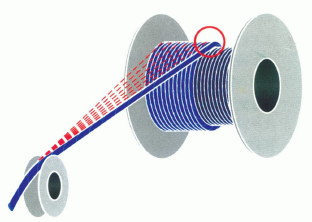
A workshop monorail hoist, barely a year old, had its twin-hook wire rope replaced twice in six months. Nothing was wrong with the hoist and nothing was wrong with the rope. The cause was behavior: operators were side-picking beyond about 3 degrees from vertical, the rope jumped out of its single-layer drum grooves, piled up at the drum end, got pinched between wraps and damaged — then was sent back to work until it failed again. Rope stock and downtime costs kept climbing while the actual defect — an untrained operator habit — stayed free of charge.
The lesson: when the same rope fails repeatedly in the same place on a young machine, stop replacing ropes and start watching the machine work. Side-pull, drum piling and slack-rope incidents are operator-domain failures, and they are fixed with training, a start-of-shift rope check (lower the hook fully and look), and the discipline to stop the moment the rope leaves its grooves.
The Pattern: What These Six Failures Have in Common
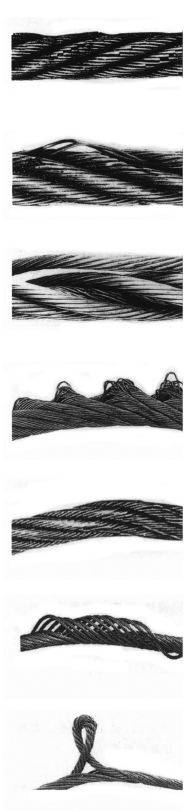
Look across the six cases and three threads repeat. First, the damage was inspectable but uninspected — under grease, inside a socket, at a thimble, or inside the core where lubrication should have reached. Second, the procedure existed but was skipped: cut-and-slip late, torque wrench absent, escalation not made, replacement calendar longer than fatigue life. Third, in two of the six, the rope itself was a contributing factor — its fatigue life and its wire quality — which is where the buying decision silently sets the failure date.
| Common thread | Seen in cases | The practice that closes the gap |
|---|---|---|
| Hidden-zone corrosion (under grease, in sockets, in the core) | 1, 2, 4 | Cut-and-slip at terminations; wipe-and-examine inspection; core-reaching lubrication on schedule |
| Procedure skipped or done without tools | 2, 3 | Torque wrenches, written re-termination procedure, escalation rule for inspection findings |
| Replacement interval longer than actual rope life | 1, 4, 5 | Estimate fatigue life from D/d, load and duty; replace to calculation, not to calendar habit |
| Rope quality as a latent factor | 4, 5 | Buy from a manufacturer with in-house wire control and lot certificates (EN 12385-4) |
| Operator behavior | 6 | Training, start-of-shift checks, zero tolerance for side-pull and slack-rope events |
Investigating a Failure on Your Own Site
If it happens to you, a failed rope is expensive evidence — keep it, both ends and the failure zone, and photograph everything in position before touching it. Then work the checklist:
| Step | Action | What it tells you |
|---|---|---|
| 1 | Record machine, load at failure, duty hours, rope age and certificate | Sets the context: was the rope within its design life and rating? |
| 2 | Measure diameter and lay length at and away from the failure zone | Necking and stretched lay point to overload; diameter loss to wear/corrosion |
| 3 | Classify the break: cup-and-cone fatigue crowns, tensile necking, or corrosion-assisted | Names the dominant mechanism |
| 4 | Open the termination zones; check sockets, clips, thimbles for internal corrosion and crush | Cases 2 and 3 both lived exactly here |
| 5 | Inspect sheaves, grooves, fleet angle and drum winding | Equipment causes repeat unless fixed — a sheave that ate one rope will eat the next |
| 6 | Send samples for metallurgical examination; test the replacement rope’s lot certificate | Separates rope-quality causes from duty causes — and holds the supplier to the certificate |
Prevention, Distilled From Six Failures
Everything the investigators recommended reduces to four standing habits: inspect hidden zones specifically (wipe the grease, cut-and-slip the sockets, feel the core through the rope’s flexibility), re-terminate only to written procedures with calibrated tools, set replacement intervals from calculated fatigue life for fixed-duty ropes, and buy rope from a manufacturer whose wire quality you can verify by certificate and by testing. Add operator training for anything with a drum, and you have covered every root cause in this article.
On that last point, a word from the supply side. Aulone is a professional manufacturer and supplier of steel wire ropes, wire rope slings, synthetic ropes and rigging hardware for lifting, marine, mining, construction and industrial applications. With over 20 years in the industry, 200,000 tons of annual capacity and EN 12385-4 manufacturing under ISO 9001 with BV, ABS, DNV, RMRS and CE certification, we control wire production in-house, keep common constructions in stock, and support customers with custom assemblies and third-party testing. If a rope on your machine keeps dying young, send me its photos, duty data and certificate — info@wireropes.net — and I will help you read the failure the way the investigators in these six cases did.
Frequently Asked Questions
What is the most common cause of wire rope failure in these case studies?
Corrosion — especially corrosion in places nobody inspects: under grease, inside sockets and terminations, and inside the core. Fatigue comes a close second, usually accelerated by wear or a dry core. Notice that overload, the cause most people fear, broke none of these six ropes on its own; four of the six failed at a fraction of their original strength because of deterioration nobody was measuring.
Can internal corrosion be detected without destroying the rope?
Yes, partially. Warning signs include loss of flexibility, a rope that crackles when bent slowly over a former, dark or rusty lubricant working out of the valleys, and visible pitting at the crown wires. Wiping off the grease to inspect is essential — Case 1 proved an inspection can pass for years with corrosion present. For certainty on critical ropes, magnetic NDT instruments can estimate internal wire breaks and corrosion loss without cutting the rope.
Should I replace a failed rope with a higher-grade or stronger one?
Only if the failure analysis says strength was the issue — in these six cases it almost never was. Upgrading from 1770 to 1960 MPa does nothing for fatigue life if the D/d ratio, lubrication or inspection regime is the problem, and a harder wire can even fatigue sooner on small sheaves. Fix the mechanism first; change the specification only when the investigation supports it.
How often should socket terminations be cut and slipped?
Follow your crane standard and manufacturer — for offshore pedestal cranes, API RP 2D requires periodic cut-and-slip of rope at terminations, commonly annually, with the removed section examined for internal corrosion and wire breaks. Saltwater and humid environments justify shorter intervals. The key discipline is that the interval is a maximum, not a target.
Who should investigate a wire rope failure?
A competent person with rope-specific training — and for serious failures or repeat failures, the rope manufacturer’s technical team plus, if needed, an independent metallurgical laboratory. Preserve both rope ends, all debris, and the maintenance and inspection records before anyone touches anything; the paperwork is often as diagnostic as the steel.
How much broken wire means immediate rope replacement?
ISO 4309 gives the discard tables: for ordinary 6-strand running ropes, a common working limit is 6 visible broken wires in one lay length or 3 in one strand, with stricter limits for rotation-resistant constructions (2 broken wires in 6 rope diameters). Broken wires at a termination, as in Case 3, are a special case — treat them as immediate-retirement territory regardless of the count elsewhere.