The short answer: store wire rope indoors, off the ground, on a reel mounted so it can rotate, keep it clean and lubricated, and handle it only by lifting through the reel shaft — never by dropping, dragging or rolling the drum. Most of the wire rope I have seen retired early was not worn out by lifting. It was damaged in the yard, on the truck, or in the ten minutes of carelessness between the reel and the drum. A kink formed during bad unreeling is permanent. Corrosion picked up on wet ground works invisibly into the core. In this guide I will walk you through how I expect rope to be stored, moved, unreeled and maintained before installation — the practices that let a rope start its working life with 100% of its strength instead of 90% nobody counted.
Why Storage Matters More Than You Think
A wire rope leaves the factory lubricated, with its breaking force verified to EN 12385-4 and recorded on a lot certificate. From that moment, everything that happens to it is your side of the story. Storage attacks rope in three quiet ways. Corrosion starts where moisture sits — on the bottom wraps of a drum resting on wet ground, or inside a coil left under a dripping roof. Lubricant loss happens in warm storage: heat softens the grease, which drains to the underside of the reel and leaves the upper wraps dry. Mechanical damage — crushed flanges, flattened wraps, kinks — comes from handling: drums dropped off trucks, rolled on rough ground, or stacked with the rope weight bearing on the bottom flange.
None of this shows on a delivery note. A rope can look perfectly serviceable and have lost 10–15% of its strength to hidden corrosion, and ISO 4309 gives no calendar-based exemption: a stored rope must meet the same discard criteria as a working one. The cheapest rope life you will ever buy is the life you protect in storage.
The Storage Environment: What “Dry and Clean” Actually Means
The classic recommendation — “store in a clean, dry place under cover” — is correct but too vague to act on. Here is how I translate it into site practice:
| Storage factor | Requirement | Why it matters |
|---|---|---|
| Location | Indoors where possible; if outdoors, covered with waterproof sheeting, elevated on blocks or pallets, with drainage | Rain, condensation and ground moisture drive corrosion into the rope interior, where it cannot be seen or re-lubricated easily |
| Ground contact | Never directly on soil, concrete or grass; reels on chocks or a shaft, coils on planks | Ground moisture wicks into the bottom wraps; a drum sitting on soil can corrode through its lower layers in one wet season |
| Temperature | Cool and stable; avoid heat sources, boilers, steam lines and direct sun | Heat liquefies the lubricant, which drains downward and leaves upper wraps unprotected; UV degrades exposed cores and coatings |
| Air quality | Away from acids, alkalis, fertilizers, sulfur, grinding dust, salt and chemical fumes | Corrosive vapors attack wire surfaces and fiber cores even without visible moisture |
| Orientation | Reels flange-up on a horizontal shaft where practical; never flange-down on the rope | A reel resting on its rope flattens the bottom wraps and can distort the strand geometry permanently |
| Organization | Labels readable, certificates filed, rope log updated; first in, first out | Traceability is part of storage: a rope without its certificate is a rope you cannot prove anything about |
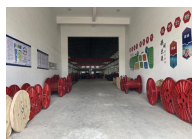
One habit worth copying from our own warehouse: rope is issued first in, first out, and every reel is turned and inspected on a fixed schedule. Storage is not a pause in rope life — it is rope life at zero load, and it gets managed like it.
Reels, Coils and Drums: Store Each the Right Way
Rope arrives in three forms, and each punishes a different mistake.
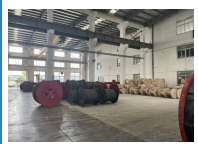
Reels and drums should rest on chocks that support the flanges, or better, be mounted on a horizontal shaft (a pipe or bar through the center hole) so the rope carries no load at all. If a reel must sit on its rim in warm storage for months, mount it on a shaft and rotate it a quarter turn every month or two so the lubricant does not all migrate to one side. Coils should stand on end on planks, never flat on the floor — a flat coil on the ground traps moisture against the bottom loops. Drums already spooled with rope (a spare machine rope, for example) should be stored the same way, with the rope end anchored and the drum covered.
Stacking drums on top of each other is the mistake I see most often in site compounds. Unless the drums are specifically designed and marked for stacking, the weight of the upper drum bears on the lower drum’s rope through the flange, crushing wraps together. Crushed rope has disturbed strand geometry, and it will never run smoothly through sheaves again.
Handling and Transport: Lift Through the Shaft, Never Drop or Drag
Between the warehouse and the machine, rope is at its most vulnerable — because this is where the forklift driver who has never read a rope catalog gets involved. The rules are short and non-negotiable:
| Do | Don’t | Why |
|---|---|---|
| Lift reels with a bar through the center hole, or sling around the drum body with spreaders | Don’t drop reels off trucks, tailgates or pallets | A dropped reel flattens wraps, cracks flanges and can start a kink inside the coil |
| Roll a reel briefly on its rim only on smooth, clean ground, in the direction the rope was spooled | Don’t drag rope off a reel or over the ground | Dragging scrapes lubricant off, grinds grit into the rope and can untwist the lay |
| Keep rope in original packaging until installation day | Don’t stack drums unless designed for it | Packaging and chocking are engineered protection; stacking crushes the rope below |
| Inspect immediately on receipt — before signing the delivery note | Don’t leave reels uncovered in rain or beside heat sources | Transit damage and moisture must be claimed while the carrier is still liable |
For transport specifically: secure reels so they cannot shift, protect them from other cargo with sharp edges, and check on arrival that the reel turns freely, the flanges are intact, the rope end is anchored, and the label and certificate match your order. If anything is wrong, photograph it and claim it now — not when the rope is on the crane.
Unreeling and Uncoiling Without Kinking
This is where more ropes are killed than anywhere else in their life. The governing principle: the reel or coil must rotate as the rope comes off — rope should never be pulled off a stationary reel or unwound from a flat coil.
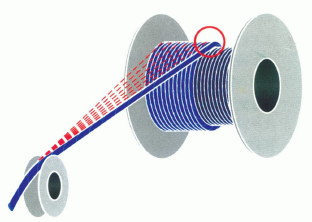
Mount the reel on a shaft through its center (a reel stand or even two trestles with a pipe) and pull the rope straight off, keeping steady tension, while the reel spins. The direction matters: rope is spooled onto the reel in a particular lay direction, and it must come off in a way that preserves that lay. On mobile machines the everyday rule of thumb is “top to top, bottom to bottom” — rope leaving the top of the reel should go onto the top of the drum, and rope leaving the bottom of the reel should go onto the bottom of the drum, so the rope never gets an extra twist between reel and drum.
For a small coil, stand it on end and roll it along the ground like a wheel while paying the rope off, or use a turning table. Never lay a coil flat and pull the end up and out — that motion puts a twist into every turn of the coil, and those twists are exactly what gather into loops and close into kinks.
If a loop does form in slack rope, stop and correct it before tension comes on: rotate the rope back in the direction of its lay to restore the twist. If a loop is pulled tight under load, it becomes a kink, and a kink is not repairable — more on that below.
Finally, seize before cutting. Binding the rope tightly with seizing wire or banding on both sides of the intended cut, at least one lay length apart, stops the strands from unlaying when the rope is cut. A rope whose cut end flies apart has already lost its geometry at the end, and that end has to be cut off again — or worse, it gets socketed or clipped in a weakened state.

Long-Term Storage: Lubrication, Rotation and Inspection
Rope stored for more than a few weeks needs a minimal maintenance routine — the same philosophy as my installation and maintenance guide, scaled down for zero load:
| Interval | Action | What you are checking or restoring |
|---|---|---|
| On receipt | Verify label vs certificate (diameter, construction, length, lot); photograph condition; file documents | Traceability and a clean baseline claim against the carrier |
| Monthly (long storage) | Rotate drums a quarter turn on their shafts; check covers, chocks and anchoring | Even lubricant distribution; no water pooling; no flange-loading from stacked items |
| Quarterly | Open a section: wipe grease off and inspect crown wires for rust or pitting; check core condition by feel and flexibility | Early corrosion before it propagates between strands; dry-lubricant detection |
| Quarterly or before use | Re-lubricate with a compatible rope lubricant if the surface is dry; clean first, then apply | Restores the corrosion barrier; compatible grease must not soften or blister the factory lubricant |
| Before installation | Full inspection to ISO 4309 discard criteria, diameter measurement, lay-length check, certificate cross-check | Confirms the rope is fit to install — a stored rope earns no exemption from the discard tables |
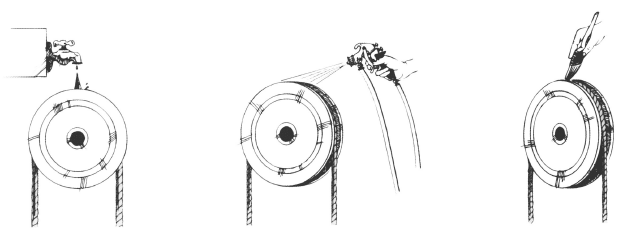
Two details matter more than people expect. First, compatibility: applying a different lubricant family over the factory grease can soften it and let it run off entirely — when in doubt, ask the manufacturer which product to use. Second, dry rope before re-lubrication: greasing over damp rope seals the moisture inside, which is worse than no grease at all.
Kinks and Birdcages: Damage You Cannot Undo
I want to be blunt about the two classic storage-and-handling injuries, because both are disqualifying.
A kink starts as a loop that got pulled tight. At that moment the strands at the kink have been permanently displaced — some wires overloaded and stretched, the lay length disturbed, the rope’s geometry permanently altered at one spot. Strength at the kink can be reduced by a large fraction, and fatigue will concentrate there from the first cycle. There is no straightening, no tapping, no “careful use”: the kinked length is cut out or the rope is scrapped.
A birdcage — the rope opening into a cage-like flare of strands — comes from imbalance between the rope’s core and its outer strands: shock release of tension, rotation applied to a rotation-resistant rope, or rope forced over an obstruction. Like a kink, it is geometry damage; the strands will not reseat themselves under load, and the rope must be retired or cut back past the damage.
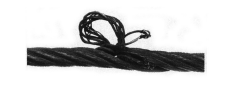
Both injuries trace back to the same short list of causes: pulling rope off a stationary reel, twisting a coil flat on the ground, applying a swivel or winch twist to a rotation-resistant construction, and letting a loaded rope jump a flange or obstruction. Every one of them is preventable with the unreeling and handling rules above.
Special Ropes, Special Rules
A few constructions need extra care in storage and handling:
- Rotation-resistant ropes (35×K7, 35WXK7, 18×K7 class): their multi-layer counter-laid design is inherently sensitive to twist. Never store them loose-coiled — keep them on reels; never attach a swivel; unreel with extra care because a twist introduced in storage will show up as birdcaging on the machine.
- Bright (ungalvanized) rope is more storage-sensitive than galvanized rope: its only corrosion protection is lubricant. If bright rope must be stored for months, inspect and re-lubricate on the quarterly schedule without exception.
- Plastic-impregnated (EPIWRC) rope is the most storage-tolerant — the polymer fills the core and locks the lubricant in — but the external wires still need their grease film, so the same dry, covered rules apply.
- Coated and small-diameter ropes should be kept out of sunlight; UV degrades plastic coatings and makes them brittle.
Receiving Inspection and Traceability
Storage discipline starts the day the truck arrives, because that is the only moment you can still claim transit damage. My receiving checklist takes ten minutes: match the label to your purchase order (diameter, construction, lay, finish, grade, length); match the certificate’s lot number to the reel; confirm the rope end is anchored and the reel turns freely; look for transit damage — flat spots, flange cracks, water staining, an open or missing rope end; and photograph anything questionable before signing. File the certificate with the rope’s ID, because at installation and at every later inspection to ISO 4309, that paper trail is what makes the rope auditable.
It is also worth saying what a well-made rope gives you on day one. Aulone is a professional manufacturer and supplier of steel wire ropes, wire rope slings, synthetic ropes and rigging hardware for lifting, marine, mining, construction and industrial applications. With over 20 years in the industry, 200,000 tons of annual capacity and EN 12385-4 manufacturing under ISO 9001 with BV, ABS, DNV, RMRS and CE certification, we deliver every reel with a lot certificate, keep common constructions in stock for fast shipment, and pack ropes for the realities of export transport — because storage discipline is a partnership between your warehouse and our factory. If you are unsure how to store a specific construction, write to me at info@wireropes.net with the rope details and I will send you the specific recommendations.
Frequently Asked Questions
Can wire rope be stored outdoors?
Only with protection: covered with waterproof sheeting, elevated off the ground on chocks or pallets, in a spot with drainage and airflow. Outdoor storage is always second-best — condensation forms under covers, and temperature swings cycle moisture into the rope. If rope must live outdoors, expect to re-lubricate and inspect far more often, and never store bright (ungalvanized) rope outdoors long-term.
How long can wire rope be stored?
Indefinitely, in principle — there is no expiry date on a certificate — but only if the storage conditions and the maintenance routine are maintained. In practice, a lubricated galvanized rope stored dry indoors on a shaft can be serviceable after years; the same rope on wet ground can be scrap in months. What matters is the quarterly inspection: if it passes the ISO 4309 discard criteria and the lubricant film is intact, it is fit to use.
Should stored wire rope be re-lubricated?
Yes, whenever the surface film looks or feels dry — typically quarterly in long-term storage, sooner in heat or humidity. Clean the surface first, let it dry, then apply a lubricant compatible with the factory grease. In warm storage, rotate drums periodically as well, because the lubricant migrates downward within the wraps.
Can wire rope drums be stacked on top of each other?
Generally no. Unless the drums are specifically designed and marked for stacking, the upper drum’s weight presses on the lower rope through the flange, crushing the wraps and distorting strand geometry — damage that never runs out through sheaves cleanly. Store drums individually with spacing, or on shafts in racks.
Should rope come off the top or the bottom of the reel onto the drum?
Follow “top to top, bottom to bottom”: if the reel pays off from the top, lead the rope to the top of the drum; if from the bottom, to the bottom of the drum. This keeps the natural lay of the rope intact between reel and drum. What is never acceptable is pulling rope off a reel that cannot rotate — that adds a twist per wrap and builds kinks.
What should I check when a wire rope delivery arrives?
Label against purchase order, certificate lot number against the reel, rope end anchored, reel turning freely, flanges uncracked, no flat spots or water staining, and packaging intact. Photograph and claim any defect immediately — transit damage is the carrier’s liability only until you sign for the delivery.