The short answer: for the main hoist line of a truck crane, the default rope is a compacted rotation-resistant 35×K7 or 35WXK7 with a steel core — sized at a 5:1 design factor to the maximum line pull; on multi-fall hook blocks, a conventional compacted 6×36WS+IWRC is usually the tougher and more economical choice; and the boom extension and retraction ropes inside a telescopic boom need a high-strength, pre-stretched galvanized rope such as 8×K26WS+IWRC, kept tighter than hoist rope when it comes to stretch and replacement. Truck cranes are the sprinters of the lifting world: short mobilizations, frequent setup and teardown, road transport between sites, and a hook that often hangs on a single part of line. Those working habits shape the rope decisions, and they are what this guide covers — circuit by circuit, with sizing rules and the replacement criteria I actually use.
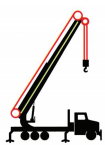
What Rope Does Each Circuit on a Truck Crane Use?
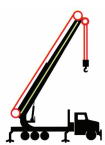
A truck crane is not running one rope — it is running a small system of them, and each circuit has its own duty profile. Before you order anything, walk the machine and list what is actually reeved on it:
| Circuit | What it does | Main duty | Typical construction |
|---|---|---|---|
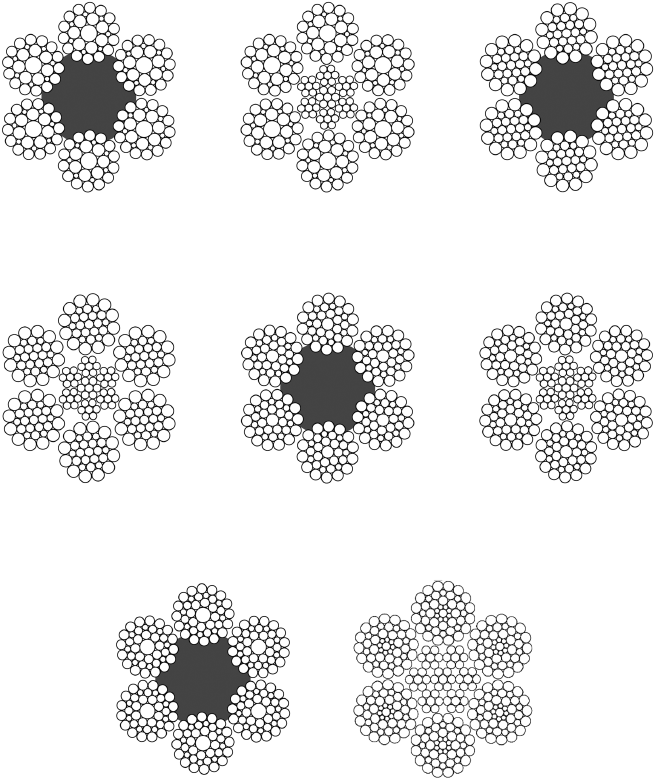
| Main hoist, single fall (load hangs on one part of line) | Lifts the load directly from the winch to the hook | Full load in one rope, free-hanging hook that can spin, multi-layer drum | 35×K7 or 35WXK7, compacted, IWRC/EPIWRC core, grade 1960–2160 |
| Main hoist, multi-fall (hook block with 2–8 parts) | Mechanical advantage reeving for heavy lifts | Load shared across falls, rotation already balanced | Compacted 6×36WS+IWRC or 8×26WS+IWRC |
| Whip / auxiliary hoist | Second winch for light, fast loads | High cycling, lighter loads, small sheaves | 35×K7 (single fall) or 6×36WS+IWRC |
| Boom extension & retraction ropes (telescopic booms) | Extend and pull back the upper boom sections in sync with the hydraulic cylinder | Internal routing, small sheaves, repeated extension cycles, near-zero tolerance for stretch | 8×K26WS+IWRC or 19×7, pre-stretched, galvanized, grade 1960+ |
| Jib / luffing lines | Swing-away jib erection and luffing | Low cycling, standing or slow-moving tension | 6×36WS+IWRC, per crane OEM spec |
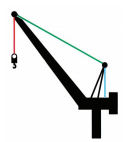
The Main Hoist Line: Rotation Resistance Comes First
Why single-fall hooks punish ordinary rope
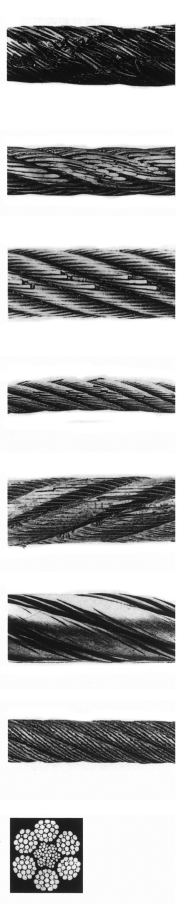
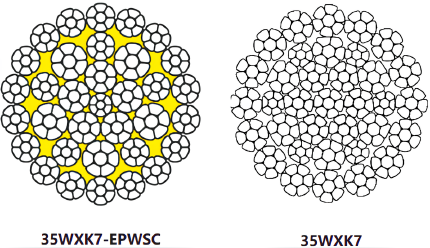
When a truck crane lifts with a single part of line, the free-hanging load acts like a spindle: every inch of rope pays off the drum under tension, the load rotates, and that rotation twists the rope until it unlays, loses lay length and finally birdcages. The fix is a rotation-resistant construction whose strand layers are laid in opposite directions so their torques cancel under load. For truck cranes that means the 35×7 class — 35×K7, or 35WXK7 with Warrington outer wires — the same construction family I specify for tower cranes on single-fall duty; the physics are in my tower crane rope guide.
The rule I give customers: count the parts of line. One part of line = rotation-resistant rope. Two or more falls = ordinary 6-strand rope is fine and usually better, because rotation-resistant ropes cost more, tolerate fleet angles poorly and carry stricter discard limits. Hanging a rotation-resistant rope on a multi-fall block wastes money and shortens rope life — the torque is already balanced across the falls.
Compaction and core: where truck crane duty bites
Truck crane hoist drums are short, so the rope spools in many layers, and every upper wrap crushes the wrap beneath. Two features earn their cost here:
- Compacted strands (the “K” in EN 12385 naming) raise the metallic cross-section by roughly 10–15%, so you get more breaking force from the same drum package, and the dense outer surface shrugs off drum-crossing abrasion far longer than round-strand rope.
- Steel core (IWRC) keeps the rope dimensionally stable under crushing — a fiber core collapses in multi-layer spooling and gives back nothing. On coastal or wet sites, I go one step further to EPIWRC (plastic-impregnated core), which locks factory lubricant in and seals water out of the rope’s heart.
Grade and finish
Grade 1960 is the sensible default; 2160 buys breaking force if the drum and sheaves can take the slightly stiffer rope. On finish: bright rope is acceptable for dry indoor and short-duration site work, but truck cranes live outdoors — rain, mud, salted yards — and I recommend hot-dip galvanized whenever the machine sits outside more than occasionally. The comparison of the three finishes is in my galvanized vs bright vs stainless guide.
Boom Extension and Retraction Ropes: The Ropes Nobody Checks
On hydraulic telescopic booms, the cylinder does not reach every section. In the common rope-pull telescoping system, a single hydraulic stage extends the first fly section, and extension and retraction ropes routed over sheaves inside the boom pull the second and third sections out in sync — and pull them back in when retracting. These internal ropes do enormous work in cramped, invisible conditions, and because nobody sees them, they are the most neglected ropes on the machine.
What matters when replacing them:
- Follow the crane OEM exactly. Extension ropes are engineered per boom design — the OEM manual names the construction (commonly 8×K26WS+IWRC or 19×7 class, galvanized, high grade) and the exact cut length. Do not freelance the spec.
- Stretch is the enemy. An extension rope that grows in service makes boom sections extend unevenly — one section lags, the boom snatches and jerks, and the load path goes crooked. Use pre-stretched, dimensionally stable rope and re-tension per the manual after the first cycles.
- A 4:1 design factor minimum applies to these internal ropes; they see repeated extension cycles and side loads when the boom is worked off-axis.
- Watch the symptoms. Sections extending unevenly, jerky extension, clunks when switching direction, or visible slack at the rope anchors all mean the extension ropes are stretched, worn or failing — check them at the same interval as the hoist line, not only when the boom stops cooperating.
Sizing the Hoist Line: the 5:1 Rule Against Real Line Pull
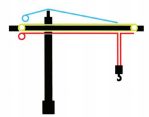
Crane hoist rope is sized by design factor — minimum breaking load divided by the maximum line pull in the rope — and for mobile crane work that factor is 5:1 (heavy or hazardous duty may demand more; ASME B30.5 sets the regulatory floor). The number to divide by is the line pull on the rope, not the crane’s tonne rating: a 25 t crane lifting its full rating on a four-part block puts about a quarter of that per rope.
Worked example: single-fall lift, load plus hook block weighs 12 t ≈ 118 kN on the rope. Required MBL ≥ 5 × 118 kN ≈ 588 kN. A 22 mm 35WXK7 at 1960 N/mm² delivers roughly 480 kN — not enough. 24 mm (≈571 kN) is still short; 26 mm (≈670 kN) clears the requirement with margin for wear. The same arithmetic, applied to slings and terminations, is in my breaking strength and safety factor guide.
| Diameter | MBL, 35WXK7 compacted, 1960 N/mm² (approx.) | Max single-fall load at 5:1 |
|---|---|---|
| 14 mm | ≈155 kN (≈15.8 t) | ≈31 kN (≈3.2 t) |
| 16 mm | ≈203 kN (≈20.7 t) | ≈41 kN (≈4.2 t) |
| 18 mm | ≈257 kN (≈26.2 t) | ≈51 kN (≈5.2 t) |
| 20 mm | ≈317 kN (≈32.3 t) | ≈63 kN (≈6.5 t) |
| 22 mm | ≈383 kN (≈39.1 t) | ≈77 kN (≈7.8 t) |
| 24 mm | ≈455 kN (≈46.4 t) | ≈91 kN (≈9.3 t) |
| 26 mm | ≈533 kN (≈54.3 t) | ≈107 kN (≈10.9 t) |
Indicative minimum breaking forces for this rope class; always confirm against the EN 12385-4 breaking-force certificate for the delivered lot, and check the drum’s spooling capacity before upsizing the diameter.
Installation and the Truck-Crane-Specific Killers
A good rope installed badly loses half its life in the first month. Beyond the standard routine (unreel, never uncoil; seize both sides of every cut; spool under 2–5% back tension; keep fleet angle near 1.5° — full checklist in my installation and maintenance guide), truck cranes have three habits that kill ropes:
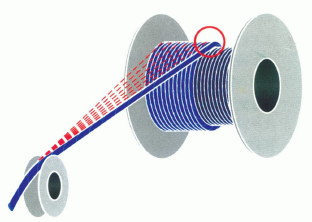
- Multi-layer crushing on short drums. Fleet angle and spooling tension matter more on a truck crane than on any other machine, because the drum is compact and the layers stack fast. Follow the drum maker’s lay-direction marking — wrong spooling direction shows up as crossovers and crushed valleys within weeks.
- Transport vibration. On the road, the boom is stowed and the rope sits static under its own tension, chattering in sheave grooves and against boom wear pads for hours at a time. A loosely tensioned rope on the drum will grind itself; tie the hook back with real tension before moving.
- No swivel on rotation-resistant rope. A swivel under a 35×K7 lets the counter-laid layers unlay against each other and defeats the whole design. The rope’s structure does the anti-rotation work by itself.
Then break it in: first lifts at reduced load so strands and core bed down, expect the small permanent stretch (about 0.25% for IWRC rope — on a 100 m line that is 25 cm) and re-check wedge sockets and end terminations after the first shift.
Inspection and Replacement: When I Retire a Truck Crane Rope
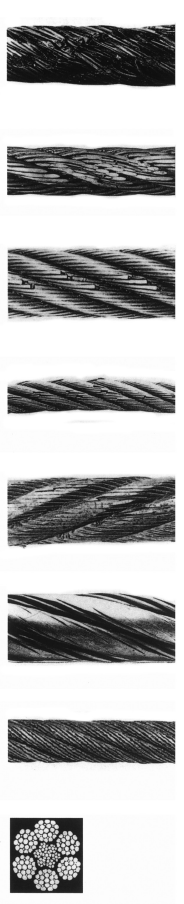
I inspect against ISO 4309, with the hot zones of a truck crane in mind: the section that rides the boom-head sheave at typical boom angles, the first three layers on the drum, and the dead end at the anchor. The damage signatures are described in detail in my article on why wire ropes fail; the practical limits are:
| What to check | Discard / action |
|---|---|
| Broken wires (6-strand hoist rope) | Retire at about 6 broken wires in one lay length or 10 in 30 rope diameters |
| Broken wires (rotation-resistant 35×K7 / 35WXK7) | Far stricter: retire at 2 breaks in 6 rope diameters or 4 in 30 — inner-layer breaks are hidden, so act at the first valley breaks |
| Diameter loss | Retire at ~7% reduction from nominal (measure with calipers at several points) |
| Drum-crushing damage | Flattened, wavy or basket-deformed sections from crossovers: retire — this is progressive, not cosmetic |
| Corrosion | Deep pitting or rust between strands = internal attack; retire even if the wire count passes |
| Kinks, birdcaging, shock loops | Retire immediately — usually slack rope pulled tight under load |
| Extension / retraction ropes | Elongation beyond OEM re-tension range, broken wires at internal sheaves, or uneven boom extension = replace; do not run these to wire-count limits |
Final Word: Match the Rope to the Circuit, Not to the Catalogue
Almost every premature truck crane rope failure I have traced came down to a circuit mismatch: ordinary 6-strand under a single-fall hook, a fiber core on a multi-layer drum, bright rope living outdoors, or an extension rope run until the boom extended crooked. Count your parts of line, respect the 5:1 factor, buy compacted with a steel core, and inspect the ropes you cannot see as seriously as the one you can. Sister machines use related logic — see my crawler crane rope guide and my comparison of 35×K7 vs 19×7.
Aulone is a professional manufacturer and supplier of steel wire ropes, wire rope slings, synthetic ropes and rigging hardware for lifting, marine, mining, construction and industrial applications. With more than 20 years in the industry, 200,000 tons of annual capacity and production to EN 12385-4 under ISO 9001 — certified by BV, ABS, DNV, RMRS and CE — we supply compacted rotation-resistant hoist lines, pre-stretched extension ropes and galvanized constructions with lot-specific breaking-force certificates, keep common truck crane sizes in stock, build custom assemblies with pressed or spliced terminations, and arrange third-party testing on request. For help speccing your next truck crane rope, write to me at info@wireropes.net.
Frequently Asked Questions
What is the best wire rope for a truck crane main hoist?
For single-fall hoisting: a compacted rotation-resistant 35×K7 or 35WXK7 with IWRC (EPIWRC on wet sites), grade 1960, hot-dip galvanized for outdoor work, sized at 5:1 to the maximum line pull. For multi-fall hook blocks: compacted 6×36WS+IWRC is usually the tougher and more economical choice.
Do I need rotation-resistant rope if my crane has a multi-fall hook block?
Usually no. With two or more parts of line, load rotation is already balanced across the falls, so a conventional 6-strand rope — more abrasion-tolerant, cheaper, and governed by more relaxed discard limits — is the better rope. Rotation-resistant construction earns its keep only where the load hangs free on a single part of line.
How often should boom extension and retraction ropes be replaced?
Follow the crane OEM’s replacement interval as the baseline, and replace early when you see elongation beyond the re-tension range, broken wires at the internal sheaves, or uneven, jerky boom extension. These ropes work inside the boom where damage is invisible, so I treat symptoms — not wire counts — as the retirement trigger.
What safety factor should truck crane wire rope meet?
A 5:1 design factor (minimum breaking load to maximum line pull) for hoist lines, which matches mobile crane practice under ASME B30.5; boom extension and retraction ropes carry at least 4:1 per the OEM design. Always apply the strictest of your local regulation, the applicable standard and the crane manufacturer’s manual.
Why does my truck crane rope wear faster than the same rope on a crawler crane?
Three truck-crane-specific reasons: road-transport vibration chafes the stowed rope against sheaves and wear pads; short drums stack many crushing layers; and rental-style usage means frequent reeving changes, small sheaves and off-axis loading. Tight spooling tension, hook tied back during transport and disciplined lubrication recover most of that life.
Can I lubricate my way to a longer rope life?
Largely, yes. Clean the rope and apply a penetrating lubricant that reaches the core every 40–80 operating hours (more often on muddy or coastal sites). Skip engine oil and general sprays — they never reach the core. A well-lubricated rope routinely outlasts a dry one two to one on the machines I follow.