The short answer: almost every wire rope failure comes down to one of ten preventable causes — bending fatigue, abrasion, corrosion, crushing, kinking and birdcaging, overload and shock loading, worn or mismatched sheaves, neglected lubrication, the wrong construction for the duty, or bad terminations and installation. In twenty years of cutting open failed ropes, I can count on one hand the ropes that failed “without warning.” Nearly all of them had been leaving a readable signature for weeks. This article walks through each cause, what the damage looks like on the rope, and the specific action that stops it from repeating.
The 10 Causes of Wire Rope Failure at a Glance
| # | Cause | What you see on the rope | Where it usually shows up | First fix |
|---|---|---|---|---|
| 1 | Bending fatigue | Broken outer wires, crowned by wear flats | Where the rope bends over sheaves; near terminations | Increase D/d ratio; reeve to reduce bends |
| 2 | Abrasive wear | Flattened, shiny outer wires; diameter loss | Sheave grooves, drum layers, gritty sites | Correct groove size; clean and lubricate |
| 3 | Corrosion | Rust, pitting, stiff dark rope | Marine, chemical, outdoor, wet storage | Galvanized or bright + proper lubrication |
| 4 | Crushing / rope bite | Flattened strands, stepped cross-section | Lower wraps on multi-layer drums | Back tension, correct grooving, compacted rope |
| 5 | Kinks / birdcaging | Permanent loops, cage-like strand opening | After mishandling or tension release | Replace; handle and install correctly |
| 6 | Overload / shock load | Stretched rope, narrowed neck at break | After a pick beyond capacity or a snatch | Load charts, smooth operation, right SF |
| 7 | Sheave / fleet angle mismatch | One-sided wear, scrubbing on flanges | Worn grooves, misaligned leads | Regroove or align; keep fleet angle ≤1.5° |
| 8 | Lubrication neglect | Dry, noisy rope; internal wire breaks | Long-service ropes never re-lubricated | Scheduled relubrication that reaches the core |
| 9 | Wrong construction or core | Premature failure despite good care | Ropes substituted at purchase | Match construction, core and grade to duty |
| 10 | Termination & installation errors | Slippage, broken wires at the socket or clip | Ends of the rope | Correct fittings, fitted by trained hands |
1. Bending Fatigue — the Number One Killer
Rope steel is excellent under tension and poor under repeated bending. Every time a rope wraps a sheave, its wires bend and straighten; after enough cycles, cracks start and the wire breaks. The classic signature is broken outer wires with flat, worn tops, clustered where the rope bends hardest — sheave contacts, fairleads, and the first wraps leaving the drum.
The single strongest lever on fatigue life is the D/d ratio — sheave tread diameter (D) to rope diameter (d). Halve the bending radius and you can cut bending life by a factor of several, not a few percent. When a customer complains that a rope “only lasted two months,” the first thing I ask for is a photo of the sheave.
| D/d ratio | Approximate relative bending life (same rope) | Typical verdict |
|---|---|---|
| ≥ 40 | 100% | Excellent — the target for high-cycle hoisting |
| 25–40 | ~40–70% | Normal for most cranes — acceptable with inspection |
| 16–25 | ~10–30% | Expect visible fatigue breaks early; tighten inspection |
| < 16 | a few percent | Static or infrequent use only — not running rope duty |
Prevention: respect the crane manufacturer’s minimum sheave sizes, avoid reeving through more sheaves than the job needs, and reeve so the most heavily used part of the rope does not always sit on the same sheave. My earlier articles on tower crane and overhead crane rope selection cover duty-specific fatigue management in detail.
2. Abrasive Wear — Outside and In
Abrasion steals cross-section. Externally, the rope scrubs against sheave grooves, drum wraps, structure and the ground; the outer wires flatten into shiny, knife-edged bands and the measured diameter shrinks. Internally, wires rub against each other and against the core, especially where grit has worked into a dry rope. Both forms end the same way: less steel carrying the load, and a rough surface that starts fatigue cracks sooner.
Prevention is housekeeping: correctly sized grooves, clean ropes, and lubrication so the rope slides rather than grinds. When measured diameter is down about 7% on a 6-strand rope — always checked against the discard table in ISO 4309 — the rope goes out.
3. Corrosion — Surface Rust Is a Symptom, Pitting Is a Verdict
Corrosion rarely breaks a rope on its own; what makes it lethal is the combination. Rust roughens the wires, which accelerates fatigue and hides broken wires from view. Pitting notches the steel like a saw cut. The worst variant is internal corrosion: the rope outside can look acceptable while the strands underneath are rusted stiff — I have opened STS crane ropes that were clean on the surface and orange in the valleys and core.
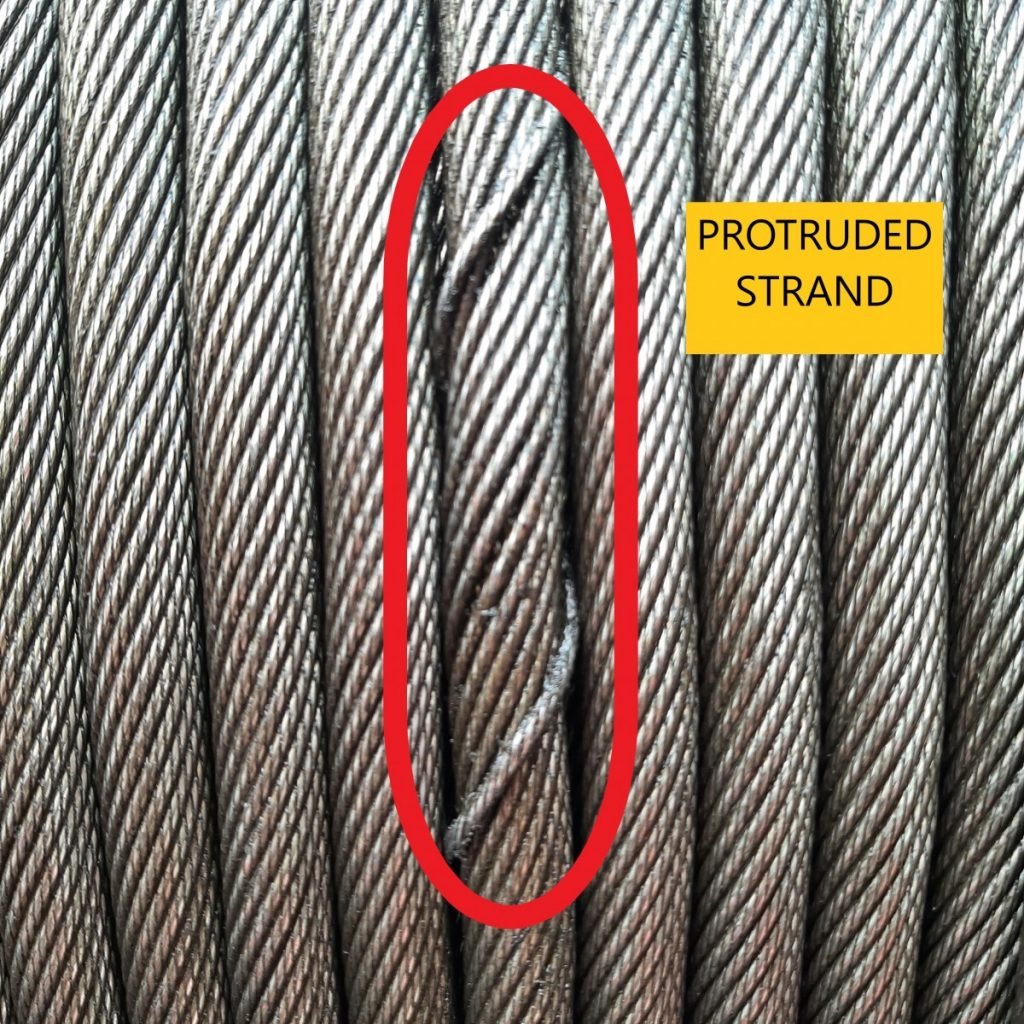
Prevention: choose the right finish for the environment — galvanized for marine and outdoor duty, bright with a disciplined lubrication program for indoor cranes — and inspect by feeling as well as looking: a corroded rope loses flexibility and audibly crackles when bent. Regular relubrication displaces moisture from the core, which is where corrosion starts.
4. Crushing and Rope Bite on Multi-Layer Drums
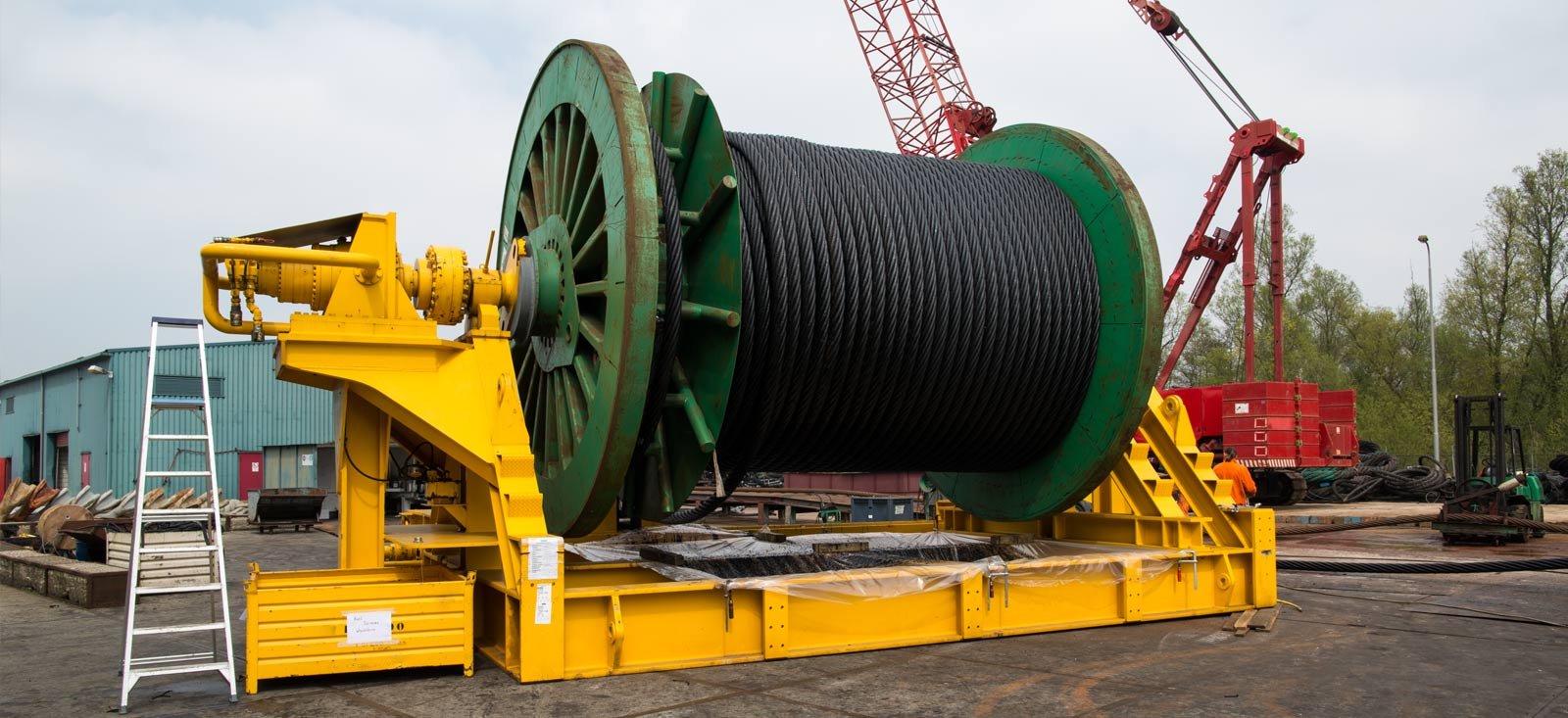
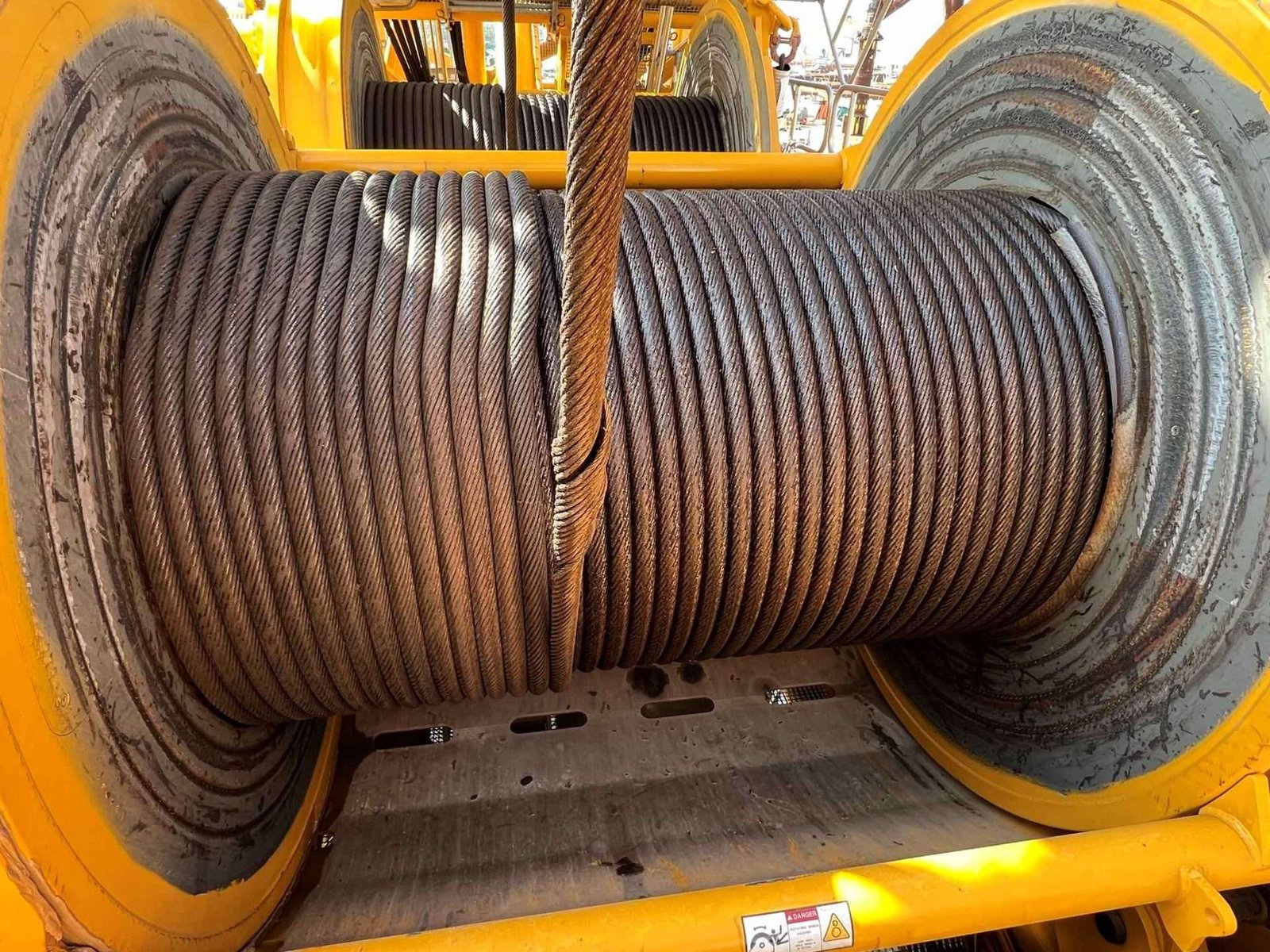
On a multi-layer drum, every upper wrap presses the layer below into the drum grooves. Poorly spooled rope crosses itself, and a crossing wrap can carry the full line tension of the layer above — that is rope bite, and it leaves flat spots, stepped strands and a cross-section that no longer runs round through the sheaves. Crushing is the signature failure of rotary drilling rigs and crawler cranes with deep multi-layer windings.
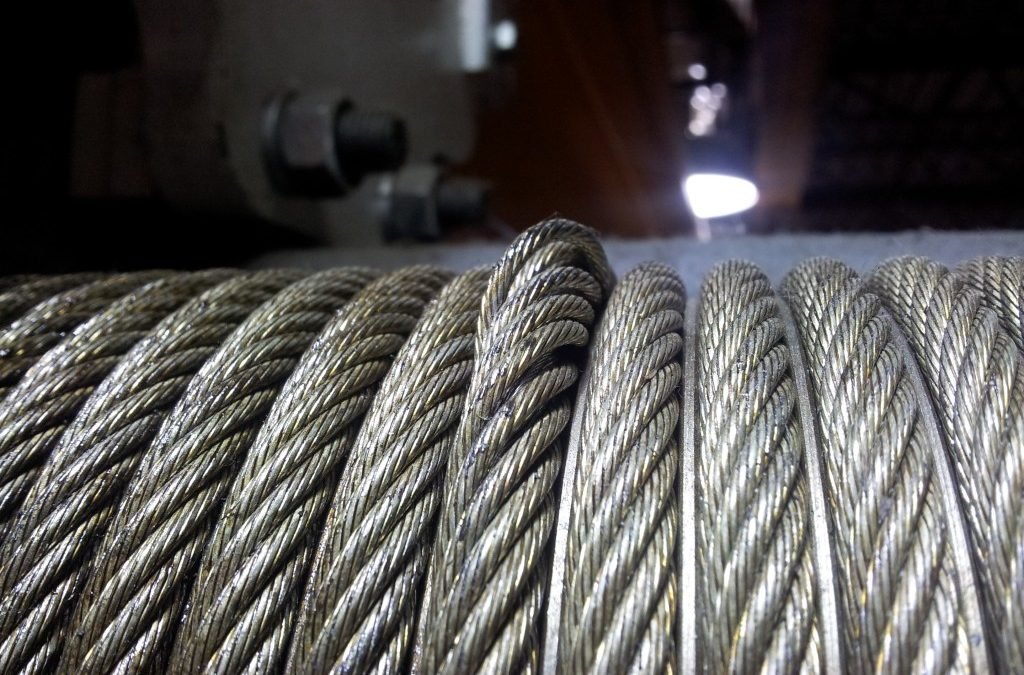
Prevention: wind the first layer with 2–5% of the rope’s breaking force as back tension, keep the fleet angle inside about 1.5 degrees, and on severe multi-layer duty specify a compacted rope — its flattened, denser strands resist deformation markedly better than a round-strand rope of the same diameter.
5. Kinks, Birdcaging and Torque Imbalance
A kink is a permanent distortion set in when a loop is pulled tight; the strands and core have been permanently displaced and the rope is scrap — no inspection regime can rehabilitate it. Birdcaging is the cousin: the outer strands blow open in a cage when the rope goes suddenly from load to slack, typical of release-under-tension incidents and of rotation-resistant ropes like 35×K7 class handled without respect for their torque balance.
Most kinks are born during installation: a reel spun off the side instead of rotating freely, a rope dragged off a coil, or a swivel fitted where the design forbade one. The fix is procedural — unreeling discipline, seizing before cutting, never letting a loaded rope go suddenly slack. My installation and maintenance guide lists the full routine.
6. Overload and Shock Loading
An overload that actually breaks a rope is rare in careful operations; what overloading does more often is set up a later failure — stretched rope, displaced strands, a crushed core, permanently elongated lay lengths. Shock loading is worse than a steady overload of the same magnitude: a snatch load can momentarily exceed twice the static load, and rotation-resistant constructions tolerate that poorly.
Prevention: size ropes with the correct design factor (5:1 for most slings, 3.5:1 or better for running crane ropes, higher for people-carrying duty), keep the load chart honest, and treat any rope that has survived a documented overload or shock event as suspect until a competent person examines it.
7. Sheave, Groove and Fleet Angle Mismatch
Frequently the rope is innocent. A sheave groove worn to a profile that no longer matches the rope diameter concentrates the entire contact pressure on a narrow band; a too-small sheave starves the rope of bending radius; a fleet angle beyond about 1.5° makes the rope scrub the drum flanges and its own wraps. The tell-tale signs are one-sided wear, polished flats on one side of the rope, and fatigue breaks that cluster on the same strand around the circumference.
Prevention: measure groove tread diameter and radius at every rope change — a sheave that has just eaten one rope will eat the next one too. Regrooving or aligning a sheave costs a fraction of a rope, which makes this the cheapest failure prevention on the list.
8. Lubrication Neglect — the Invisible Half of the Rope
Roughly 70% of the fatigue and wear damage in a rope happens inside, between wires and core, where the eye cannot follow. The manufacturer’s lubricant protects the rope until commissioning; from then on, the operator owns the core. Ropes that are never re-lubricated fail from the inside out — internal broken wires, dark dry valleys, and sudden loss of flexibility.
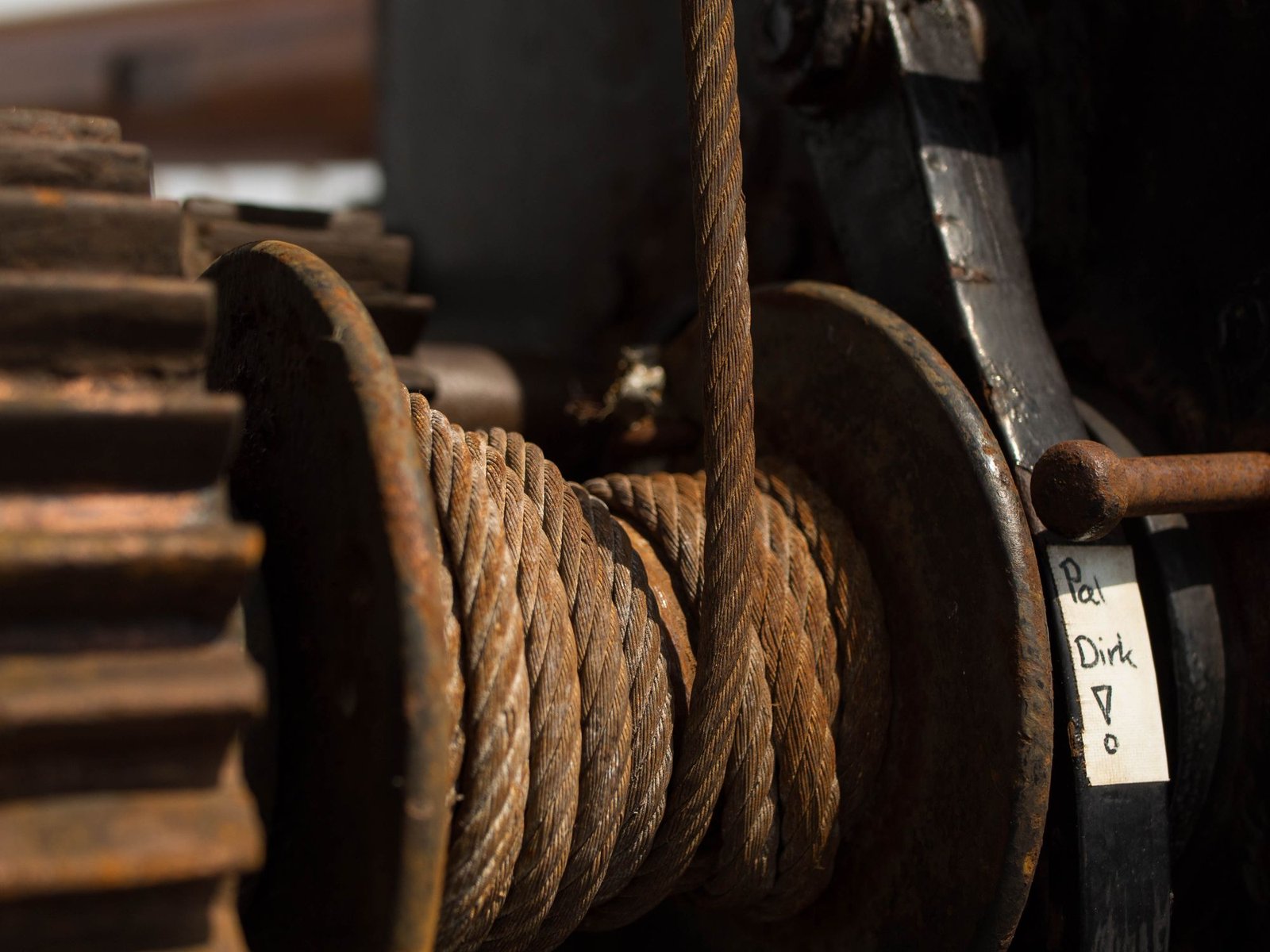
Prevention: clean before lubricating (otherwise you preserve the grit), use a lubricant designed to penetrate to the core rather than a general-purpose grease film, and log every application. I covered the full routine, intervals and product types in the installation and maintenance article.
9. The Wrong Construction or Core for the Duty
Some ropes fail because they were never the right rope. A 6×19 class rope on small sheaves will fatigue long before a 6×36 class; a fibre-core rope on a multi-layer drum will crush where an IWRC would have survived; a non-rotation-resistant rope on a single-fall hoist will corkscrew itself into trouble; a bright rope outdoors will rust away a galvanized rope’s life.
Prevention: buy to a written specification — construction, core, finish, grade, lay — matched to the machine and duty, and resist the cheapest-substitute reflex. My guide to 6×36 wire rope specifications and the core types article give you the selection tables.
10. Termination Failures and Installation Errors
The ends of the rope concentrate stress. Wire rope clips fitted upside down or under-torqued let the rope slip and fret; poured sockets with a poorly broomed or degreased cone pull out below the rope’s strength; wedge sockets back-loaded and unseized tail ends work loose. Combined with installation sins — cutting without seizing, reeving over sharp edges, dragging the rope through grit — terminations are where a well-chosen rope most often meets a preventable end.
Prevention: use the right fitting fitted correctly, and remember that every termination efficiency below 100% lowers the rope’s effective breaking force — my terminations and fittings guide compares socket, splice and clip efficiencies with numbers.
How to Read a Damaged Rope: Signatures and Diagnosis
When a rope comes off the machine, diagnose it like a mechanic reads a failed bearing — the damage pattern names the cause:
| Signature you observe | Most likely cause | Immediate action |
|---|---|---|
| Broken wires with worn flat crowns, spread along bending zones | Bending fatigue (cause 1), accelerated by wear | Check sheave sizes and grooves; retire rope per ISO 4309 |
| Polished, flattened outer wires; diameter down >7% | Abrasion against grooves or structure (2) | Measure and regroove sheaves; review lubrication |
| Rust in valleys with clean surface; stiff rope | Internal corrosion (3) | Open-strand inspect or replace; start relubrication program |
| Flat spots or stepped strands on lower drum wraps | Crushing / rope bite (4) | Re-spool with back tension; consider compacted rope |
| Loops, opened cage of strands | Kink or birdcage (5) | Replace; retrain handling and installation |
| Rope stretched, lay length visibly increased | Overload / shock load (6) | Measure against record; competent-person inspection |
| Wear on one side only, fatigue on same strand around rope | Groove or fleet angle mismatch (7) | Survey sheaves, alignment and fleet angle |
| Slippage or broken wires at the end fitting | Termination fault (10) | Refit or re-pour; retorque clips; check wedge seating |
When a Rope Fails: A Field Investigation Checklist
A broken rope is expensive evidence — do not throw it away. Preserve both ends and the failure zone, photograph everything in position before moving it, and record the machine, the load, the duty hours and the rope’s certificate. Then work the chain: measure the failed section’s diameter and lay length, note where breaks started (crowns = fatigue, tensile necking = overload, pitting = corrosion), and send samples for metallurgical examination where possible. For destructive verification of replacement ropes, insist on the manufacturer’s own breaking test — like the one below — before the rope goes to work.
Prevention: The Routine That Stops 90% of Failures
Nearly everything above reduces to three habits: buy the right rope, install it right, and inspect it on schedule. Put those into a written routine so they survive staff turnover:
| Interval | Action | Stops which causes |
|---|---|---|
| Daily / before shift | Visual walk-around: visible breaks, kinks, diameter, corrosion signs at drum and sheave zones | 1, 2, 3, 5 catching damage early |
| Weekly | Feel the rope through slow motion: stiffness, crackling, flats; check sheave grooves and fleet angle | 1, 4, 7 |
| Monthly | Measured inspection per ISO 4309 with calipers; lubrication application with log entry | 2, 3, 8 |
| At every rope change | Verify construction and certificate against spec; survey grooves, sheaves and drum winding | 4, 7, 9, 10 |
| After any incident | Overload, shock, kink or jam: competent-person inspection before return to service | 5, 6 |
One more prevention lever sits upstream of all of this: rope quality itself. A rope made from clean, properly heat-treated wire to a controlled process simply takes longer to accumulate the fatigue and wear damage described above. Aulone is a professional manufacturer and supplier of steel wire ropes, wire rope slings, synthetic ropes and rigging hardware for lifting, marine, mining, construction and industrial applications. With over 20 years in the industry, 200,000 tons of annual capacity and EN 12385-4 manufacturing under ISO 9001 with BV, ABS, DNV, RMRS and CE certification, we keep common constructions in stock for fast shipment and support customers with failure analysis and custom assemblies. If you have a rope that keeps failing before its time, send me the photos and the certificate — info@wireropes.net — and I will help you read the damage and fix the cause, not just replace the rope.
Frequently Asked Questions
What is the most common cause of wire rope failure?
Bending fatigue is the most frequent single cause, usually accelerated by abrasion or corrosion wearing away the outer wires. The three work together: a slightly worn rope on a marginal sheave fails far sooner than any one factor alone would predict. That is why a good inspection program measures diameter and counts broken wires together.
Can a wire rope break without any warning?
Genuinely sudden failures are rare and usually involve overload, shock loading, a kink, or severe internal corrosion that a surface-only inspection missed. Most ropes give weeks of visible signs — broken wires, diameter loss, stiffness. Warnings only help if someone is scheduled to look for them — including inside the rope, where damage hides.
How much diameter loss means a wire rope must be replaced?
As a working rule: about 7% diameter reduction on 6-strand ropes (10% on rotation-resistant constructions), or earlier if the broken-wire discard table in ISO 4309 is reached first. Measure with calipers at several points and compare against the certificate’s nominal diameter.
Can a kinked or birdcaged wire rope be repaired?
No. A kink permanently displaces the strands and core, and a birdcage permanently unbalances the torque distribution; load sharing in the rope is destroyed even if it looks better after being worked straight. Both require immediate retirement and replacement, followed by a look at the handling or installation practice that caused them.
How often should wire rope be inspected?
A quick visual check before every shift or working day, plus a documented thorough examination at intervals set by your standard and usage — for cranes, commonly at least monthly, and more often for heavy-duty or harsh-environment service. ISO 4309 is the reference most inspection regimes build on; the exact frequency should follow your machine standard and risk assessment.
Does a more expensive rope really fail less often?
A better-specified rope usually does, because you are paying for steel and design that match the duty: compacted strands resist crushing, an impregnated core holds lubricant, higher-grade wire resists fatigue. But even the most durable rope fails fast under the abuse that killed the cheap one. Rope quality buys margin; disciplined operation and inspection buy rope life.