Tower Crane Wire Rope: A Practical Selection and Care Guide, Hoist Line to Trolley Rope
By Andri — Technical Writer & Crane Rope Specialist, Aulone (www.wireropes.net)
The short answer: the hoist rope on a tower crane must be a rotation-resistant rope — an 18×K7 for standard single-fall towers at typical heights, stepping up to a compacted 35×K7 (or 35WXK7 with a plastic-impregnated core) for tall lifts, heavy loads and high cycle counts. The trolley and luffing circuits usually run a flexible line-contact rope such as 6×36WS+IWRC. Add an IWRC steel core, grade 1960 N/mm², bright finish with disciplined lubrication — galvanized on coastal sites — and you have the specification I write for nine out of ten tower crane enquiries. In this guide I’ll walk through each rope circuit on the crane, the choice between the two rotation-resistant families, how to install and run the rope in without killing it, and the inspection limits that decide when it comes off.

Why a Tower Crane Cannot Use an Ordinary 6-Strand Hoist Rope
On most tower cranes the hook hangs from a single rope fall, or from a short two-fall reeving through the trolley that is far from torque-balanced. When a conventional 6-strand rope carries load like that, the tension unbalances the torque built into the rope during manufacture and the load starts to spin. The consequences escalate fast: the hook rotates under every lift, the rope below the hook twists onto itself, loops form, and the next heavy cycle can kink the rope permanently — or drop the load. I have seen the aftermath of a 6-strand rope fitted to a single-fall tower by mistake: two months of service, then a birds-nest of corkscrewed rope that had to be cut out of the reeving in pieces.
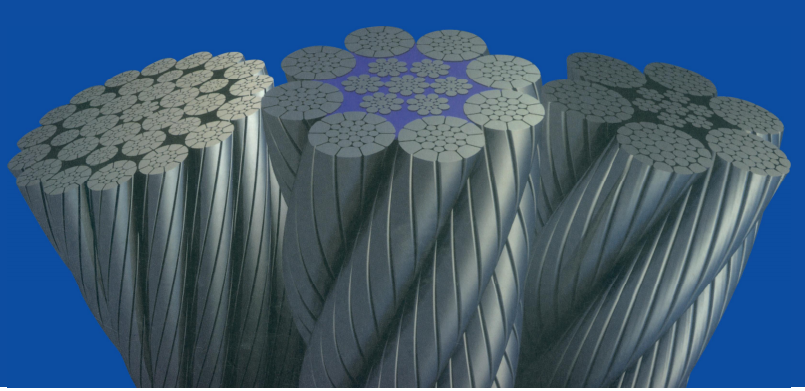
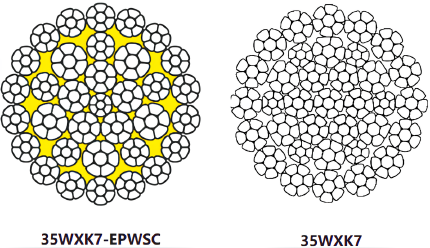
Rotation-resistant ropes solve this structurally. An 18×7 class rope carries its load on two counter-rotating strand layers — nine outer strands laid one way over nine inner strands laid the other, around a core. The 35×7 class (including compacted 35×K7 and 35WXK7) adds a third counter-rotating layer, giving the best torque balance in the industry. The layers fight each other’s twist, so the load stays put. The price of that balance is sensitivity: rotation-resistant ropes must never be shock-loaded, they demand correct spooling and fleet angles, and their discard criteria are far stricter than ordinary rope — more on both below. If you want the full structural comparison, I covered it in detail in my 35×K7 vs 19×7 rotation-resistant rope guide.
The Rope Circuits on a Tower Crane: Match the Rope to the Job
A tower crane is really three or four rope systems wearing one name, and each has a different duty. The table below is the quick-reference version of what I specify for each circuit — always confirm against the crane manufacturer’s rope schedule, because the drum and sheave geometry was designed around a specific construction:
| Rope circuit | Constructions I typically specify | Key demands on the rope |
|---|---|---|
| Hoist line, standard single fall | 18×K7, IWRC, 1960 N/mm² | Torque balance, bending fatigue over the jib-head sheave, stable spooling |
| Hoist line, tall lifts / heavy loads / high cycles | 35×K7 or 35WXK7 (compacted, plastic-impregnated core) | Higher breaking force, drum-crush resistance, longer fatigue life, minimal stretch |
| Trolley travel rope | 6×36WS+IWRC, sometimes 8×26WS+IWRC | Bending fatigue over small trolley sheaves, abrasion resistance, low stretch for trolley positioning |
| Luffing rope (luffing-jib cranes) | 6×36WS+IWRC, or rotation-resistant where the OEM requires it | Multi-layer drum spooling, crush resistance, high static tension |
| Erection / climbing / auxiliary winches | Per OEM schedule — usually 6-strand or 18×7 class | Intermittent duty, but still torque-safe where free-hanging loads occur |
Two practical notes. First, on luffing-jib towers the luffing rope spools several layers onto a small drum under high tension — this is a crushing environment, and it is one of the few places I consider a compacted 6-strand or even a rotation-resistant construction even though the reeving is multi-fall. Second, on trolley ropes, stretch is an accuracy problem: the trolley position sensor assumes a stable rope length, so a low-stretch IWRC rope (or a compacted one, which stretches even less) keeps load positioning honest through the job.
18×K7 or 35×K7? Choosing the Hoist Rope
Both families are rotation-resistant, but they are not interchangeable, and the crane’s height and duty cycle decide which one belongs on the drum. Here is the comparison as it applies specifically to tower crane hoist duty:
| Property | 18×K7 (18×7 class, compacted) | 35×K7 / 35WXK7 (compacted, 3-layer) |
|---|---|---|
| Structure | 9 outer + 9 inner counter-rotating strands around IWRC | 34–35 strands in three counter-rotating layers around IWRC |
| Flexibility | Better — reeves and bends more easily | Good, slightly stiffer — respect sheave D/d |
| Breaking force, same diameter & grade | Baseline | Roughly 15–20% higher — more load-carrying outer strands |
| Drum-crush resistance | Moderate | Excellent — the dense compacted outer layer tolerates multi-layer spooling |
| Torque balance | Good for typical tower heights | Outstanding — best rotation resistance available |
| Stretch | Moderate | Lower, especially with EPIWRC core |
| Best tower crane duty | Standard single-fall hoisting, typical building heights, two-fall reeving | Tall lifts (100 m+ hoist lines), heavy precast and cladding panels, high-cycle sites, luffing drums |
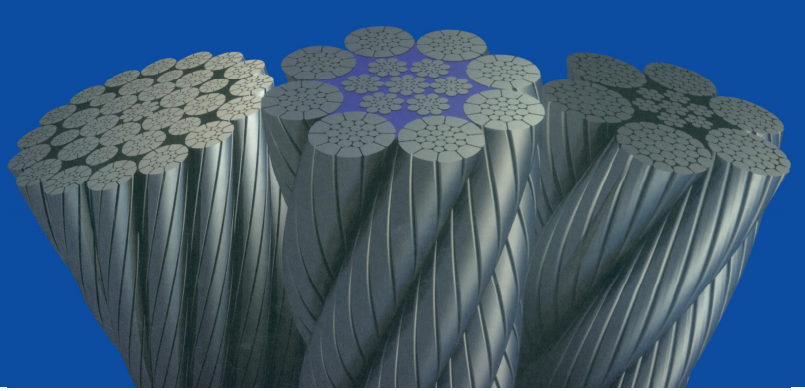
My rule of thumb after years of quoting both: if the crane hooks from a single fall at ordinary building heights and cycles are moderate, an 18×K7 gives you torque safety and flexibility at a friendly price. The moment the job involves long free-hanging lifts, heavy panel loads or a drum that spools multiple layers, the compacted 35×K7 class earns its premium in service life — it is the construction the major tower crane OEMs have been moving toward on their bigger flat-tops and luffing-jib machines.
Core, Grade and Finish: The Three Decisions After Construction
Core: IWRC, always
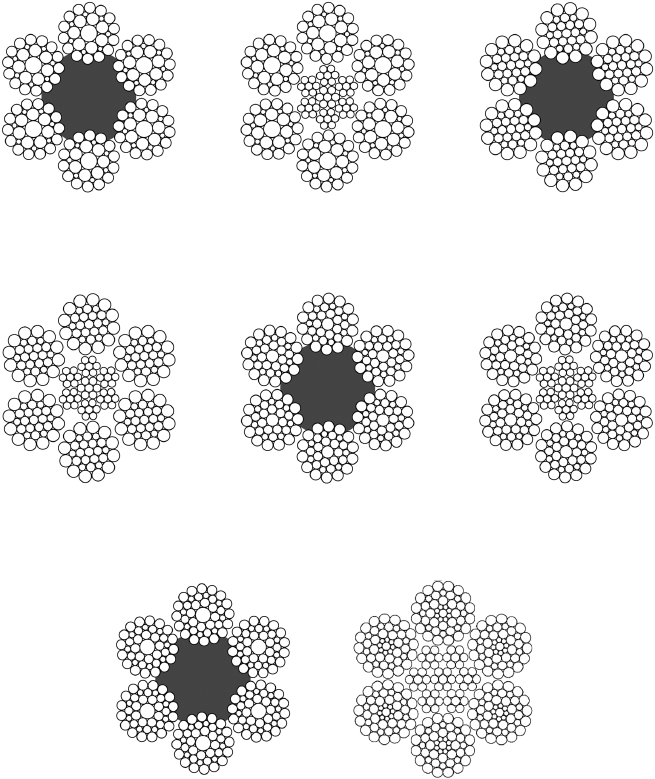
A fiber core has no place on a tower crane hoist. Under multi-layer drum pressure and the heat of high-speed hoisting, a fiber core crushes and degrades, the rope loses its geometry, and the outer strands cut into it. An independent wire rope core (IWRC) supports the strands under radial pressure, adds roughly 7% breaking force over FC, and resists drum crushing — it is what every tower crane rope specification I have ever written or quoted carries. For the toughest duties I go one step further to a plastic-impregnated core (EPIWRC), which locks the factory grease inside and cushions strand-on-core contact; the core options are compared in detail in my FC, IWRC and WSC core guide.
Grade: 1770 or 1960 N/mm²
Tower crane hoist ropes are specified in 1770 or 1960 grade, with 1960 the default on modern machines because it packs more breaking force into the same drum envelope. Remember how the check works: the line pull per rope part must stay below the rope’s minimum breaking force divided by the design factor, which is at least 5:1 for tower crane hoist rope and higher under some local regulations. The arithmetic is in my breaking strength and safety factor guide. Never try to infer breaking force from diameter alone — compare certified MBL values at the same grade.
Finish: bright with lubrication, or galvanized on the coast
Bright (ungalvanized) rope remains the standard choice for tower cranes: it bends fatigue-friendly, works with every crane lubricant, and costs less. It survives outdoors only if you lubricate on schedule — a bright rope left dry will rust from the inside first, where you cannot see it. For coastal sites, humid climates and jobs that stand idle for months, galvanized rope is the rational upgrade; the zinc layer sacrifices itself for the steel underneath at a modest cost in fatigue performance.
Installing and Running In a Tower Crane Hoist Rope
More rotation-resistant ropes die in their first week than in their first year, and the cause is almost always handling. Four field rules matter most. Reeve it clean: pay the rope off a rotating reel — never off a coil lying on its side — and keep tension on the rope from reel to drum so it never goes slack enough to loop. Spool it straight: keep the fleet angle at or below roughly 1.5° for rotation-resistant constructions, wind the first layer tight under 2–5% of the rope’s breaking force, and leave at least two dead wraps on the drum at full travel. Seize before you cut: bind the rope tightly on both sides of the cut or the strands will spring apart and the end will never spool properly. Run it in: work several full-height cycles with a light load at low speed before service, and expect constructional stretch — an IWRC rope permanently elongates around 0.25% early in life, which on a 60-metre hoist line is about 15 cm of hook drift. Re-level the hook block and re-check rope tension after the first days. The full procedure, from storage to lubrication intervals, is in my wire rope installation and maintenance guide.
Inspection and Replacement: The Limits That Matter on a Tower Crane
Tower crane rope inspection follows ISO 4309, with the regional rule sets — OSHA 29 CFR 1926.1413 and ASME B30.3 in the US — adding concrete numbers. The critical difference from general crane practice: rotation-resistant ropes are retired far earlier than 6-strand ropes, because their damage is often internal, between the counter-rotating layers, and invisible until the rope is close to failure. Inspect the wraps that sit on the drum at the bottom of travel, the sheave contact zones on the jib, the rope just below the drum entry, and the dead-end terminations. The headline limits:
| Condition | Standard 6-strand running rope | Rotation-resistant hoist rope (18×7 / 35×7 class) |
|---|---|---|
| Randomly distributed broken wires | 6 in one rope lay | 2 in 6 rope diameters, or 4 in 30 rope diameters (ASME B30.3); ISO 4309 applies class-specific limits |
| Broken wires in one strand | 3 in one strand in one lay | Stricter — typically 2 in one strand in one lay triggers removal |
| Valley wire break | Remove immediately | Remove immediately |
| Diameter reduction | Beyond the limit in the applicable standard (ISO 4309: 7% for steel-core constructions) | Same — measure against the diameter you recorded on installation day |
| Kink, bird-cage, core protrusion | Remove immediately | Remove immediately — distortion in a rotation-resistant rope means internal damage has already begun |
| Heat or arc damage, severe corrosion | Remove | Remove |
Because rotation-resistant ropes can fail from the inside, I tell every site manager the same thing: keep a dated inspection log with measured diameters and broken-wire counts from day one, and treat any sudden change in rope lay, diameter or spooling behaviour as a stop-work signal. The full discard-criteria breakdown is in my ISO 4309 inspection guide.
What I Would Ask a Rope Supplier Before Ordering
When a tower crane stands idle, rope lead time is worth more than rope price. My pre-order checklist is short: demand a guaranteed minimum breaking force tested to EN 12385-4 with actual lot results on a 3.1 mill certificate; confirm ISO 9001 production and, where the project demands it, third-party testing or class approvals (BV, ABS, DNV, RMRS); check that common tower crane diameters and constructions are in stock and cuttable to length; and for turnkey convenience, ask whether the supplier delivers the rope as a custom assembly with swaged eyes or sockets fitted, which removes one whole failure opportunity from the site crew.
The Bottom Line From the Rope Side of the Site
Specify rotation-resistant rope on every tower crane hoist line — 18×K7 for standard single-fall duty, compacted 35×K7 or 35WXK7 when height, load or cycle count grows — run flexible 6×36WS+IWRC on the trolley and luffing circuits, install it with clean reeving and proper break-in tension, and let the rotation-resistant discard limits, not the calendar, decide when it retires. Aulone is a professional manufacturer and supplier of steel wire ropes, wire rope slings, synthetic ropes and rigging hardware for lifting, marine, mining, construction and industrial applications. With more than 20 years in the industry, an annual capacity of 200,000 tons, ropes produced to EN 12385-4 under an ISO 9001 quality management system, and class certifications including BV, ABS, DNV and RMRS with CE marking, we keep standard tower crane rope sizes in stock for fast delivery and build custom terminated assemblies to order, with third-party testing available. Send your crane model, rope schedule and required lengths to info@wireropes.net and I’ll recommend the construction I would spool onto my own drum.
FAQ: Tower Crane Wire Rope
What wire rope does a tower crane use?
The hoist line is a rotation-resistant rope: 18×K7 for standard single-fall towers, or a compacted 35×K7 / 35WXK7 for tall lifts, heavy loads and high cycle counts. Trolley and luffing ropes are usually flexible line-contact constructions such as 6×36WS+IWRC. All tower crane hoist ropes carry an IWRC steel core, typically in 1960 N/mm² grade, bright or galvanized depending on the site environment. Always confirm against the crane manufacturer’s rope schedule.
Can I use an ordinary 6-strand rope on a tower crane?
Not on the hoist line. With a single-fall or lightly balanced reeving, a conventional 6-strand rope lets the load spin, twists onto itself below the hook and can kink permanently within weeks. Ordinary 6-strand rope is acceptable on the trolley or luffing circuits where the reeving is balanced and the rope never carries a free-hanging single fall — but only if the crane manual allows it.
Should the rope be bright or galvanized?
Bright rope is the standard choice: best fatigue behaviour, lowest cost, fully serviceable if you lubricate on schedule. Choose galvanized for coastal sites, humid climates or jobs with long idle periods — the zinc coating costs a little fatigue performance but protects the rope from rusting from the inside out. On inland dry sites with disciplined lubrication, bright rope is the better value.
How often should a tower crane hoist rope be replaced?
Never by calendar alone — replacement follows the discard criteria of ISO 4309 and regulations such as OSHA 1926.1413 and ASME B30.3. For rotation-resistant hoist ropes the limits are strict: roughly 2 broken wires in 6 rope diameters or 4 in 30 rope diameters, any valley wire break, diameter loss beyond the standard’s limit, or any kink, bird-cage or core protrusion retires the rope immediately. In heavy-duty service, plan for a rope change every 12–24 months and inspect monthly at minimum.
Why is my new hoist rope stretching and the hook drifting?
That is constructional stretch — normal permanent elongation as the strands and core seat under load. An IWRC rope stretches roughly 0.25% of its length early in life: on a 60-metre hoist line that is about 15 cm of hook drift. Run the break-in cycles, then re-level the hook block and re-check the dead-end tension. Stretch that keeps growing after the first weeks is not constructional — inspect for core damage or overloading.
Why did the rope bird-cage just below the drum?
Bird-caging in a rotation-resistant rope is almost always a handling or geometry fault: the rope was shock-loaded or back-slacked, the fleet angle exceeded about 1.5° so the rope cut into the layer below, or it was kinked during reeving. Once the outer strands separate from the core, the internal balance is gone and the rope must be discarded. Prevention is mechanical: correct fleet angle, spooling tension on the first layers, and no slack rope under any circumstance.