The short answer: for a crawler crane’s main hoist, the default choice is a compacted rotation-resistant multistrand rope — 35WXK7 or 35×K7 in 1960 N/mm² grade or higher — while the boom hoist normally runs a flexible six-strand rope such as 6×36WS-IWRC, and the pendant lines use exactly what the crane OEM specifies, never a look-alike substitute. Crawler cranes punish wire rope differently from tower cranes or truck cranes: long booms, big drums with many layers of rope, dusty or muddy sites, and lifts that hold heavy loads suspended for long minutes at a time. Get the construction right and the rope will quietly do its job for months; get it wrong and you will be reeving a new line in the rain, wondering where the money went. Here is how I work through the selection, circuit by circuit.
What Makes Crawler Crane Duty Different
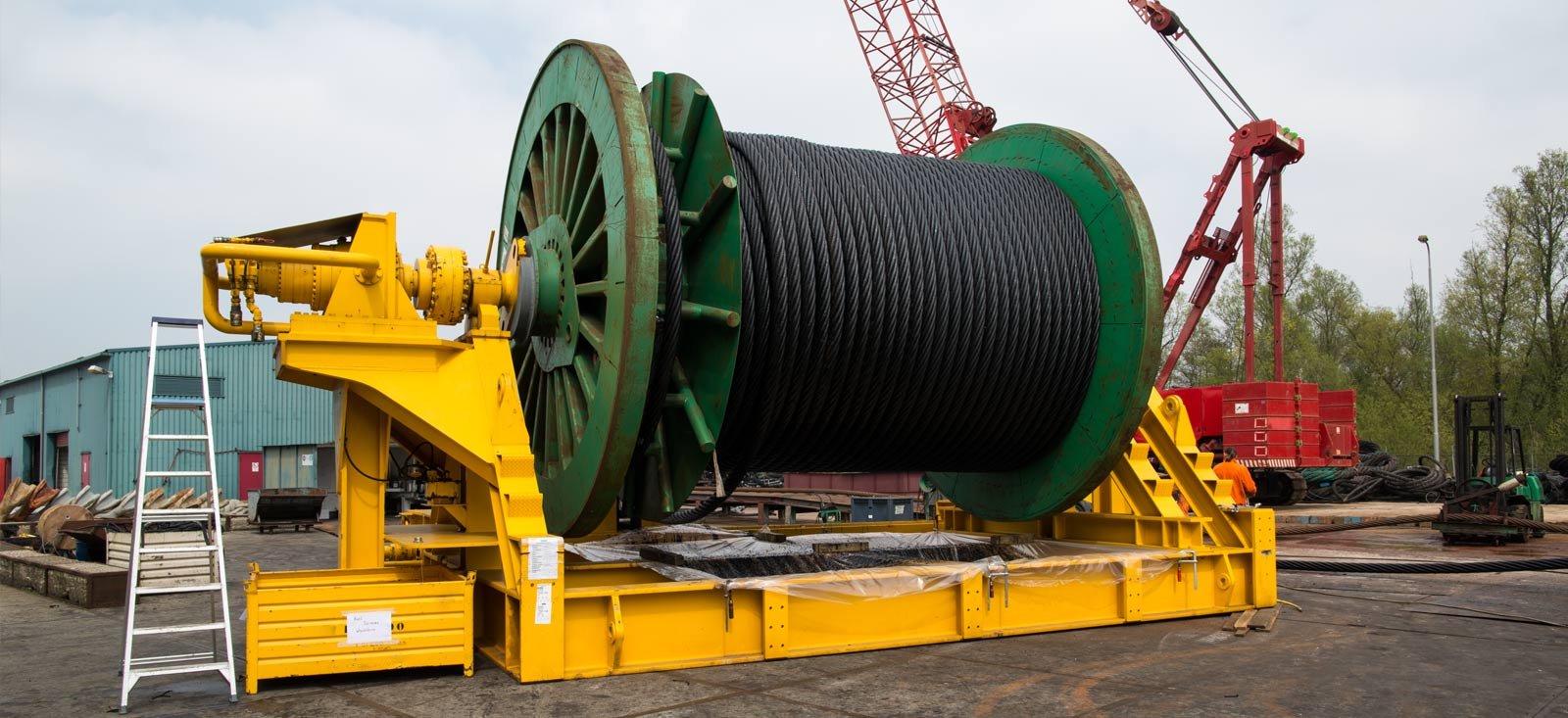
I have spent a lot of time on job sites watching crawler cranes work, and the rope problems are almost never random — they trace back to three features of the machine. First, the boom is long and the working radius wide, so rope length on the drum is large and multi-layer spooling is unavoidable: the rope crushes itself between wraps every lift. Second, crawler cranes frequently work with the hook on a single part of line, exactly the loading condition that makes a standard six-strand rope spin, birdcage and misbehave on the drum. Third, the sites are brutal: mud, sand, dust and weather all find their way into the rope’s core if it is not sealed and lubricated properly.
A fourth difference people forget: a crawler crane usually stands still while it works, so the same section of rope passes over the same sheaves and drum wraps lift after lift. Localised fatigue builds faster than the calendar suggests — which is why inspection has to be position-aware, not just a quick glance at the hook end.
The Rope Circuits on a Crawler Crane
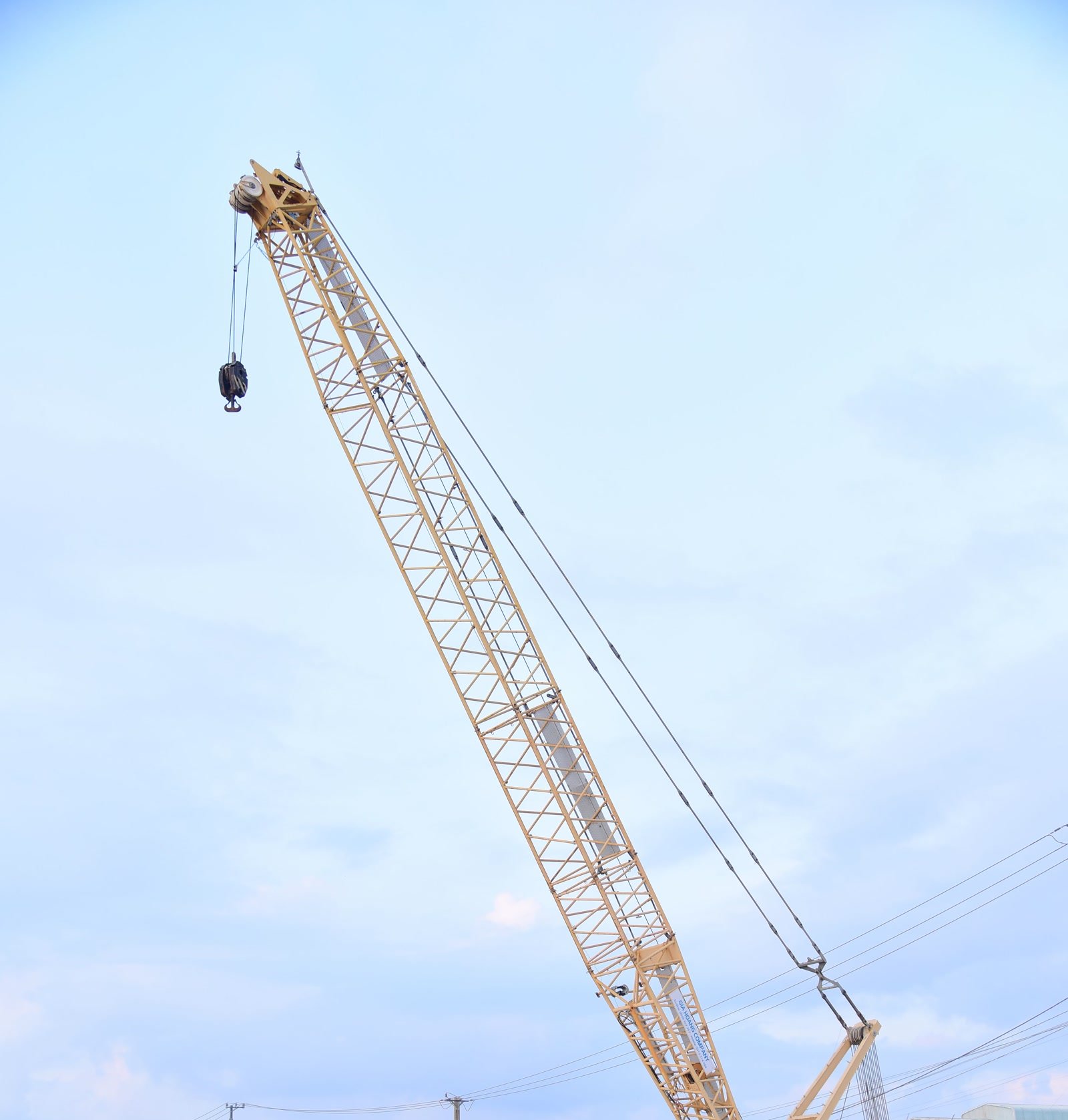
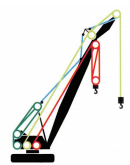
A typical crawler crane carries four or five distinct rope circuits, and they do not all want the same construction. Treating them as one shopping item is the most common quoting mistake I see. The diagram below shows how the circuits run on the machine, and the table is how I normally specify them.
| Rope circuit | What it does | Typical construction | What matters most |
|---|---|---|---|
| Main hoist (load line) | Lifts the load, often single-part or few parts of line | 35WXK7 or 35×K7, grade 1960–2160 N/mm² | Rotation resistance, breaking force, drum-crushing resistance |
| Auxiliary (whip) hoist | Fast, lighter lifts and rigging handling | 35×K7 in the OEM diameter, or 19×7 on smaller units | Rotation resistance at high line speed |
| Boom hoist (luffing) | Raises and lowers the boom | 6×36WS-IWRC or the OEM-listed equivalent | Bending fatigue over sheaves, flexibility |
| Boom pendants / standing lines | Hold the boom geometry, carry static load | OEM-specified six-strand rope, usually larger diameter | Strength, minimal stretch, termination integrity |
| Jib or trolley ropes (where fitted) | Jib hoist / trolley traverse | OEM spec, often 6×19 or 6×36 class | Fatigue life in continuous bending |
One rule overrides this table: the crane manufacturer’s load chart and parts book assume specific rope diameters, breaking forces and constructions. You can upgrade within those limits — say, from a standard to a compacted version of the same family — but a swap to a different construction family should be approved by the crane OEM or a qualified rope engineer. Drum capacity, sheave groove profiles and the load chart itself are all tied to the rope the OEM listed.
Choosing the Main Hoist Rope
When You Need Rotation Resistance
Any time the load hangs free on one part of line, torque is your enemy. Load a standard six-strand rope on a single fall and it twists under the weight; the outer strands loosen over the core, the rope goes sloppy, spools unevenly across the drum, and eventually forms a birdcage that has to be cut out. Rotation-resistant ropes solve this structurally: concentric layers of strands laid in opposite directions cancel each other’s torque under load.
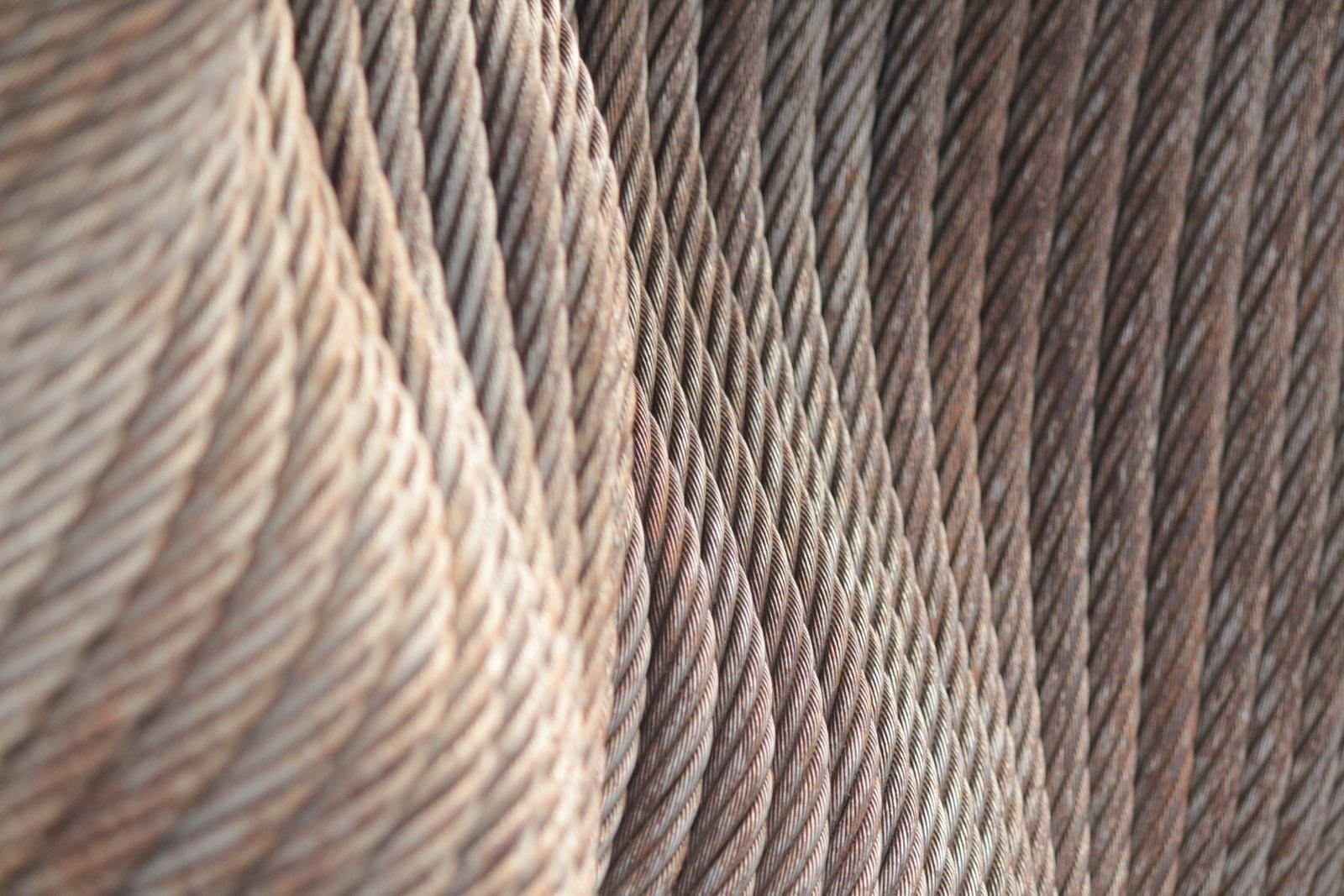
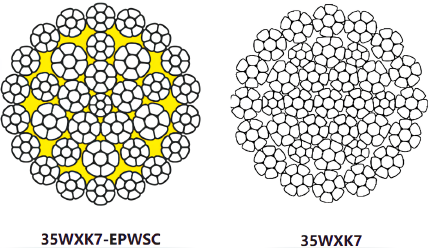
In the EN 12385 naming system, 35WXK7 means thirty-five strands in concentric layers, Warrington wire pattern in the strands (W), compacted strands (K). Each layer is counter-laid against its neighbour, so the rope stays essentially twist-free under a single-line pull. The compacted strands also pack more steel into the same diameter — roughly 10 to 15 percent more breaking force than an uncompacted rope of the same size — and present a smoother surface to sheaves and drum wraps, which is worth a lot in multi-layer spooling. For crawler crane main hoists this is the construction I recommend by default, typically in 1960 N/mm² grade, stepping to 2160 where the OEM allows and the lift plan benefits from it. A 35×K7 without the Warrington pattern is the closely related alternative many OEMs list; both are established rotation-resistant families.
When a Standard Six-Strand Rope Is the Better Fit
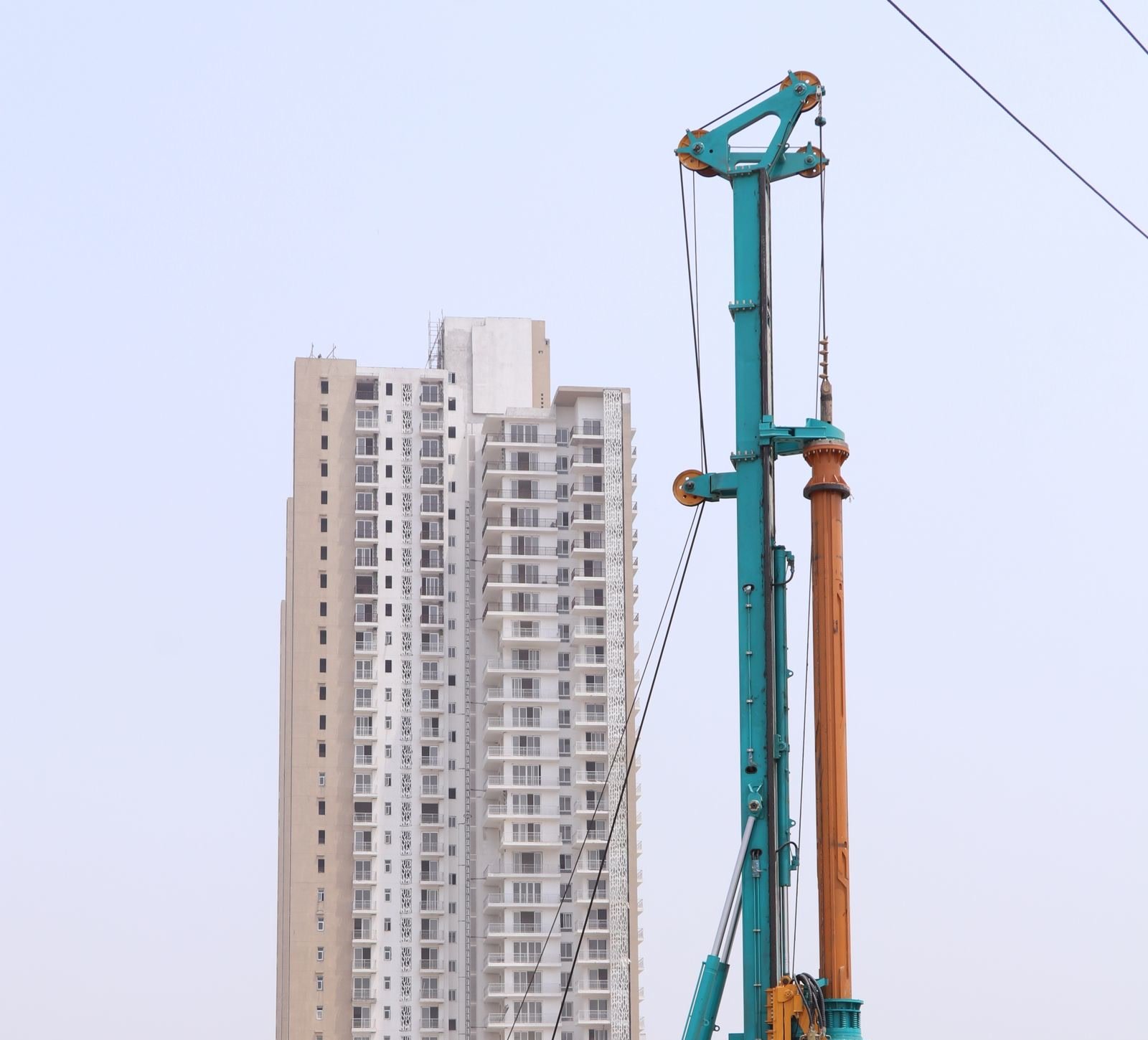
If the crane works mainly in multi-part reeving — four, six or eight parts of line through the hook block — rotation ceases to be the dominant problem, because the reeving itself balances the rotation. In that duty a good six-strand rope such as 6×36WS-IWRC gives excellent fatigue life, tolerates multi-layer drum spooling well and costs less. Many crawler crane owners run exactly this construction on the main hoist and keep a rotation-resistant rope for single-part work. Match the rope to the reeving you actually use most, not to the worst case that happens twice a year.

Core: IWRC, Always
On crawler crane hoist ropes I do not consider a fibre core a serious option. Steel supports steel: an IWRC resists the crushing of multi-layer drum spooling, adds its own breaking force to the rope, and dissipates heat far better. Where the budget allows, a plastic-impregnated core (EPIWRC) is the upgrade I push hardest for crawler duty — the polymer layer locks in lubricant, cushions the core against the outer strands, and seals mud and moisture out of the interior. On dusty sites the difference in internal corrosion after a year is visible with the naked eye.

Safety Factor: What ASME B30.5 Expects
In North America, ASME B30.5 sets the minimum design factors for mobile and crawler crane ropes, calculated as rope breaking force times the number of rope parts, divided by the static load. These are floors, not targets: a rope that lives permanently near the minimum ages fast, and shock loading eats margin quickly.
| Rope circuit (ASME B30.5) | Minimum design factor |
|---|---|
| Running ropes on drums or over sheaves, supporting rated load | 3.5 |
| Boom pendants or standing ropes, supporting rated load | 3.0 |
| Rotation-resistant ropes | 5.0 |
| Running ropes during boom erection conditions | 3.0 |
| Boom pendants or standing ropes during boom erection | 2.5 |
Practically, that 5.0 factor for rotation-resistant ropes is one reason 35WXK7 in a higher grade is attractive: it buys back margin without growing the diameter. Send me your crane model, drum capacity and rope spec and I will run the numbers — info@wireropes.net.
Installation and Spooling: Where Rope Life Is Won or Lost
Installation is where most premature crawler crane rope failures begin — not in the rope itself. The rules that matter most:
- Unreel, never uncoil. Pull the rope off the reel under control onto the drum. A rope kinked during installation is permanently damaged, even if it looks straight afterwards.
- Seize before you cut. Bind the rope tightly on both sides of the cut with seizing wire or tape. Let it unravel and you have released strand torque that can never be put back.
- Spool with back tension. Keep the new rope under tension as it winds onto the drum so the first layers seat tightly. Loose bottom wraps dig into the layers above and crush.
- Respect the fleet angle. Keep it within about 1.5 degrees at the drum; beyond roughly 2 degrees the rope piles up at the flanges and wears itself out against them.
- Break it in gently. Run the first lifts at light load to seat the rope, and expect constructional stretch — roughly a quarter of one percent for IWRC ropes — before the rope settles.
If you want the full procedure, I have written a dedicated field guide to wire rope installation and maintenance on this site.
When to Replace: Discard Criteria That Actually Apply
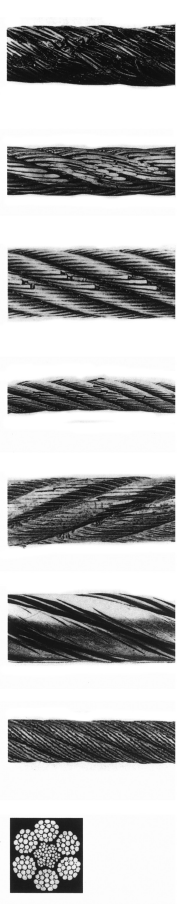
Inspection is where safety and economics meet. Under ASME B30.5 and OSHA 1926.1413, a competent person inspects running ropes before each shift and documents a detailed inspection at least monthly. Rotation-resistant ropes deserve extra attention precisely because their construction hides internal damage — a 35WXK7 can look respectable outside while its core deteriorates, so count carefully and measure honestly.
| Criterion | Running ropes (hoist lines) | Standing ropes (pendants) | Rotation-resistant ropes |
|---|---|---|---|
| Broken wires | 6 in one rope lay, or 3 in one strand in one lay | 2 in one rope lay | 2 in 6 rope diameters, or 4 in 30 rope diameters |
| Valley break (wire broken at contact with core) | One = remove from service | One = remove from service | One = remove from service |
| Diameter loss | More than 5% below nominal — measured crown to crown with a proper caliper, not estimated by eye | ||
| Structural damage | Kinks, birdcaging, crushing, core protrusion, high or low strands, heat or arc damage, severe corrosion — remove immediately, none are repairable | ||
These limits align closely with ISO 4309 discard criteria, covered in detail elsewhere on this blog. The discipline that matters is a dated log per rope: where the damage was found, how many wires, what the caliper read. That log tells you whether a rope is wearing normally or about to surprise you, and it is the first thing an auditor will ask for.
Sizing, Stock and What I Would Check Before Ordering
Diameter is only the headline of a rope specification. Before you order, confirm the construction family, grade, core type, lay direction, finish and the applicable standard — for European-built cranes that usually means a rope to EN 12385-4, and the certificate should state the actual measured breaking force of the production lot, not just the nominal table value. Check drum capacity at the new diameter, sheave groove condition (a worn groove will kill a new rope in weeks), and whether your site justifies galvanized finish over bright.
This is also where the supplier matters more than the price list. Aulone is a professional manufacturer and supplier of steel wire ropes, wire rope slings, synthetic ropes and rigging hardware for lifting, marine, mining, construction and industrial applications. With more than 20 years in the business and an annual capacity of 200,000 tons, we keep common crawler crane constructions in stock for fast shipment, manufacture to EN 12385-4 under an ISO 9001 quality system, and hold third-party certifications including BV, ABS, DNV, RMRS and CE. Every rope can be supplied with third-party testing on request, and we build custom assemblies — socketed, swaged or spliced to your termination spec — so the rope arrives ready to reeve. Send me your crane model and current rope spec for an exact replacement quote or an approved upgrade: info@wireropes.net.
One last practical note: if your fleet also includes tower cranes, the same rotation-resistant families apply but the selection logic differs — see my tower crane wire rope guide, and the breaking strength and safety factor guide for the MBL-to-WLL math in full.
Frequently Asked Questions
How long should a crawler crane wire rope last?
There is no calendar answer — rope life is measured in lifts, bends and drum cycles, not months. A heavily worked main hoist line can need replacement in months while a pendant line lasts years. Track broken wires and diameter at fixed positions every month; the log, not the calendar, tells you when.
Can I replace 19×7 with 35WXK7 on my crawler crane?
Often yes, and usually with a gain in breaking force and bending fatigue life, because 35WXK7 has more outer wires sharing the work. But both are rotation-resistant constructions with different strength-per-diameter, so check drum capacity and sheave groove fit first, and get OEM approval for the swap.
Why can’t I fit any same-diameter rope to the pendant lines?
Pendants carry the boom as standing ropes and work through fixed terminations, so their strength, stretch and end-fitting compatibility are part of the crane’s certification. ASME B30.5 applies a lower design factor to them precisely because they are not continuously inspected in motion. Use the OEM part specification, or an equivalent approved by the crane manufacturer.
Should crawler crane ropes be galvanized?
For outdoor crawler crane work — which is most of it — galvanized finish is worth the small premium unless the OEM specifies otherwise. It slows corrosion at the critical points where mud and moisture sit against the rope: the drum layers and the sheave grooves. Bright rope is fine for dry, sheltered duty.
How often must a crawler crane wire rope be inspected?
OSHA 1926.1413 requires a visual inspection for apparent deficiencies before each shift by a competent person, plus a documented detailed inspection at least monthly. Rotation-resistant and boom hoist ropes warrant shorter intervals under heavy use, and any rope idle a month or more should get a full detailed inspection before returning to work.
What is the minimum safety factor for a crawler crane hoist rope?
Under ASME B30.5: 3.5 for running ropes at rated load, 3.0 for pendants, and 5.0 for rotation-resistant ropes, with slightly lower values permitted during boom erection. Local regulations and the crane manufacturer’s manual may require more — the manual always wins.