Wire Rope Inspection to ISO 4309: Discard Criteria, Broken Wire Limits and a Practical Inspection Guide
By Andri — Technical Writer & Crane Rope Specialist, Aulone (www.wireropes.net)
Short answer: ISO 4309 is the international standard that tells you when a crane wire rope must be taken out of service. A rope is condemned when any one of its discard criteria is met: too many broken wires over a reference length of 6 or 30 rope diameters, a complete broken strand, excessive diameter loss, pitting or internal corrosion, or any structural deformation such as a kink, birdcage or protruding core. The exact numbers depend on the rope’s category (RCN), construction and operating zone — so a rope acceptable on a single-layer drum may already be scrap in a multi-layer crossover zone.
I have spent most of my working life around crane ropes — selecting them, watching them fail, and arguing with inspectors about what “too many broken wires” means. Here is ISO 4309 the way I explain it to maintenance teams on site.

What Is ISO 4309 and What Does It Cover?
ISO 4309 — Cranes — Wire ropes — Care, maintenance, inspection and discard — is the internationally recognised framework for deciding whether a crane or hoist rope is still safe to use. The current edition is ISO 4309:2017, adopted in many countries as a national standard — in China, for example, as GB/T 5972. If your crane manual, third-party inspector or insurance surveyor quotes a rejection rule, chances are it traces back to this document.
The standard covers storage and handling, lubrication, inspection methods and intervals, and — the part everyone cares about — the discard criteria that end a rope’s working life. It applies to all crane and hoist ropes, including rotation-resistant constructions such as 18×K7 and 35WXK7 used as tower crane and truck crane hoist ropes.
What ISO 4309 deliberately does not give you is one universal “broken wire number”. The limits depend on the Rope Category Number (RCN) — a classification from 01 to 31 based on the number of load-bearing wires in the outer strand layer (filler wires not counted); the reference length — counts are taken over 6d or 30d, always on the worst section, never averaged; the operating zone — sheaves and single-layer drums have tighter limits than multi-layer drum crossover zones, where fatigue is systematically worse; and the duty — ropes handling molten metal or hazardous loads get half the normal limits.
The Five Discard Criteria: What Actually Kills a Rope
ISO 4309 groups rope deterioration into five families of discard criteria. If any single one is met, the rope is out of service — there is no averaging one defect against another.
| # | Discard criterion | What the inspector checks | Practical discard trigger |
|---|---|---|---|
| 1 | Broken wires | Count of visible broken wires over the worst 6d and 30d lengths; breaks at terminations counted separately | Limit for the rope’s RCN exceeded; 2 or more breaks in one strand over one lay length; 2 or more valley breaks; any breaks at a socket or termination |
| 2 | Broken strand | Complete severance of one outer strand | Immediate discard — no monitoring option |
| 3 | Reduction in diameter | Diameter measured across opposite strand crowns with a caliper at multiple points, compared with nominal | Localized decrease (core failure, sunken strand) anywhere; non-localized reduction beyond 7% of nominal diameter for typical 6- and 8-strand constructions (up to 10% for certain compacted and rotation-resistant types per the standard’s tables) |
| 4 | Corrosion | Surface rust, pitting, and signs of internal corrosion such as reddish dust exuding between strands when flexed | Pitting or confirmed internal corrosion = discard. Light surface rust without pitting = clean, lubricate, re-inspect sooner |
| 5 | Deformation and other damage | Kinks, birdcaging, waviness, crushing, flattening, core protrusion, heat or arc damage | Any kink, birdcage or core protrusion = immediate discard. Waviness is discardable when the gap under a straightedge reaches about 1/10 of rope diameter. Heat damage (blue discoloration, burnt lubricant) = discard |
One criterion deserves special attention because it hides: valley breaks. Crown breaks — broken wires on the crest of a strand — are easy to see and are normal fatigue. Valley breaks occur between strands and usually mean the core underneath is failing. On an IWRC rope, two valley breaks within one lay length is a discard even if the total count looks fine. Crown breaks mean the rope is aging; valley breaks mean it is dying.

Broken Wire Limits: The RCN Table in Practice
The heart of ISO 4309:2017 is a table of maximum permitted visible broken wires for each RCN, which reflects the load-bearing wires in the outer strand layer. Representative values:
| Rope Category (RCN) | Outer load-bearing wires n | Max breaks, 6d — sheaves / single-layer drum | Max breaks, 30d — sheaves / single-layer drum | Max breaks, 6d — multi-layer drum | Max breaks, 30d — multi-layer drum |
|---|---|---|---|---|---|
| 21 | n ≤ 100 (4-strand group) | 2 | 4 | 2 | 4 |
| 23 | 101 ≤ n ≤ 140 | 3 | 5 | 5–6 | 10–11 |
| 25 | 161 ≤ n ≤ 180 | 4 | 7 | 7 | 14 |
| 27 | 201 ≤ n ≤ 220 | 4 | 9 | 9 | 18 |
| 31 | n > 300 | 6 | 12 | 12 | 24 |
The pattern: the more wires in the strand, the more breaks the rope tolerates. Multi-layer drum values are roughly double the sheave values, because crossover wear is expected there.
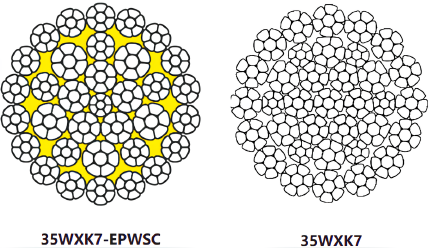
Rotation-resistant ropes get stricter treatment. Constructions like 18×K7, 35×K7 and 35WXK7 — the standard hoist ropes for tower cranes, truck cranes and rotary drilling rigs — are built from strand layers laid in opposite directions. Ropes with Seale-type outer strands of 19 wires or fewer are classified two rows higher in the table, meaning fewer permitted breaks. And because their inner strands are buried, internal deterioration can be advanced long before the surface looks bad — one more reason for shorter inspection intervals on these ropes.
How to Inspect: A Routine That Works on Site
ISO 4309 requires inspections by a competent person, at intervals set according to the crane’s duty, usage and environment — with a thorough examination at least every 12 months. A layered routine in practice:
| Frequency | Who | What gets done |
|---|---|---|
| Daily / each shift | Crane operator | Visual scan of accessible rope: kinks, broken strands, loss of lubricant film, anything unusual at the dead-end. Logged in the daybook. |
| Weekly | Site maintenance | Close visual of all accessible rope; wire-break counts on visible sections; re-lubricate if the surface is dry. |
| Monthly | Competent person | Full-length inspection with the rope spooled out under controlled tension: break counts over worst 6d/30d, diameter measurements at marked points, corrosion check. |
| Annually | Thorough examination | Complete ISO 4309 examination; MFL testing where internal damage is suspected. |
| Special | Competent person | After any shock overload, fouling, arc strike, or whenever the operator reports an anomaly. |
Pay attention to the high-risk zones first, because experience shows ropes fail there first:
- Drum crossover zones — where the rope crosses over itself on a multi-layer drum under fleet angle. Most fatigue breaks originate here.
- Sheave contact sections — especially where the rope sits at standstill or reverses over the sheave.
- Terminations — the rope entering a socket, swaged fitting or wedge. Any broken wires here are an escalation, not a statistic.
- Fixed wear points — where the rope passes guides, rollers or supports at the same spot every cycle.
The tools are simple: a diameter caliper, a wire gauge, a rag, good light, and a spike to part the strands for an internal look. ISO 4309 also requires a rope record — a logbook entry for every inspection. After an accident investigation or audit, that logbook is the difference between “we managed the rope” and “we ignored it”.

Internal Damage: What Your Eyes Cannot See
A rope can look acceptable outside while failing inside. Internal wire breaks, abrasion and core corrosion happen where you cannot see them — particularly on plastic-impregnated ropes where the exterior stays clean while the core deteriorates. Warning signs: diameter loss without matching external wear (the core has lost support), reddish-brown dust between strands, and a “soft” feel when flexed by hand.
When these signs appear, ISO 4309 calls for opening the rope or, increasingly, electromagnetic rope testing (MRT/MFL), which sweeps the whole length and quantifies hidden broken wires and loss of metallic area. MFL does not replace the competent person, but it has saved more than one client of ours from a rope that “passed” three visual inspections.

Extending Rope Life So Inspection Finds Less to Condemn
Inspection tells you when a rope is finished; good practice delays that day. From two decades in the field, the biggest life-extenders are:
- Lubrication. Dry ropes fail from internal friction and corrosion long before fatigue limits. Re-lubricate when the surface looks dry — in hot or coastal climates, far more often than the brochure suggests.
- Sheave and drum condition. Worn or undersized grooves (D/d below roughly 16:1) multiply bending stress. A rope on a worn groove inherits the groove’s damage on day one.
- Handling discipline. Seize before cutting, never flame-cut, never drag through dirt, never shock-load. Kinks and birdcages are the most avoidable discard on any site.
- Right rope from the start. Compacted, plastic-impregnated ropes tolerate multi-layer crossovers far better than commodity constructions — and give inspectors fewer valley breaks to find.
Aulone is a professional manufacturer and supplier of steel wire ropes, wire rope slings, synthetic ropes and rigging hardware for lifting, marine, mining, construction and industrial applications. With over 20 years of manufacturing experience, 200,000 tons of annual capacity, finished-goods stock for fast dispatch, and certifications including EN 12385-4, ISO 9001, BV, ABS, DNV, RMRS and CE, we supply catalogue ropes and custom assemblies with third-party testing. When clients need inspection support, we help them map ISO 4309 limits against their specific rope construction and duty class.
FAQ: ISO 4309 Wire Rope Inspection
1. What exactly is a “lay length” and how do I count broken wires correctly?
A lay length is the distance in which one outer strand makes one complete 360° turn around the core — roughly 6 to 8 rope diameters. ISO 4309 counts visible broken wires over 6d and 30d, always on the worst section: find the 6d length with the highest count and compare that single number with the limit. Never average over the whole rope.
2. How often must a crane wire rope be inspected under ISO 4309?
Intervals are set by a competent person based on duty, usage and environment, with a thorough examination at least every 12 months. In practice: operator checks every shift, a weekly walk-over, a documented monthly full-length inspection, an annual thorough examination. Shorten every interval for rotation-resistant ropes, multi-layer drums, coastal atmospheres and hot or molten-metal service.
3. Can a rope with surface rust be kept in service?
Usually yes — light, uniform rust that wipes off without pitting is not automatic discard. Clean it, measure the diameter, re-lubricate and shorten the interval. But pitting or any sign of internal corrosion — reddish dust squeezed out between strands — is discard, regardless of the broken-wire count.
4. How much diameter loss is allowed before the rope must be scrapped?
Measure across the crowns of opposite strands with a caliper. Any localized reduction — a “waist” at one spot — means core failure and is an immediate discard; uniform loss beyond 7% of nominal discards a typical 6- or 8-strand rope (up to 10% for certain constructions). Also discard when outer wire wear has removed one third of the original wire diameter.
5. Do the ISO 4309 rules apply to rotation-resistant ropes like 35WXK7?
Yes, with stricter numbers: such ropes may be shifted two rows higher in the discard table, permitting fewer breaks. Because their buried inner layers deteriorate invisibly, keep intervals short and consider periodic MFL testing on high-duty cranes.
6. What is the difference between ISO 4309 and OSHA/ASME rules?
Same goal, different mechanics. OSHA and ASME B30 use fixed rule-of-thumb numbers — classically “12 randomly distributed broken wires in one lay, or 4 in one strand in one lay” — plus fixed diameter-reduction tables. ISO 4309 uses the RCN system with counts over 6d and 30d.
Final Word from the Rope
ISO 4309 is not a mystery document — it is a checklist that turns “the rope looks fine” into a measurable decision. Count breaks over the worst 6d and 30d, measure the diameter at the same points every month, hunt for valley breaks and termination damage, treat deformation as an automatic discard, and write everything down. The rope will tell you its true condition long before it becomes front-page news.
If you need help matching a rope construction to your crane’s duty class, or want replacement ropes with full EN 12385-4 certification and fast delivery, contact us at info@wireropes.net — I am happy to look at your inspection records and tell you what I see.