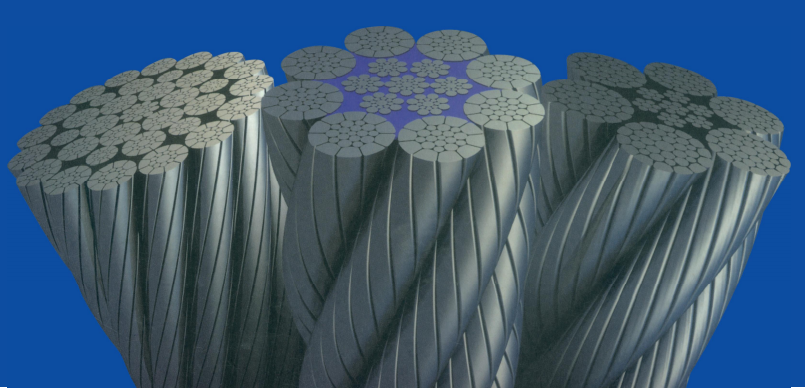
STS Crane Wire Rope: The Complete Selection Guide for Ship-to-Shore Container Cranes
By Andri — Technical Writer & Crane Rope Specialist, Aulone (www.wireropes.net)
The quick answer: a ship-to-shore (STS) container crane runs on three or four different wire ropes, and each position has its own best construction. The main hoist ropes are almost always a 6×36WS class rope with an independent wire rope core (IWRC), typically 28–40 mm. The trolley traction rope — the one that drives the trolley along the boom — is most widely specified as 4V×39S+5FC or a high-flexibility AL FLEX-7 type. The boom hoist uses the same 6×36WS+IWRC family in slightly smaller diameters, and the boom pendants are static-strength ropes selected for breaking force and corrosion resistance rather than flexibility. In this guide I’ll explain why each rope is built the way it is, what it costs to get the choice wrong, and the inspection and buying habits I’ve picked up in more than twenty years around port cranes.
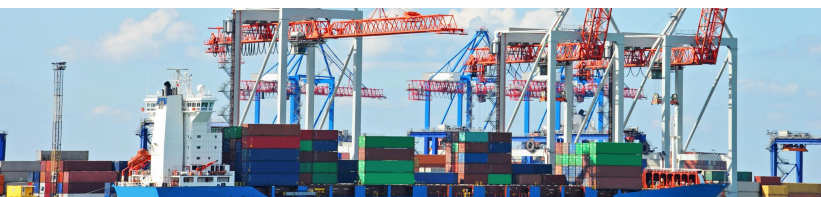
What Ropes Does an STS Crane Actually Use?
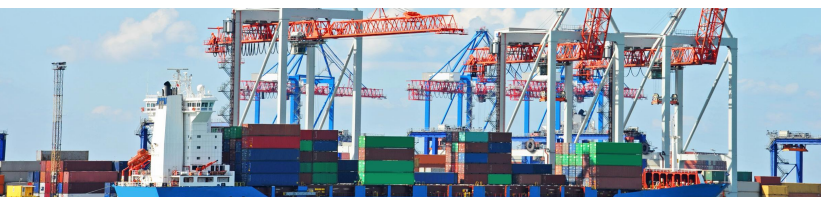
People often talk about “the STS crane rope” as if there were one. In reality a modern ship-to-shore crane carries a small family of ropes, and mixing up their jobs is the first specification mistake I see. The main hoist lifts 40–70 tonnes of spreader plus container through a reeved block. The trolley traction rope does no lifting at all — it just drags the trolley back and forth, but it does it millions of times a year. The boom hoist and pendants mostly sit under static tension, waiting for a storm. Each duty punishes a rope differently:
| Rope system | Function | Typical construction | Typical diameter | What it must survive |
|---|---|---|---|---|
| Main hoist | Lifts the spreader and container | 6×36WS+IWRC, often compacted | 28–40 mm | Bending fatigue, multi-layer drum crushing, corrosion |
| Trolley traction | Drives the trolley along the boom | 4V×39S+5FC or AL FLEX-7 type | 16–26 mm | Millions of high-speed bend cycles, torsion, splice integrity |
| Boom hoist | Raises and lowers the boom | 6×36WS+IWRC | 26–36 mm | Static tension, corrosion, shock loads |
| Boom pendants / tie-downs | Hold the boom in stored position | 6×36WS+IWRC or spiral strand | 30–45 mm | Static strength, corrosion, long idle periods |
If you remember only one line from this section, make it this: hoist ropes die of fatigue and crushing, traction ropes die of cycle count, and static ropes die of corrosion. Everything else in this article follows from those three failure modes.
Trolley Traction Ropes: Why 4V×39S+5FC Dominates
A trolley on a busy STS crane may travel 60–70 metres per move, accelerating and braking hard, forty or more times an hour, around the clock. Multiply that out and the traction rope bends over its sheaves several million times a year — more bend cycles than any other rope on the crane. That is why the traction position rewards flexibility and bending-fatigue life above raw strength.
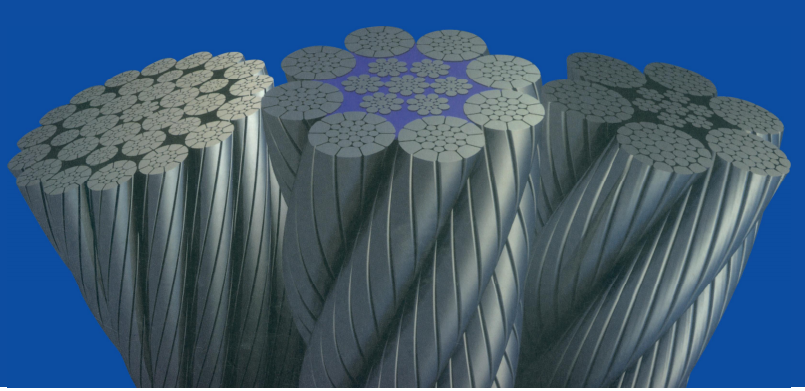
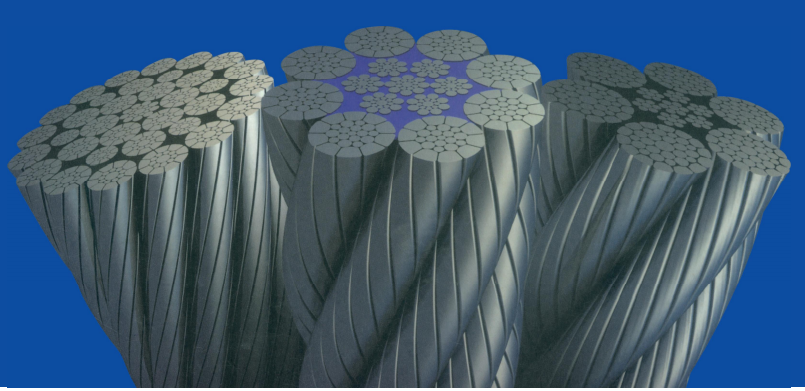
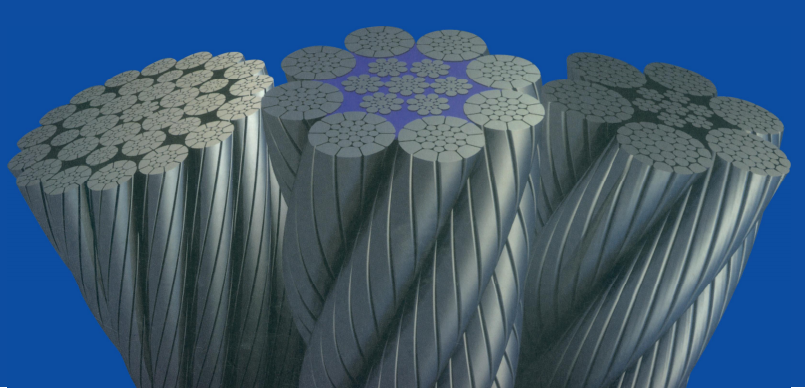
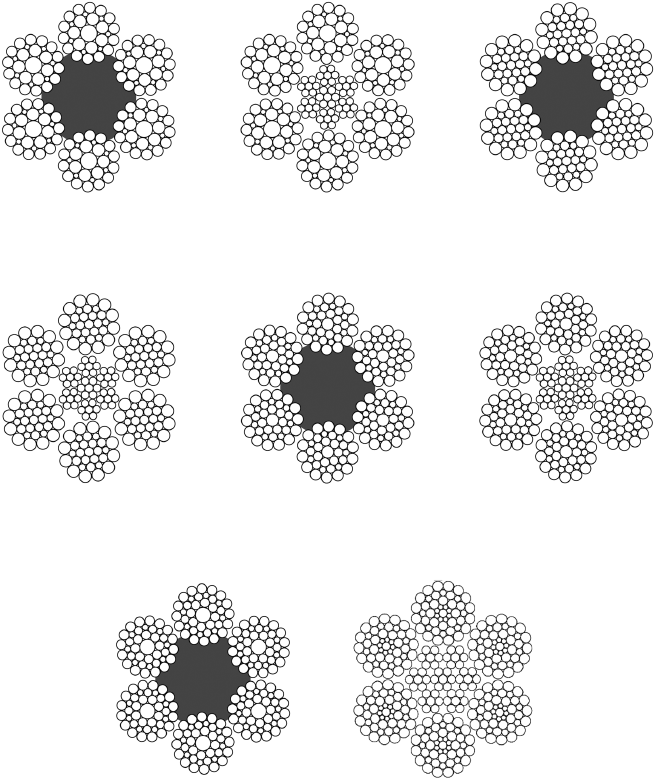
The 4V×39S+5FC construction answers that demand in a clever way. It uses four oval (“flat”) strands of 39 wires each in a Seale-type arrangement, laid over five separate fibre cores instead of one. The flat strands present a wide, even bearing surface to the sheave groove, which spreads contact pressure and dramatically improves bend fatigue. The multiple fibre cores keep the rope exceptionally supple and act as lubricant reservoirs that feed the strands from the inside as the rope works. Because the rope is flexible rather than stiff, it also tolerates the small sheave diameters and tight reeving found on trolley drives.
The AL FLEX-7 type is the other rope you will meet in this position: a seven-strand, high-flexibility traction design with specially shaped strands, developed for exactly the same duty where even smoother running and longer life on small D/d ratios are wanted. Both types are joined into endless loops on the trolley drive, so splice quality matters as much as the rope itself — a perfect rope with a poor splice is a rope waiting to fail.
| Feature | 4V×39S+5FC | AL FLEX-7 type |
|---|---|---|
| Design logic | 4 flat strands over 5 fibre cores | 7 high-flex shaped strands |
| Flexibility | Very high | Highest in the traction family |
| Bend fatigue life | Excellent | Excellent; often longer on small sheaves |
| Breaking strength | Moderate | Moderate to high |
| Core | Fibre (lubricant reservoir) | Fibre / synthetic |
| Best suited for | Standard STS trolley traction | High-speed trolleys, tight sheave D/d ratios |
Main Hoist Ropes: Fatigue and Crushing Are the Enemies
The main hoist rope is the headline act. It runs from a multi-layer drum, over the boom sheaves, down to the spreader block, and a busy crane lifts thirty or more containers per hour with it. Two forces hunt this rope constantly. First, bending fatigue: every cycle the rope bends back and forth over sheaves and drum. Second, crushing: on a multi-layer drum, upper wraps press the lower wraps flat with the full weight of the lifted load behind them.
That is why the 6×36WS+IWRC family has become the default. The 36-wire strands give enough flexibility for good fatigue life, while the independent wire rope core resists crushing and keeps the rope round under load — a fibre core here would be squashed flat within months and let the strands cut into each other. For cranes with aggressive duty cycles, I recommend stepping up to a compacted version and, where the budget allows, a plastic-impregnated one. Compaction packs more steel into the same diameter (roughly 10–15% higher breaking force at equal size) and locks the strand geometry, while the plastic between core and strands cushions internal contact stresses and seals in lubricant. On port cranes these two features routinely stretch rope life by 20–50%.
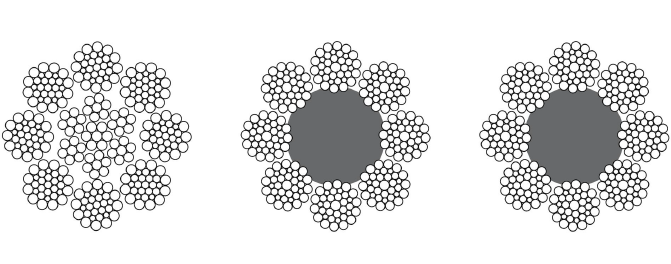
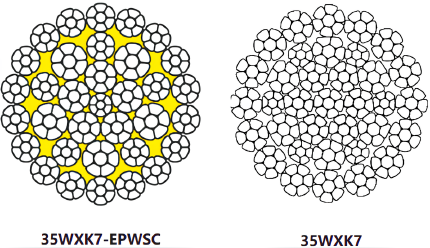
How much strength does the position need? STS hoist ropes are designed with the safety factor set by the crane manufacturer and the applicable crane codes — a factor of about 5:1 against the maximum line pull is a useful rule of thumb for initial sizing (I explain the full MBL/WLL logic in my article on wire rope breaking strength and safety factors). Typical MBL values for the most common hoist rope sizes, grade 1960, 6×36WS+IWRC to EN 12385-4:
| Rope diameter | Approx. MBL (kN) | Approx. MBL (t) | Line pull at 5:1 factor |
|---|---|---|---|
| 26 mm | 424 kN | 43.2 t | 8.6 t |
| 28 mm | 492 kN | 50.2 t | 10.0 t |
| 32 mm | 642 kN | 65.5 t | 13.1 t |
| 36 mm | 813 kN | 82.9 t | 16.6 t |
| 40 mm | 1,003 kN | 102.3 t | 20.5 t |
Treat these as typical calculated minimums, not a substitute for the manufacturer’s data sheet — exact values vary with grade and construction details, and a compacted rope will exceed them. For the full construction breakdown, see my guide to 6×36 wire rope specifications.
Why the Port Environment Makes These Ropes Different
Port cranes live outdoors, a few hundred metres from salt water, working in sea haze, rain and industrial air. Corrosion attacks from the outside in — and, on fibre-cored ropes, from the inside out, because a saturated fibre core holds moisture against the inner wires where you cannot see it. Internal corrosion is the stealth killer here: a rope can look perfectly serviceable on the surface while its hidden wires are being eaten away. That is why lubrication is not a nice-to-have on port ropes; it is a structural requirement. A rope that leaves the factory fully impregnated with lubricant and gets topped up in service will comfortably outlast a dry one, and ISO 4309 inspection explicitly treats internal corrosion and lubrication loss as discard-relevant damage.
For permanent outdoor positions — boom pendants especially — I usually steer buyers toward galvanised rope. The small sacrifice in breaking force (typically about 10% versus bright wire) is a fair trade for corrosion protection on a rope that sits under tension in salt air for years.
Fibre Core or Steel Core? Getting the Core Right
The core is the rope’s foundation, and the STS crane is the perfect illustration of why core choice is positional, not universal. The traction rope deliberately uses fibre core for flexibility and lubrication storage. The hoist rope deliberately uses IWRC for crush resistance on its multi-layer drum and for roughly 7–10% more metallic cross-section — hence more breaking force — at the same diameter. Put each core in the wrong position and you get the failure mode of the other: a crushed, distorted hoist rope, or a traction rope too stiff to survive its sheave fleet. I compare all three core types in detail in my guide to FC, WSC and IWRC cores.
When Should an STS Rope Be Replaced?
Most ports retire ropes on a combination of rope-cycle counters (many modern STS cranes count hoist and trolley cycles electronically) and scheduled inspection to ISO 4309. In practice, main hoist ropes on busy terminals are replaced roughly every two to four years; traction ropes often run longer on the calendar but should be inspected more frequently because of their enormous cycle counts. Whatever the counter says, ISO 4309 discard criteria always have the final word: broken wires in one lay length, diameter reduction (the standard references 6% as a common threshold for this rope class), visible or suspected internal corrosion, and physical distortions such as kinks, birdcaging or flattened spots. Fatigue breaks concentrated near a splice or socket end are a classic traction-rope warning sign — do not just trim and re-splice repeatedly without asking why the fatigue is localised.
Installation Tips From the Field
A surprising share of premature port-rope failures traces back to installation day. The rules I insist on: never unwind a coil on the ground — reel the rope off a turntable or spinning frame so it keeps its lay; spool onto the drum under tension (a few percent of MBL is enough) so the lower wraps cannot be pulled loose later; keep the fleet angle within the manufacturer’s limit, typically about 1.5° on smooth drums, so the rope does not grind against itself at the drum flanges; and cut the rope with the ends immediately seized so the lay cannot open. For traction ropes, the endless splice is specialist work — have it done by a crew that does it weekly, not by whoever is free that afternoon.
Buying STS Wire Rope: What I Would Ask a Supplier
Before you sign anything, ask for: the actual data sheet with guaranteed minimum breaking force to EN 12385-4 (not marketing tables); a 3.1 test certificate from third-party testing if your port requires it; confirmation of preformed rope and the lubricant type; and a genuine answer on lead time — port cranes do not wait politely for a ten-week production queue, so stock availability or a fast custom-assembly service is worth as much as a few dollars per metre. Aulone is a professional manufacturer and supplier of steel wire ropes, wire rope slings, synthetic ropes and rigging hardware for lifting, marine, mining, construction and industrial applications. With more than 20 years in the industry and an annual capacity of 200,000 tons, Aulone supplies STS crane ropes with EN 12385-4 certification, ISO 9001 quality management, and class approvals including BV, ABS, DNV and RMRS, plus CE marking — and keeps common crane-rope sizes in stock for fast delivery with custom cut lengths, sockets and terminations. You can reach our technical team at info@wireropes.net for a datasheet review or a quotation.
FAQ: STS Crane Wire Rope
What diameter wire rope does an STS crane use?
It depends on the position. Main hoist ropes are typically 28–40 mm in 6×36WS+IWRC construction; trolley traction ropes run 16–26 mm in 4V×39S+5FC or AL FLEX-7 type; boom hoist ropes fall in the 26–36 mm range, and boom pendants from 30–45 mm. Always confirm against the crane manufacturer’s rope schedule — diameters are matched to sheave and drum geometry, so an arbitrary substitution is not safe.
Why do trolley ropes use a fibre core (5FC) while hoist ropes use IWRC?
Because their jobs are opposite. The traction rope bends millions of times a year and lives on flexibility, so a multi-core fibre structure keeps it supple and lubricated. The hoist rope works over a multi-layer drum where upper wraps crush the lower ones, so it needs the solid steel support of an IWRC to stay round and keep its strength.
What is the difference between 4V×39S+5FC and AL FLEX-7?
Both are high-flexibility traction ropes for STS trolleys. The 4V×39S+5FC uses four flat strands over five fibre cores, giving a wide bearing surface on sheave grooves. AL FLEX-7 type ropes use seven specially shaped strands in a high-flex design, and are often chosen for high-speed trolleys or particularly small sheave D/d ratios, where they can deliver even longer bend-fatigue life. Both are spliced into endless loops.
How long does an STS hoist rope last?
On a busy terminal, main hoist ropes are commonly replaced every two to four years, but the real rule is ISO 4309 plus your rope-cycle counter. High cycle counts, aggressive multi-layer drum spooling, poor lubrication or misaligned sheaves can shorten that dramatically. Compacted and plastic-impregnated ropes typically extend service life by 20–50% compared with standard constructions.
Can I fit a cheaper general-purpose rope to a port crane?
I would not. General-purpose ropes are not built for the specific killers of port service: multi-layer drum crushing, millions of bend cycles and salt-air corrosion. The saving of a few hundred dollars on rope is erased by one unplanned crane stoppage — and a hoist rope failure under load at a terminal is a very serious incident, not an inconvenience.
Where can I get STS crane wire rope with a short lead time?
Look for a manufacturer that both stocks standard crane sizes and offers custom assemblies. Aulone keeps common STS hoist, boom and traction rope specifications in stock and makes custom cut lengths, spliced endless loops, socketed assemblies and pendant ropes to order, with EN 12385-4 certification and third-party testing available. For quotations and datasheets, contact info@wireropes.net.