HMPE Rope vs Wire Rope: Which Should You Choose for Lifting, Mooring and Winch Lines?
By Andri — Technical Writer & Crane Rope Specialist, Aulone (www.wireropes.net)
The short answer: if your winch line is long enough that its own weight eats into your payload, or your crew handles rope on deck every day, HMPE (high-modulus polyethylene) rope will usually earn its higher price through lighter handling, zero corrosion and far lower snap-back risk. If the rope runs over abrasive surfaces, near heat sources, or on a machine that was engineered around steel — drums, sheaves, fleet angles and sockets — wire rope remains the safer, cheaper and more forgiving choice. There is no universal winner; there is only the right rope for the duty. In this guide I’ll put the two materials side by side with real numbers, show where each one wins, and explain why a diameter-for-diameter swap almost never works.
What Is HMPE Rope?
HMPE stands for high-modulus polyethylene — the rope industry’s name for rope made from ultra-high-molecular-weight polyethylene (UHMWPE) fibre, the family that includes the well-known Dyneema® brand. The fibre is gel-spun into filaments of extraordinary tensile efficiency: weight for weight, a premium HMPE rope is roughly 8 to 15 times stronger than steel, and the fibre’s specific gravity of about 0.97 means it floats. Modern constructions include 12-strand braids, double braids and covered ropes with polyester jackets for abrasion protection, terminated with braided splices that retain around 90% of rope strength.
Two fibre grades matter when you specify: SK75-class fibre for general marine and lifting service, and SK78-class fibre with substantially lower creep for permanent mooring and long-duration static loads. Typical HMPE applications include vessel mooring lines (the fleet has been converting steadily since OCIMF MEG4 raised the profile of mooring-line safety), deepwater subsea lifting, tug towlines, winch fall lines where self-weight is critical, and anywhere crews repeatedly haul heavy rope by hand.
What Is Steel Wire Rope?
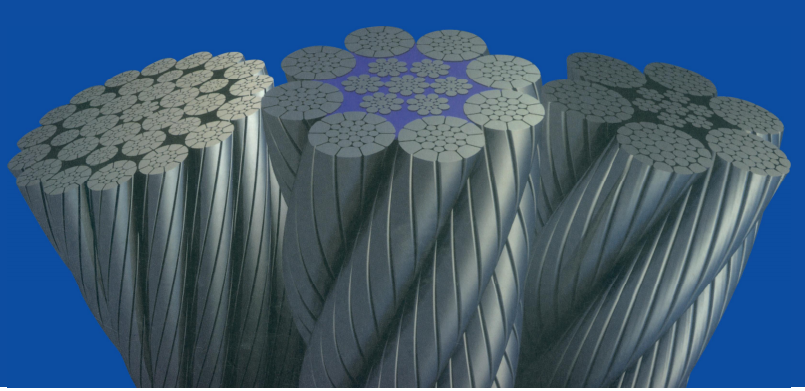
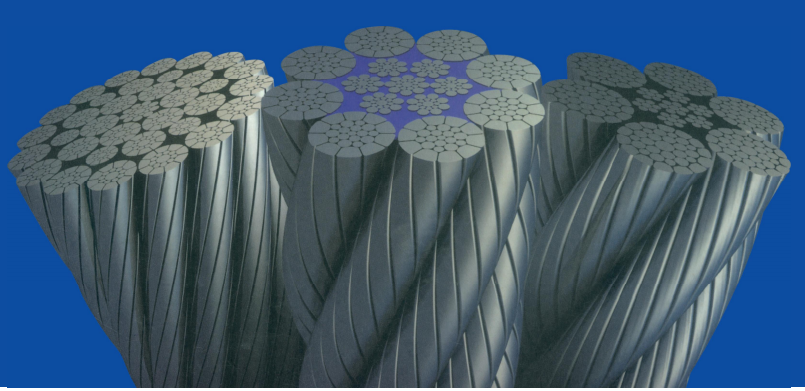
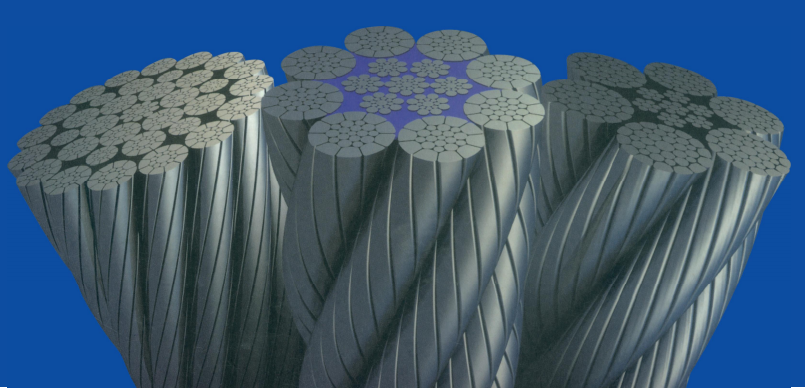
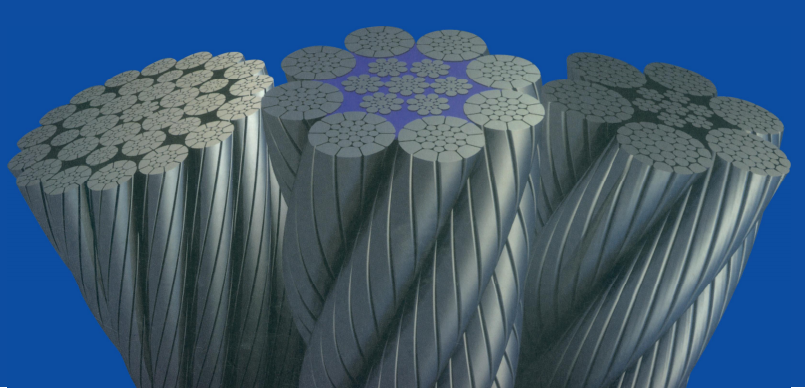
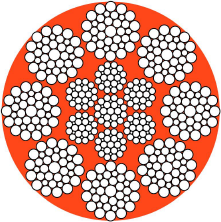
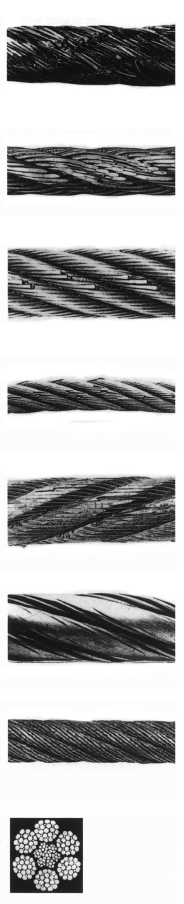
Wire rope needs less introduction — it has been the workhorse of lifting for over a century. High-tensile steel wires are twisted into strands, and the strands are laid around a core (fibre, IWRC or compacted) to produce a rope whose behaviour engineers understand down to the wire. Constructions are chosen by duty: 6×36 class for flexibility over sheaves, rotation-resistant 35×K7 or 35WXK7 for single-fall crane hoists, 6×19 class for abrasion-heavy static service — all covered by EN 12385-4. I walk through the constructions in detail in my guide to 6×36 wire rope specifications.
Wire rope’s strengths are exactly the mirror image of its weaknesses: it tolerates heat and abrasive contact that would destroy synthetic fibre, resists crushing in multilayer drums, and has mature inspection and discard criteria under ISO 4309. What it cannot escape is mass (7.85 g/cm³, eight times denser than water) and corrosion — it needs lubrication, it sinks, and internal wire breaks can hide where you cannot see them.
HMPE Rope vs Wire Rope: Side-by-Side Comparison
Here is the comparison table I sketch on the whiteboard whenever a customer asks the question. Every row has exceptions in specific products, but as a decision framework it holds:
| Criterion | HMPE rope | Steel wire rope |
|---|---|---|
| Weight at equal strength | Roughly 1/8 of steel — up to 80–87% lighter | Baseline; self-weight often limits deepwater reach |
| Strength per diameter | Comparable to high-tensile wire; premium grades higher | Very high; raised further by compacted constructions |
| Buoyancy | Floats (SG ≈ 0.97, depending on cover and hardware) | Sinks (SG ≈ 7.85) |
| Elastic stretch | Low (approx. 1.5–3% at working load) | Low to moderate by construction |
| Creep | Permanent elongation under sustained load — SK78 grades minimise it | None in the polymer sense |
| Temperature | Loses strength above approx. 65–70°C continuous; melts near 147°C | Excellent; service temperatures far beyond HMPE’s limits |
| Abrasion and cutting | Good with jackets; vulnerable to sharp edges | Excellent; tolerates rough, gritty contact |
| Corrosion / lubrication | Immune; no lubrication ever | Requires lubrication and monitoring; internal corrosion can hide |
| Snap-back on failure | Low stored energy — rope typically falls dead | High stored energy — violent recoil hazard |
| Handling | Light, flexible, no barbs or fishhooks | Heavy; broken wires cut gloves and hands |
| Inspection | Mostly visual: fuzzing, cuts, glazing, splice condition | Visual plus measurement; mature criteria (ISO 4309) |
| Initial cost | Higher — typically 2–4× wire rope | Lower; available off the shelf everywhere |
One row deserves a warning label: creep. Under sustained load HMPE fibre permanently elongates over time — slowly at moderate loads, faster at high load and temperature. For a mooring line that stays loaded for years, creep is a design parameter, which is exactly why low-creep SK78-class fibre exists. Wire rope simply does not have this failure mode, and if your application involves long-duration static tension at high percentage of breaking load, that row alone can decide the argument.
Strength-to-Weight: The Numbers Behind the Hype
Manufacturers love to quote “stronger than steel” — let me put real representative numbers next to each other so you can see where the crossover sits. The table below compares standard 6×36 IWRC wire rope (1960 grade) with a 12-strand braided HMPE rope of SK75-class fibre. Values are nominal for new rope; your manufacturer’s certificate always governs, and I explain how breaking loads are verified in my guide to wire rope breaking strength and MBL.
| Nominal diameter | Wire rope weight (kg/m) | HMPE weight (kg/m) | Wire rope MBL approx. (kN) | HMPE MBL approx. (kN) |
|---|---|---|---|---|
| 32 mm | 4.1 | 0.55 | 645 | 850 |
| 40 mm | 6.4 | 0.80 | 1,000 | 1,350 |
| 48 mm | 9.2 | 1.15 | 1,430 | 1,950 |
Read the table two ways. Per metre, HMPE wins the breaking-load contest at these diameters while weighing roughly one-eighth as much — on a 1,000-metre deepwater lift line, that is about 5.6 tonnes of steel self-weight you no longer lower, brake, haul and ship, against under 1 tonne of synthetic. But strength per diameter is not the whole story: the wire rope’s MBL is stable from the day it is made to the day it is retired, while HMPE strength is sensitive to temperature, sustained-load creep and accumulated internal abrasion — so the working load limits and design factors you apply to each material are not interchangeable.
And note what the table does not say: that a 40 mm HMPE rope can replace a 40 mm wire rope. It cannot, not directly — the two materials behave differently in drums, sheaves, sockets and brakes, which brings us to the most common mistake in this whole field.
Where HMPE Is the Better Choice
In two decades around ropes I have seen HMPE take over certain duties almost completely, and the pattern is consistent — HMPE wins wherever line weight, corrosion or crew handling dominates: deepwater lifting and deployment, where steel self-weight consumes crane capacity; vessel mooring, where MEG4-era operators value the lower snap-back and the absence of lubricant on deck; towing pennants and workboat winch lines; rescue and leader lines that must float; and any repetitive manual handling task where an 80% lighter rope means fewer back injuries. In corrosive marine environments HMPE also outlives wire — mooring operators commonly report HMPE service lives two to three times longer than the steel lines they replaced, precisely because nothing rusts.
Where Steel Wire Rope Still Wins
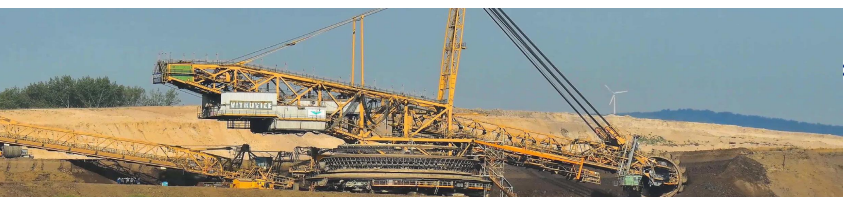
Wire rope holds the ground where heat, abrasion, crushing and system compatibility matter. Mobile crane hoists, mining electric shovels and draglines, tower crane falls and STS container crane hoist and trolley ropes all stay steel — I explain the STS case in my STS crane wire rope selection guide. The reasons are practical: brake drums run hot enough to degrade HMPE; multilayer spooling crushes synthetic rope far harder than steel strands; gritty, sharp-edged environments cut fibre; and the entire machine — drum diameters, groove profiles, fleet angles, socket terminations, the inspector’s checklist — was designed around wire. Wire rope’s lower initial price also matters when duty cycles are short or the equipment is near retirement anyway.
Can You Swap HMPE onto Existing Equipment? Not Diameter-for-Diameter
This is the question that lands in my inbox most often, and the honest answer is: sometimes, but never as a simple like-for-like swap. Before converting a winch or crane fall from wire to HMPE, work through this checklist — ideally with the rope manufacturer and, for classed vessels, the classification society:
Drum and sheave geometry — drum diameter, groove profile, pitch and fleet angle must suit the synthetic rope; HMPE generally wants bend ratios at least as generous as steel. Friction and spooling — the drum-to-rope friction coefficient differs from steel, which changes multilayer behaviour and winch torque settings. Heat — brake and drum operating temperatures must stay below HMPE’s limits. Terminations — sockets do not work on HMPE; spliced eyes or proprietary terminations are required, and they change the assembly’s rated capacity. Procedures — inspection criteria, retirement rules and crew training must all be rewritten; the ISO 4309 discard criteria a rigger knows by heart do not apply to synthetic rope. A conversion done properly is a small project; done casually, it is an incident report waiting for a date.
Safety: Snap-Back, Handling and Inspection
The most important safety difference between the two materials is stored elastic energy. A loaded wire rope is a spring: when it parts, the recoiling ends kill and maim experienced crews every year, and mooring-line snap-back zones are painted on every professional deck for exactly this reason. An HMPE rope under the same tension stores a fraction of that energy — when it fails, it typically drops instead of flying. Combined with the absence of barbs and fishhooks, this is why safety-conscious mooring masters have been the strongest advocates of the synthetic conversion.
Inspection is where the two materials part company philosophically. Wire rope inspection is codified — measured diameter loss, broken wires per lay length, corrosion and deformation, all graded against ISO 4309, which I cover in my ISO 4309 inspection and discard criteria guide. Internal damage remains the blind spot, sometimes requiring magnetic testing on critical ropes. HMPE inspection is mostly visual and tactile — surface fuzzing and abrasion, cut strands, heat glazing, splice slippage and, critically, permanent elongation as the creep clock — but the retirement criteria are less standardised, so the manufacturer’s guidance plus class-society rules must fill the gap.
| Application | My recommendation | Why |
|---|---|---|
| Vessel mooring lines | HMPE, covered, SK78-class for permanent systems | Weight, no corrosion, low snap-back; MEG4 alignment |
| Deepwater subsea lifting | HMPE (or hybrid wire/HMPE) | Self-weight of steel consumes payload and winch capacity |
| Tug towline / workboat winch | HMPE with chafe protection | Snap-back reduction; wire acceptable where chafe is controlled |
| Mobile crane main hoist | Wire rope 35×K7 / 35WXK7 | Heat at brakes, drum crush, mature standards |
| Mining electric shovel / dragline | Wire rope | Abrasion, heat and crush tolerance; proven discard criteria |
| STS container crane hoist / trolley | Wire rope | Multilayer spooling, sheave fatigue life, equipment design |
| Slings for hot-work environments | Wire rope sling at 5:1 | HMPE loses strength near welding heat — see my sling guide |
Total Cost of Ownership: Look Past the Price Tag
HMPE’s sticker shock is real — expect to pay roughly two to four times the wire rope price up front. The honest accounting happens over the rope’s life: no lubrication programme, no corrosion-driven replacements, lower transport and handling costs, and on lifting duties the payload or reach you gain from the lighter line. Many mooring operators report total service life two to three times that of the steel lines they replaced, which flips the arithmetic entirely. Wire rope fights back with its own strengths: near-universal availability, fast off-the-shelf replacement, and disposal value in scrap steel. My rule of thumb — for long-line, high-utilisation, salt-water duties, HMPE usually wins the lifetime cost comparison; for short lengths, abrasive workshops and existing steel-optimised machines, wire does.
The Bottom Line From a Rope Specialist
HMPE and wire rope are not rivals so much as complementary tools. Ask yourself five questions: How much does the line’s self-weight cost me? How hot and abrasive is the environment? Is the machine already engineered around steel? What do my crew’s hands and backs tell me? And can my inspectors and classification society support the retirement criteria for the rope I choose? Answer those honestly and the material choice makes itself. Aulone is a professional manufacturer and supplier of steel wire ropes, wire rope slings, synthetic ropes and rigging hardware for lifting, marine, mining, construction and industrial applications. With more than 20 years in the industry, an annual capacity of 200,000 tons, EN 12385-4 certification, ISO 9001 quality management, class approvals including BV, ABS, DNV and RMRS, and CE marking, we supply both sides of this comparison — certified wire ropes and HMPE synthetic ropes, in stock or built to order as custom assemblies with third-party testing on request. If you are weighing HMPE against wire for a specific winch, crane or mooring system, send the duty details to info@wireropes.net and I will help you run the numbers.
FAQ: HMPE Rope vs Wire Rope
Is HMPE rope stronger than steel wire rope?
Per unit of weight, yes — roughly 8 to 15 times stronger. Per unit of diameter, premium HMPE ropes match or exceed high-tensile wire rope, but their effective strength in service depends more on temperature, creep and abrasion history than wire rope does. Compare certified MBL of finished assemblies, never fibre-versus-steel brochure claims.
How much lighter is HMPE rope than wire rope?
At equal breaking strength, HMPE weighs about one-eighth of wire rope — an 80–87% weight reduction. For example, 100 metres of 40 mm 6×36 IWRC wire weighs around 640 kg; the equivalent HMPE rope is under 100 kg. That difference transforms deck handling, transport and deepwater payload.
What are the main disadvantages of HMPE rope?
Sensitivity to heat (strength loss above roughly 65–70°C continuous, melting near 147°C), vulnerability to cutting on sharp edges, long-term creep under sustained load, higher initial cost, and less standardised retirement criteria than wire rope’s ISO 4309 framework. None are dealbreakers, but each must be managed in the design.
Can I replace wire rope with HMPE on my existing crane or winch?
Not as a direct diameter-for-diameter swap. Drum and sheave geometry, groove profiles, friction and spooling behaviour, brake heat, terminations (splices instead of sockets) and inspection procedures all need review, and classed equipment needs approval. Treat it as a small engineering project with the rope manufacturer involved from the start.
How long does HMPE rope last compared with wire rope?
In corrosive marine service, HMPE commonly lasts two to three times longer than the steel wire it replaces because nothing rusts and there is no lubrication programme. In abrasive, high-temperature or crushing environments, wire rope outlasts HMPE. Service life follows the environment, not the material’s headline strength.
Does HMPE rope float?
Yes — HMPE fibre has a specific gravity of about 0.97, so the rope floats on water. Covers, coatings and attached hardware can change this, so if buoyancy matters to your operation (recovery lines, leader lines, propeller-fouling avoidance), confirm the floating behaviour of the complete assembly, not just the fibre.