The short answer: the default hoist rope for RTG and RMG container gantry cranes is hot-dip galvanized 6×36WS + IWRC at 1960 N/mm² — upgraded to compacted 6×K36WS + IWRC on high-cycle terminals — sized so the static rope pull sits inside a 5:1 design factor, spooled onto the multi-layer drum with a fleet angle under 2°, and retired per ISO 4309 with corrosion checks weighted harder than on any land-bound crane. If you are coming from tower cranes or truck cranes, the biggest mental shift is this: rotation-resistant constructions (35×K7, 35WXK7), which are heroes on those machines, are usually the wrong choice on a yard gantry. Multi-part reeving cancels torque naturally, and rotation-resistant ropes tolerate multi-layer drum spooling poorly. I have spent years supplying and troubleshooting ropes for port equipment, and this guide condenses what actually decides rope life on RTGs and RMGs.

What the Ropes Actually Do on a Gantry Crane
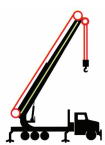
RTGs and RMGs are strategic yard assets: they shuttle containers between ships, trucks, trains and stacks, and the rope is the single component that does the lifting on every one of those moves. Before choosing a rope, be clear about which circuits your machine has, because they see very different duty:
| Rope circuit | What it does | Typical duty | What usually wins the spec |
|---|---|---|---|
| Main hoist rope | Raises and lowers the spreader and container through a multi-part reeving (commonly 4 to 10 falls) | Highest cycles on the terminal, 24/7, thousands of lifts per week | 6×36WS + IWRC or compacted 6×K36WS + IWRC, 1960 grade, galvanized |
| Boom / luffing rope (foldable-boom RTGs, some RMGs) | Raises and holds the boom for clearance when moving between rows or under STS cranes | Few cycles, high static load, long periods tensioned | 6×36WS + IWRC; check static tension and drum anchorage |
| Anti-sway / stabilizing ropes | Damp spreader swing for precise positioning | Continuous low-load cycling | Follow the crane OEM — often smaller-diameter flexible construction |
| Trolley traversing ropes (rope-trolley RMGs) | Pull the trolley along the girder instead of wheel drives | Very frequent reversals | OEM-specified flexible construction; watch bending fatigue |
The hoist rope is the one that matters most, and the one this guide focuses on. Get that call right and the rest of the machine usually behaves.
Why Yard Duty Punishes Rope
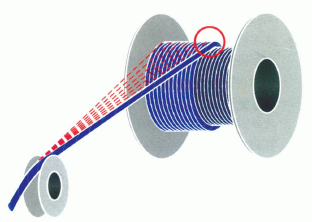
Three things make gantry crane duty harder than it looks on the datasheet. First, cycle count: an RTG stacking boxes can make 20–40 moves an hour around the clock — more bending cycles per week than most cranes see in a month. Second, multi-layer drums: yard cranes need huge rope lengths (high lift plus operating clearance) on short drums, so the rope spools in 3–5 layers and every layer crushes the one beneath it. A fibre core compresses under that stacking pressure, strands shift, and internal fretting eats the rope from the inside; an IWRC resists the crush and keeps strand geometry stable. Third, salt air: terminals sit in humid, chloride-laden atmospheres that creep past surface lubricant and start corrosion deep in the rope where you cannot see it. Fatigue, crushing and corrosion — add them up and you understand why a rope that lasts two years in a workshop can be done in six months in the yard.
Choosing the Construction
Here is how the candidate constructions compare for gantry hoist duty:
| Construction | Strength vs 6×36WS | Best for | Watch out for |
|---|---|---|---|
| 6×36WS + IWRC (standard) | Baseline | The safe default for nearly every RTG/RMG hoist | Nothing — it is the industry workhorse for a reason |
| 6×K36WS + IWRC (compacted strands) | +10–15% breaking force, smoother surface | High-utilization terminals where bending fatigue and drum crush are the life limiters | Slightly stiffer; needs correct D/d and honest re-lubrication |
| 8×K26WS + IWRC (compacted, 8-strand) | +15–20% breaking force | Heavy-duty RMGs and high-utilization RTGs specified by some OEMs | Match drum and sheave grooves to the flatter 8-strand profile |
| 6×19S + IWRC | Similar MBL, thicker outer wires | Boom and low-cycle circuits where abrasion dominates | Less fatigue-resistant — not for main hoist duty |
| 35×K7 / 35WXK7 (rotation-resistant) | Lower relative fatigue life on drums | Single-fall hooks (tower cranes, rig cranes) — not recommended for RTG hoists | Multi-layer spooling damages these constructions; multi-part reeving already balances torque |

Compacted or Not?
Compaction (the K in 6×K36WS) means the strands are rolled or drawn after stranding, flattening the outer wires and packing more steel into the same diameter. You gain 10–15% breaking force, a smoother bearing surface for sheaves and drum layers, and meaningfully better crush resistance — the three properties that multi-layer-drum, high-cycle gantry duty attacks first. The trade-offs are modest: a slightly stiffer rope, a groove that must actually fit the fuller profile, and a rope that is less forgiving of sloppy re-lubrication, because compacted strands hold lubricant differently. My rule of thumb: if your RTG runs more than about 15 loaded moves an hour, or your previous standard-construction ropes died of fatigue rather than abrasion, step up to compacted. The per-cycle cost usually wins.

The Core: IWRC Is Not Optional
On a gantry hoist, a wire rope core is mandatory. FC (fibre core) crushes under the drum stacking pressure and lets strands shift, which multiplies internal wear exactly where you cannot inspect it. IWRC keeps the rope round and dimensionally stable through years of multi-layer spooling. If your machine works in wet or slurry-adjacent conditions, ask about plastic-impregnated cores (EPIWRC), which seal the core against moisture and cushion internal contact stresses — they are a quietly excellent fit for coastal terminals.

Grade and Finish
Specify 1960 N/mm² as the default grade. Going from 1770 to 1960 buys you strength without growing the diameter — important on yard cranes where drum torque and sheave sizes are fixed. Higher grades exist, but the fatigue life benefit flattens out and brittleness creeps up, so I only move above 1960 when a retrofit genuinely needs the numbers. On finish: hot-dip galvanized, always, for anything near salt air. The small premium buys years of corrosion allowance; bright rope in a terminal is a false economy, full stop. (If you want the finish decision explained in depth, see our guide on galvanized vs bright vs stainless steel wire rope.)
Sizing the Rope: Design Factor and a Worked Example
Port cranes are conventionally designed around a 5:1 ratio between rope minimum breaking load and the static load on the rope, with the dynamic peaks of yard work folded into that margin. Here is how the arithmetic runs for a typical 40.6 t RTG with eight falls:
- Static tension per fall: 40,600 kg × 9.81 ÷ 8 falls ≈ 49.8 kN
- Dynamic allowance (acceleration, swing, off-centre picks): ×1.25 ≈ 62.3 kN
- Required MBL at 5:1 on the dynamic figure: 62.3 × 5 ≈ 312 kN
- Choose 24 mm 6×36WS + IWRC, 1960 grade: MBL ≈ 398 kN → actual margin ≈ 6.4:1 static, 5.1:1 dynamic — comfortable, with room for the inevitable wear.
| Diameter | MBL 6×36WS + IWRC, 1960 N/mm² (kN) | Approx. mass (kg/100 m) | Max single-fall load at 5:1 (kN) |
|---|---|---|---|
| 20 mm | 278 | 165 | 55.6 |
| 22 mm | 336 | 200 | 67.2 |
| 24 mm | 398 | 237 | 79.6 |
| 26 mm | 466 | 280 | 93.2 |
| 28 mm | 542 | 322 | 108.4 |
| 32 mm | 708 | 421 | 141.6 |
Two practical notes. First, always take the fall count from the actual reeving on your machine — an equalized 8-fall system and a 4-fall double-reeved system distribute load differently. Second, never fix a “rope keeps breaking” problem by jumping a grade: if the margin is that tight, the root cause is usually mechanical (grooves, fleet angle, misalignment), not rope strength. The deeper design-factor arithmetic lives in our breaking strength, MBL and safety factor guide.
Drums and Sheaves: Where Rope Life Is Actually Won
Most premature gantry rope failures are geometry problems wearing a rope costume. Three checks matter more than any others:
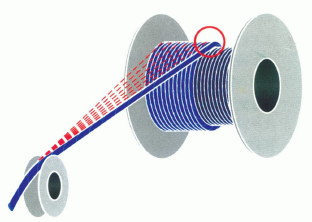
- Fleet angle. The rope entering the drum must stay within about 1.5° (grooved drums) to 2°. Beyond that, each wrap climbs the previous one, crushing and nicking at the crossovers. On RTGs the drum sits close to sheaves and the machine rolls — measure the angle with the crane positioned at its working extremes, not parked square.
- D/d ratio. A 6×36-class rope wants a sheave-to-rope diameter ratio of 25:1 or better; compacted ropes tolerate the low end of that band better than standard ones. Undersized sheaves multiply bending fatigue, and the fatigue zone concentrates wherever the rope repeatedly bends under the same tension.
- Groove condition. Grooves worn to a flat, or new rope run in old worn grooves, guarantee early damage. New rope, new (or re-machined) grooves — and check the crossovers on the drum first, because that is where the rope dies. Full geometry guidance is in our sheave and drum guide.
Installation Notes for Yard Cranes
RTG rope changes happen on a schedule between stack moves, so the installation has to be right the first time. Unreel in the rotation direction of the original winding — never off the side of a coil, which manufactures kinks for free. Maintain 2–5% of MBL back tension while spooling, or the first layers will be too loose and the upper layers will cut into them. Seize the rope on both sides before cutting it. Match the lay direction to the drum groove so the rope beds instead of climbing. After installation, break the rope in with light loads before full duty, expect roughly 0.25% constructional stretch on an IWRC rope, and re-tension the system once that stretch has settled — on multi-fall RTGs, an un-equalized reeving will quietly load one fall beyond its share. Our installation and maintenance guide covers the full procedure.
Inspection and Discard Criteria
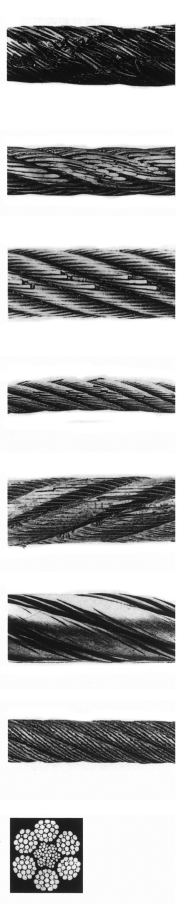
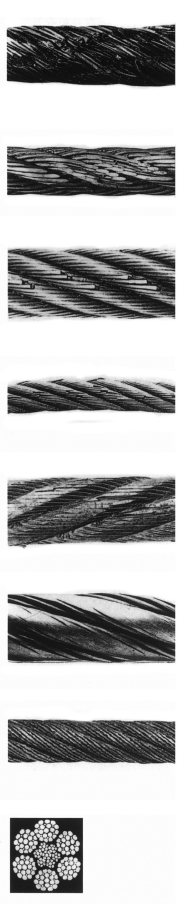
Inspect gantry hoist ropes to ISO 4309, but weight your attention to where this duty actually damages rope: the drum crossover zones (worked over every cycle), the equalizer sheave (which hides broken wires in a low-tension zone nobody looks at), and the sheaves nearest the spreader (maximum bending plus salt wash). A documented periodic inspection should walk the full rope; daily and weekly checks should hit the hot zones. Discard when any of these appear:
| Criterion | Threshold |
|---|---|
| Broken wires (6×36-class, ordinary lay, running rope) | 10 broken outer wires in one lay length (6d), or 19 in thirty lay lengths (30d) |
| Broken wire concentration | Clusters or valley breaks — wire breaks low in the groove signal core problems; retire early, do not wait for the count |
| Strand break | One strand broken = immediate retirement |
| Diameter loss | 7% below nominal diameter (measure with a caliper at several points) |
| Corrosion | Pitting, or brown dust in the valleys (internal corrosion) — treat as discard, internal rust does not negotiate |
| Distortion | Kinks, birdcaging, crush flats, waviness — any permanent deformation |
Living with Salt Air: Maintenance That Actually Helps
Terminal corrosion is a maintenance problem before it is a rope problem. Rinse the exposed rope with fresh water weekly if your climate allows — salt crystals pull moisture into the strand valleys and hold it there. Re-lubricate on a fixed interval (every 2–4 weeks or roughly every 5,000–10,000 cycles for a busy RTG) with a penetrating lubricant that reaches the core; a thick grease painted over a dry rope protects the outside of a rope that is rusting inside. Keep a rope log — installation date, meter count, inspection findings — because on a fixed-cycle machine like a gantry crane, life measured in moves is far more predictable than life measured in months, and the log turns replacement into planning instead of reaction.
Frequently Asked Questions
Can I use a rotation-resistant rope like 35×K7 on my RTG hoist?
Usually no. Rotation-resistant constructions exist to stop single-fall loads from spinning, but a gantry spreader hangs in multi-part reeving that already cancels torque. Meanwhile 35×K7-class ropes suffer on multi-layer drums and tolerate the crossover crushing of yard duty poorly. Reserve them for machines that genuinely hoist single-line — and follow your crane OEM’s specification when in doubt.
How long should an RTG hoist rope last?
Anywhere from about six months to two years plus, depending on utilization, climate and machine geometry. Counting moves beats counting months: terminals that log cycles and inspect against ISO 4309 on a fixed schedule replace rope at the right time, not after a failure forces it.
Why does my rope keep failing at the drum crossover points?
Crossover zones get every failure mechanism at once: crushing from the layer above, bending fatigue, and nicking if the fleet angle exceeds about 2°. Measure the fleet angle at the machine’s working extremes, check the groove pitch against the rope diameter, and verify spooling tension. If the geometry is right, the failures move from the crossovers to the normal fatigue zones — and rope life roughly doubles.
Is galvanized rope really necessary on an RTG?
Yes, in my experience. Yard cranes live in humid, salt-laden air, and corrosion inside the rope is invisible until it has already taken a third of the strength. Hot-dip galvanized rope with disciplined re-lubrication costs a small premium once and repays it in years of avoided early retirement.
Can I replace my gantry rope with a slightly different diameter or construction?
Only with the crane manufacturer’s approval. Diameter sets groove fit and drum capacity; construction changes torque, stretch and bend fatigue behaviour. The safe default is matching the original specification exactly — same diameter, construction, core and lay — and only deviating with an engineering sign-off.
What should I do if broken wires appear at the equalizer sheave?
Treat them seriously. The equalizer zone runs at low tension and hides damage from casual inspection, so broken wires found there usually mean the zone has been working undetected for some time. Inspect the full equalizer circuit, check sheave alignment and groove condition, and retire the rope early if the count is rising between inspections.
Getting the Rope Right from Day One
A gantry crane rope is a system: construction, core, grade, finish, drum geometry and maintenance interval all vote on the outcome. Aulone is a professional manufacturer and supplier of steel wire ropes, wire rope slings, synthetic ropes and rigging hardware for lifting, marine, mining, construction and industrial applications. With over 20 years in the industry, 200,000 tons of annual capacity, EN 12385-4 manufacturing under ISO 9001 and BV, ABS, DNV, RMRS and CE certification, we keep common port constructions in stock, cut to your drum length, and supply custom assemblies with third-party testing on request. If you are speccing rope for an RTG or RMG fleet — or troubleshooting a rope that keeps dying early — write to me at info@wireropes.net and I will help you match the rope to the way your terminal actually works.