Mining Wire Rope: How to Choose Hoist, Drag and Crowd Ropes for Electric Shovels and Draglines
By Andri — Technical Writer & Crane Rope Specialist, Aulone (www.wireropes.net)
The quick answer: the best mining wire rope for most electric rope shovels is a compacted, plastic-impregnated 8×K36WS-EPIWRC (or 6×K41WS-EPIWRC on the largest machines), with the 8×K36WS-EPIWRC family also the default for dragline hoist and drag ropes. If you remember nothing else: mining rope duty is dominated by shock loading, abrasion and crushing on multi-layer drums — so you buy a rope that packs more steel into the same diameter, keeps lubricant sealed inside, and tolerates repeated bending over boom-point sheaves. In this guide I’ll walk through each rope duty on a shovel and a dragline, explain why compacted and plastic-impregnated constructions dominate in mines, show you what different wear patterns reveal about your machine, and finish with a practical ordering checklist.
What Makes Mining Wire Rope Different From Crane Rope
I have supplied rope into both ports and mines, and the difference is easy to feel when you stand on a shovel deck. A port crane rope lives a comparatively gentle life; a mining rope is hammered every cycle. Four factors set mining duty apart. Shock loading: a dipper or bucket hitting solid ground, or a drag rope yanked through broken rock, spikes tension far above the static load — many times per minute, thousands of cycles per shift. Abrasion: quartz dust and sharp overburden grind the outer wires, so the rope loses diameter continuously. Crushing: shovel and dragline drums are multi-layer wound, and each upper wrap presses into the lower ones; a soft rope develops “masking” and core damage quickly. Downtime cost: when a hoist rope fails, the whole mine’s loading chain stops. That is why mines accept a higher rope price for measurably longer life — and why rope choice here is an engineering decision, not a catalogue lookup.
A useful mental model: on a crane you are often selecting for bending fatigue over sheaves (see my overhead crane rope guide); in a mine you are selecting for abrasion plus fatigue plus crush, and the constructions that win are usually the densest, most heavily lubricated ones available.
The Rope Duties on Shovels and Draglines — and What Each One Needs
Electric rope shovel ropes
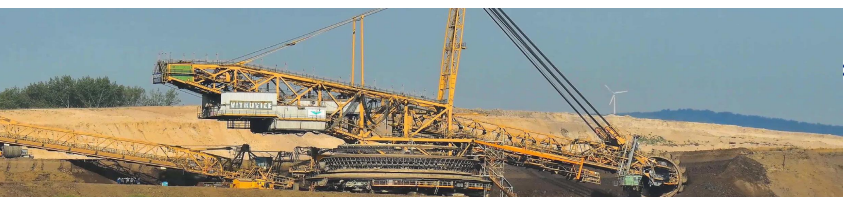
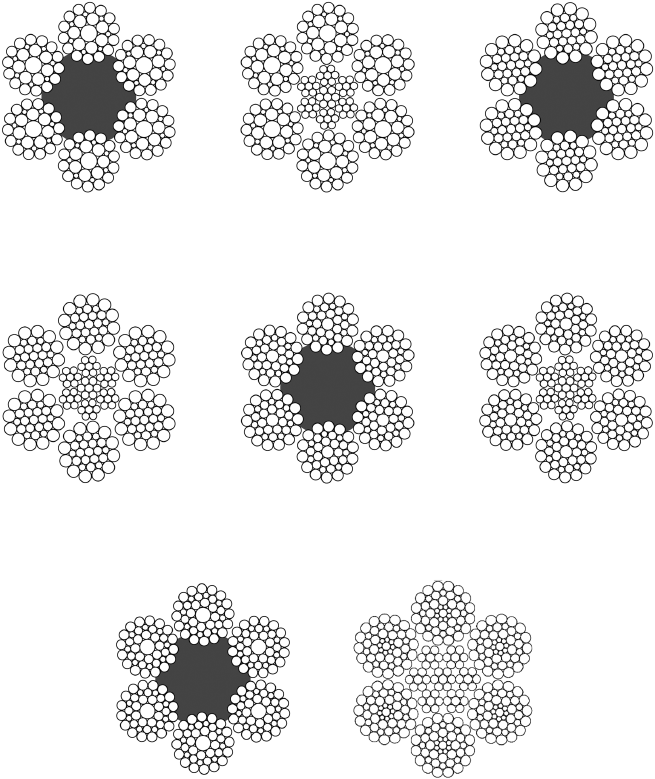
A modern electric rope shovel runs its power to the dipper through two or four parallel hoist ropes reeved over boom-point sheaves, and drives the dipper into the face with crowd ropes (on crank-driven machines) or rack-and-pinion (on newer designs). Hoist ropes see the full digging and breakout loads plus severe bending at the boom sheaves; the bail area of the dipper is also a known damage point where ropes meet rock. Crowd ropes see less bending but brutal abrasion and reversing tension. For both, the industry default has moved firmly to compacted, plastic-impregnated constructions: 8×K36WS-EPIWRC for hoist on most machines, 6×K41WS-EPIWRC where the OEM specification calls for it on large frames, and compacted 8×K36WS-IWRC variants for crowd duty.
Dragline ropes
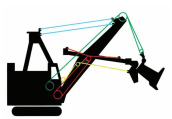
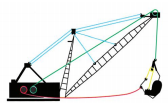
A walking dragline swings its bucket on three separate rope systems: hoist ropes raise the bucket from pit to spoil bank, drag ropes pull it through the pit toward the machine, and dump ropes tip the bucket for unloading. Because the bucket runs on the ground, drag and hoist ropes alike are punished by dragging through muck and repeated shock loads. There is a genuine engineering compromise here: drag ropes live best with maximum abrasion resistance and tolerance of plastic deformation of the outer wires, while hoist ropes also need bending fatigue life over the boom sheaves. As a general rule 8-strand compacted constructions (8×K36WS-EPIWRC) deliver the most cost-effective performance on most installations, with 6-strand heavy-duty ropes (6×K36WS / 6×49 type) preferred on some machines. Dump ropes can run a lighter flexible construction such as 6×K36WS.
| Application | Function | Recommended construction | Why it works |
|---|---|---|---|
| Shovel hoist | Raise/lower the dipper through breakout loads | 8×K36WS-EPIWRC, compacted + plastic-impregnated; 6×K41WS-EPIWRC on large machines per OEM spec | High fill factor resists abrasion and crush; plasticized core absorbs shock bending at boom sheaves |
| Shovel crowd / retract | Drive the dipper handle into the face | Compacted 8×K36WS-IWRC (or OEM-specified crowd rope) | Reversing tension + severe abrasion; compaction fights outer-wire wear and masking |
| Dragline hoist | Raise the bucket from pit to spoil bank | EP8XK36WS-EPIWRC / 8×K36WS-EPIWRC, compacted | Shock loads and multi-layer drum crushing demand a dense, well-cushioned rope |
| Dragline drag | Pull the bucket through the pit | 8×K36WS-EPIWRC or heavy 6-strand (6×49 class) | Maximum abrasion resistance and tolerance of outer-wire deformation take priority |
| Dragline dump | Tip the bucket for unloading | 6×K36WS-EPIWRC, compacted | Lighter, flexible rope for frequent, moderate loads |
| Pendants (shovel/dragline) | Static support of boom and gantry | Spiral strand, heavily galvanized (up to 400 g/m²), pre-stressed, socketed assemblies | No bending over sheaves — stability, low elongation and corrosion protection matter more than flexibility |
Treat the table as a starting point, not a substitute for your machine’s manual: OEMs such as Komatsu (P&H), Bucyrus and Liebherr specify constructions, diameters and groove geometry for a reason, and deviating from the specified diameter or lay direction can silently shorten rope life (more on that below).
Why Compacted and Plastic-Impregnated Ropes Win in Mines
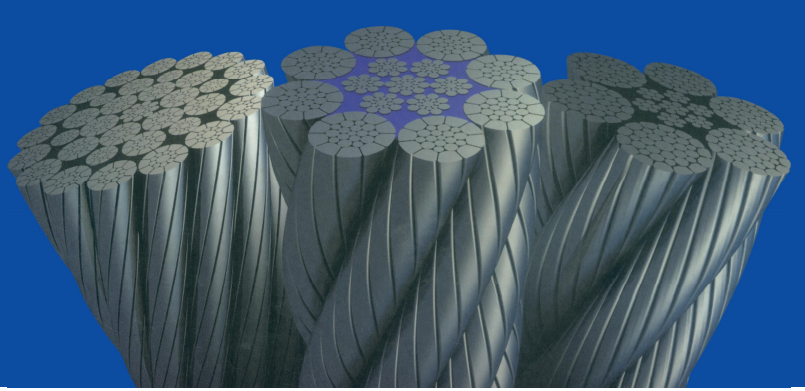
Two technologies explain most of the performance gap between an ordinary crane rope and a proper mining rope. Compaction means the strands are run through dies or rollers after stranding, pressing the wires tighter together and raising the rope’s metallic fill factor. You get roughly 10–15% more breaking force in the same diameter, a much denser outer surface that shrugs off abrasion, and better resistance to crushing between drum layers. Plastic impregnation (the “EPI” in EPIWRC) means a tough polymer layer is extruded between the steel core and the strands, and often between strand layers. It locks the factory lubricant in place, cushions the strands against each other, and dramatically reduces internal wear — the invisible killer in shock-loaded ropes.

| Property | Standard round strand IWRC | Compacted IWRC | Compacted + plastic-impregnated (EPIWRC) |
|---|---|---|---|
| Breaking force (same diameter) | Baseline | +10–15% | +10–15% |
| Abrasion resistance | Moderate — round outer wires wear quickly in quartz dust | High — flat, dense outer surface | High |
| Bending fatigue life | Baseline | Better (larger effective D/d tolerance) | Clearly better — polymer cushions strand-on-strand contact |
| Crush resistance (multi-layer drums) | Prone to masking and core damage | High | Highest — core is insulated against inter-layer pressure |
| Lubrication retention | Relies on field re-lubrication | Relies on field re-lubrication | Factory grease sealed in; field re-lubrication only supplements |
| Shock-load tolerance | Moderate | Good | Best available in conventional rope |
| Indicative cost | 1.0× | 1.2–1.4× | 1.3–1.6× |
That last row is the objection I always hear, and it deserves a straight answer: on a shovel or dragline, rope price is small against rope-driven downtime. If a plastic-impregnated compacted rope costs 40% more but lasts 60–100% longer in tons moved — which is what field experience typically shows in abrasive conditions — it is the cheaper rope by a wide margin. I cover the underlying strength numbers in my guide to wire rope breaking strength, MBL and safety factors.
Diameter, D/d and the Machine Geometry Trade-Off
Here is the trade-off OEMs wrestle with: increasing rope diameter generally improves fatigue life and damage tolerance, but a bigger rope demands bigger drums and sheaves, higher-torque motors and more structural mass. The rope, the drum and the machine design are one system. This has two practical consequences for the mine side of the table. First, never upsize a rope without checking the machine: a rope fatter than the groove design expects can ride badly, jam on the drum, or overload bearings. Second, never downsize to save weight — the specified diameter is the floor for the load cycle. What you can do at constant diameter is change construction: switching from a standard round-strand rope to a compacted rope of the same diameter is the single easiest performance upgrade, because it adds metallic area without touching D/d. Keep the classic D/d guidance in mind as well: for drum and boom-point sheave design, mining machines typically run D/d of 25:1 or better; smaller sheaves or worn, oversize grooves chew even the best rope prematurely.
How Mining Ropes Fail — and What the Wear Pattern Tells You
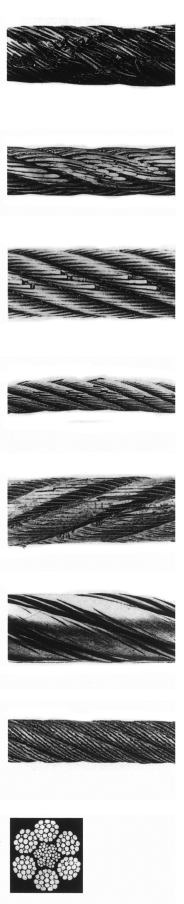
One of the most valuable habits I teach maintenance teams is to read the old rope before it goes in the scrap bin. Damage location and repeatability distinguish rope problems from machine problems: isolated damage tied to a specific operating event points to external causes, while the same wear pattern appearing on successive ropes points at the machine. The most common failure point on electric shovels, for example, is near the bail, where the rope meets rock contact and aggressive digging — remedies include improving blasting fragmentation, adjusting digging technique, or specifying ropes with protective sleeves installed at the factory.
| What you see on the rope | Most likely cause | What to do |
|---|---|---|
| Broken wires concentrated near the dipper bail / bucket attachment | Rock contact, aggressive digging, poor fragmentation | Rope guards or factory-fitted protection sleeves; improve blasting; adjust digging practice |
| Uniform flattening and wear of outer wires | Normal abrasion in overburden | Move to a compacted construction; monitor diameter loss against discard limits |
| Fatigue breaks at repeated spacing along the rope | Bending fatigue at boom-point sheaves — tight D/d or worn/oversize grooves | Check groove radius and alignment; re-machine or replace sheaves; confirm OEM diameter |
| Crushing, masking or step formation on drum wraps | Multi-layer spooling: low winding tension, wrong drum lagging, cross-over damage | Correct spooling tension and fleet angle; consider a plastic-impregnated rope |
| Internal wear, dark grit between strands, corrosion bleed | Loss of internal lubrication | Switch to plastic-impregnated rope; establish field re-lubrication program |
| Sudden diameter reduction, birdcage or loose strands | Shock overload or momentary snag | Retire immediately; review operating technique and machine condition |
When a pattern repeats on consecutive ropes at the same location, escalate to the machine: boom-point sheave alignment, drum grooving and suspension geometry are usually the real culprits. For the formal retirement side — broken-wire counts per lay, diameter reduction limits, corrosion and deformation criteria — my guide to wire rope inspection to ISO 4309 walks through the discard criteria in detail; the same logic applies to mining rope, with diameter loss and internal corrosion being the items I check most carefully on shovels.
Pendants: The Static Side of the Machine
Boom and gantry pendants are a different animal: they barely move, so flexibility hardly matters — what matters is stability and corrosion protection. That is why pendants are typically spiral strand ropes, heavily galvanized (up to 400 g/m² of zinc), pre-stressed at the factory and supplied as socketed assemblies. Pre-stressing removes most constructional stretch, so the machine holds its geometry after installation, and factory-terminated sockets mean the mine fits a complete assembly instead of pouring sockets on site in the dust. If your supplier can deliver pendants cut to length with open spelter sockets fitted and proof-tested, take that option every time.
Ordering Mining Rope: My Checklist
When a mine sends me an enquiry, the fastest path to the correct rope is a complete specification. Before you request a quotation, have these ready:
1. Machine identity: manufacturer, model and serial number (e.g. Komatsu/P&H 4100 series, Bucyrus 495, Liebherr R 9800) — OEM rope data follows from this. 2. Position: hoist, drag, dump, crowd or pendant; they are rarely interchangeable. 3. Exact specification: nominal diameter, construction, core, finish (bright or galvanized), lay and preformation per the OEM drawing. 4. Length and reeling: cut length, drum capacity, and delivery on steel reels for safe site handling. 5. Documentation: EN 12385-4 compliance, a 3.1 mill certificate per batch, and ISO 9001-backed production records; class certificates such as BV, ABS, DNV or RMRS where procurement policy requires them. 6. Support items: sockets, rope guards, protection sleeves, and whether you want the rope supplied as a complete socketed assembly.
Aulone is a professional manufacturer and supplier of steel wire ropes, wire rope slings, synthetic ropes and rigging hardware for lifting, marine, mining, construction and industrial applications. Aulone has over 20 years in the industry, an annual production capacity of 200,000 tons, EN 12385-4 certification, ISO 9001 quality management and CE marking, with class approvals including BV, ABS, DNV and RMRS. Standard mining constructions such as 8×K36WS-EPIWRC, 6×K41WS-EPIWRC and EP8XK36WS-EPIWRC are available with stock in common diameters, and custom assemblies — cut lengths, factory sockets, protection sleeves, pre-stressed spiral strand pendants — can be built with third-party testing on request. Send your machine model and rope schedule to info@wireropes.net and we will come back with a matched specification.
FAQ: Mining Wire Rope
What wire rope construction is best for an electric rope shovel?
For hoist duty, a compacted, plastic-impregnated 8xK36WS-EPIWRC is the industry default, with 6xK41WS-EPIWRC specified on some large machines. For crowd/retract duty, a compacted 8xK36WS-IWRC is typical. Always confirm the exact construction and diameter against the OEM rope drawing before ordering.
Why are 8-strand ropes usually preferred over 6-strand on draglines?
Eight-strand constructions put slightly smaller outer wires under the wear surface, which spreads abrasion and improves resistance to plastic deformation of the outer wires — the dominant failure mode on drag and hoist ropes dragging through muck. As a general rule 8-strand ropes deliver the most cost-effective performance, though 6-strand heavy ropes are preferred on certain installations.
What does EPIWRC mean and why does it matter in mining?
EPIWRC stands for Elongated/Plastic-Impregnated Wire Rope Core: a polymer layer is extruded between the steel core and the strands. It seals factory lubricant inside the rope, cushions strand-on-strand contact and dramatically reduces internal wear. On shock-loaded, multi-layer-drum machines like shovels and draglines, it is the single most effective fatigue-life upgrade available at constant diameter.
How long should a shovel hoist rope last?
There is no calendar answer — life is measured in operating hours and, more honestly, in tons moved, and it varies with material hardness, blasting quality and operator technique. Best practice is to monitor diameter loss, broken-wire counts per lay and bail-area damage against ISO 4309 discard criteria, and trend rope consumption per machine. A wear pattern that repeats on successive ropes points to a machine problem, not a rope problem.
What safety factor applies to mining hoist ropes?
Mining excavator hoist ropes are typically specified by the OEM with design factors in the region of 4:1 to 5:1 against rope breaking load, depending on the duty and local regulations. The certified minimum breaking load (MBL) on the mill certificate is the number to divide, never an estimated strength. See my guide to wire rope breaking strength and safety factors for how design factors work.
Where can I buy replacement ropes for mining shovels and draglines?
Buy from a manufacturer who can match the OEM specification, certify to EN 12385-4 with 3.1 mill certificates, and supply complete socketed assemblies and protection sleeves. Aulone manufactures and stocks mining rope constructions such as 8xK36WS-EPIWRC and 6xK41WS-EPIWRC, builds custom cut lengths and pendants with third-party testing available, and ships on steel reels for safe site handling — contact info@wireropes.net with your machine model and rope list.