The short answer: YB/T 6449-2026, Steel wire rope — Method for
determination of actual residual stress, became effective on 1 November 2026. It is the
first Chinese industry standard that tells a wire rope manufacturer — or a crane rope buyer
— how to measure the stress that is already locked into the steel before the rope ever
carries a load. Two methods are defined: a rope-end observation method for macro residual
stress, and a full release strain method for micro residual stress. Neither is a pass/fail
certification for the rope. Both are prediction tools, and the standard says so plainly: the
measured values are for reference only.
For twenty years the Chinese wire rope industry measured what a rope could do. Tensile
strength, breaking force, lay length, mass per metre — all of it ends up on a data sheet
and a certificate. What nobody could put a number on was the stress sitting inside the wires
themselves, left over from drawing, stranding and closing. That number was always the
unexplained variable in fatigue life. As of 1 November it has a method, a name and a
national industry standard behind it.
What the New Standard Actually Says
YB/T 6449-2026 is a black metallurgy industry standard (YB series) issued by the Ministry
of Industry and Information Technology and administered by the National Technical Committee on
Steel Standardization. It was published on 16 April 2026 and took effect on 1 November 2026.
The drafting unit list is worth reading, because it tells you who actually had to build the
method: a municipal product quality supervision institute, a wire rope manufacturer, a
metrology institute, a special equipment inspection institute and the metallurgical industry
information research institute. This is a standard written by people who had to make the
measurement work on a real production line.
Table 1 — YB/T 6449-2026 at a glance
| Item | Detail |
|---|---|
| Standard number | YB/T 6449-2026 |
| Title | Steel wire rope — Method for determination of actual residual stress |
| Type | Recommended black metallurgy industry standard (YB) |
| Issued by | Ministry of Industry and Information Technology |
| Administered by | National Technical Committee on Steel Standardization |
| Published | 16 April 2026 |
| Effective | 1 November 2026 |
| ICS classification | 77.140.65 ( wire, wire rope and link chain ) |
| China standard class | H49 |
| Referenced standards | GB/T 43357, GB/T 7704, GB/T 8170, GB/T 8706, JJG 623-2005 |
| Leading drafting units | Nantong Product Quality Supervision Institute; Maanshan Falersen Technology; Nantong Metrology Verification Institute; Henan Special Equipment Inspection Institute; Metallurgical Industry Information Standardization Institute |
| Status of the result | For prediction and reference only — not an acceptance criterion |
Why Residual Stress Decides How Long a Crane Rope Lasts
Every wire in a wire rope is drawn through a series of dies to reach its final diameter.
Cold drawing is what gives rope wire its strength — typically in the range of 1,570 to
2,160 MPa for rope grades — but it leaves a metallurgical bill behind. The crystal lattice
is distorted, dislocations pile up, and the outer fibres of the drawn wire carry residual
tensile stress. That stress then stacks on top of everything the rope sees in service: the
bending imposed as the wire takes its natural shape in the rope, the bending again over
sheaves and drums, and the working tensile load. The sum is where fatigue cracks start.
The practical consequence is not abstract. In work published through the OIPEEC, a
1.1 mm cold-drawn stainless wire showed a peak tensile residual stress of 369 MPa in
its mid-section. By manipulating the residual stress state — bringing that mid-section
figure down to 77.9 MPa and imposing a compressive residual stress of 209 MPa on the
wire surface — the resulting 12.7 mm 6×36 WS rope reached a
strength-to-weight ratio 20 per cent higher than a standard rope of the same diameter,
and its reverse-bend fatigue cycles to failure rose by 65 per cent. Same construction, same
diameter, same nominal breaking force on the certificate. A different stress state inside the
wire.
This is why rope makers have used stress relieving — typically induction heating of the
strand or the finished rope — for decades. A well-known handbook on winch technology puts
it plainly: removing the residual tensile stress left in the outer fibres of a drawn wire lets
the wire carry the imposed service loads with more margin, and raises the elastic limit, the
yield strength and the modulus of the rope as a whole. The measurable gain is fatigue life,
and fatigue life is what decides whether a 30 mm hoist rope on a tower crane lasts three
years or eight.
There is a second, more visible consequence. Residual stress and the torsional stress
introduced by stranding are exactly why a cut rope end springs open and the strands unravel
unless the end is secured. Rope that has been manufactured to release that stored energy
behaves better after cutting: the strands stay in place, the lay length holds, and the
structure does not open up during a termination. Chinese technical literature on
non-unfastening (non-loose) rope records a fatigue improvement of roughly 40 per cent
over ordinary rope when both residual stress and stranding stress are removed.

The Two Methods, Side by Side
The standard separates the problem into two kinds of residual stress and gives each its own
procedure. This is the single most useful thing about the document, because the two are
measured in completely different places and answer completely different questions.
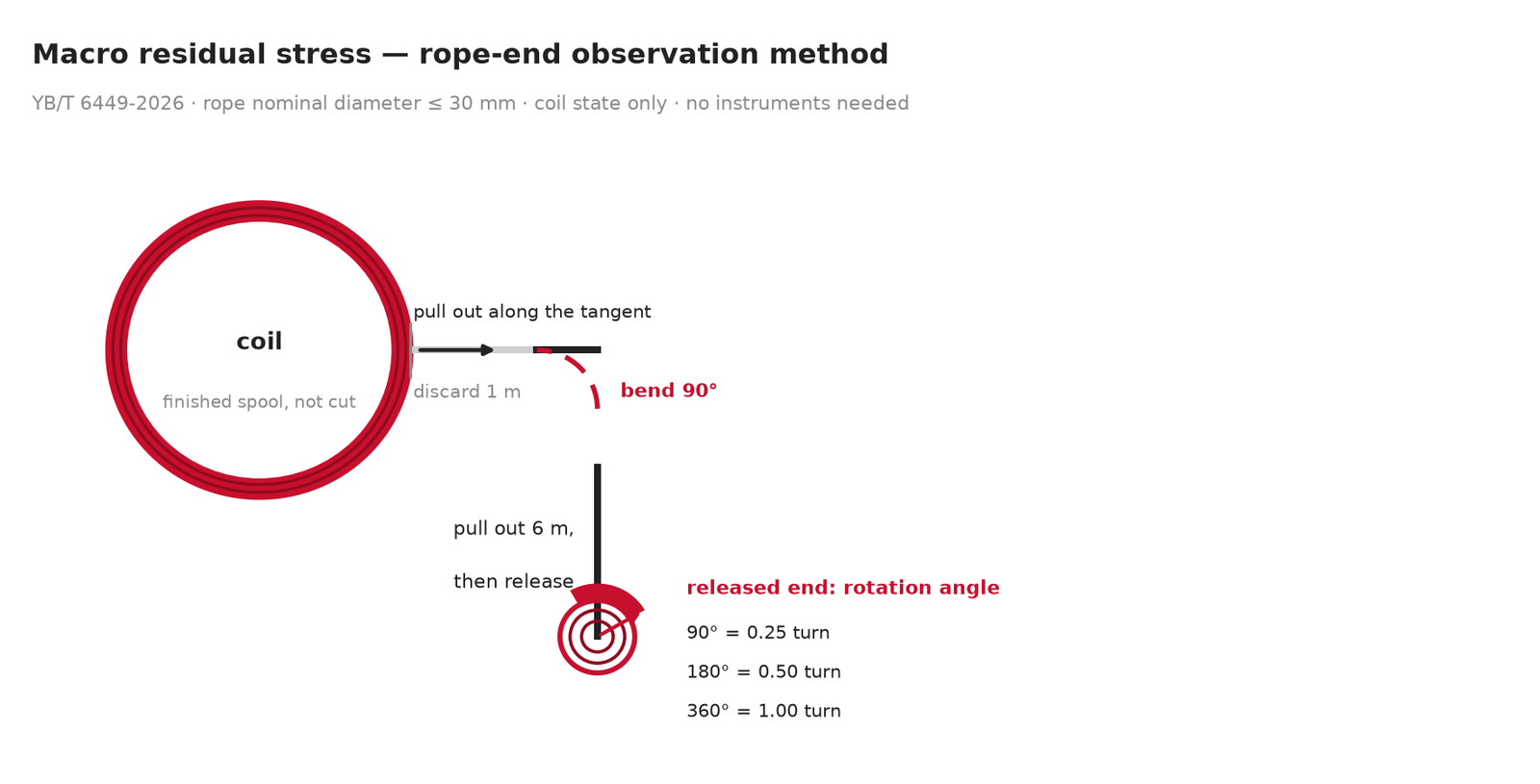
Macro residual stressis the stress that makes a whole rope, or a long length
of it, behave as a bent or twisted body. It is the stress you can see in the way a rope end
twists. The method is deliberately crude and deliberately portable: pull the rope from the
coil along the tangent, discard the first metre, bend the rope through a right angle, pull out
six metres, let it go, and measure the rotation of the released end. Ninety degrees equals
one quarter of a turn, 180 degrees equals half a turn. Rotation in the same sense as the
lay is positive, rotation against it is negative. No instruments are needed at all, which means
it can be done on a dock, in a workshop or in a mine shack.
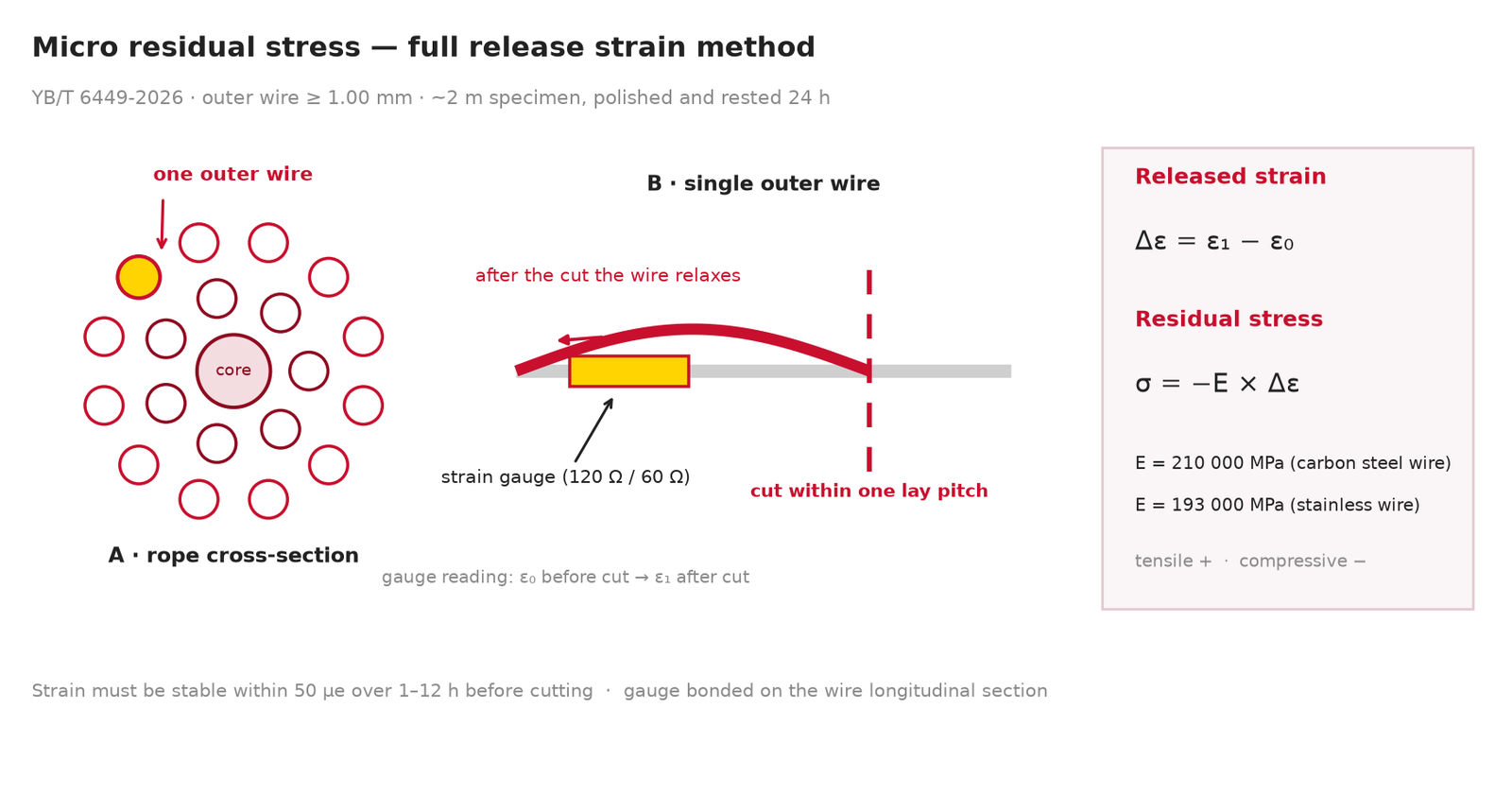
Micro residual stressis the stress living inside the crystal structure of a
single wire, caused by lattice distortion and dislocations. This one is a laboratory method. A
strain gauge is bonded to the longitudinal section of an outer wire, the reading is allowed to
stabilise, and then the wire is cut within one lay pitch of the gauge. The strain the wire
releases as it relaxes is the measurement. The released strain is the difference between the
reading before and after the cut, and the residual stress follows from Hooke’s law with a
modulus of 210,000 MPa for carbon steel wire and 193,000 MPa for stainless steel
wire. Tensile is positive, compressive is negative.
Table 2 — The three determination methods in YB/T 6449-2026
| Feature | Macro: rope-end observation | Micro: full release strain | X-ray diffraction (appendix) |
|---|---|---|---|
| Principle | Bend the rope end and let it spring back; observe the rotation | Bond a strain gauge, cut the wire, measure the released strain | Measure the change in lattice spacing |
| Applies to | Rope of nominal diameter 30 mm and below | Rope with outer wire diameter of 1.00 mm and above | Strands separated from the rope |
| Specimen | Finished coil, not cut | About 2 m, cleaned, polished and rested 24 h | At least one lay pitch, kept in original condition |
| Equipment | None — manual observation | Strain measuring instrument, 120 Ω or 60 Ω gauges, cutting machine, analysis software | Micro-area X-ray residual stress instrument |
| Result | Rotation in turns, to 0.25 turn, signed by direction | Stress in MPa, tensile positive and compressive negative | Stress in MPa |
| Main limitation | Coil state only; qualitative or semi-quantitative | Complex: gauge bonding, then cutting | Requires strand separation; spot size needs adjusting on a curved surface |
There is an appendix method as well. The X-ray diffraction approach measures the change in
crystal lattice spacing and works on strands separated from the rope, or on wire before
stranding. It needs specialist equipment, so it sits in the appendix rather than in the main
body, but it is the method that gives a true micro-level picture, and it is the one that
underpins the OIPEEC work quoted earlier.
What This Changes in a Factory
Here is where the standard gets practical. It does not tell a manufacturer what residual
stress a rope should have, because there is no universal number. What it does is make the
measurement reproducible, which means the process variables that create residual stress can now
be controlled against something instead of by reputation.
Three of those variables dominate. The drawing routesets the initial residual
stress in the wire, which is why stress relieving and non-unfastening rope construction exist
at all. The stranding and closing tensionsets how much torsional stress the
rope carries, and this is the reason a rope that sits on a drum for a year may behave
differently from the same rope fresh off the line. The spooling tension at the coilis the macro term: a rope wound too tight and then pulled straight will visibly rotate, and
under the new standard that rotation is a number with a defined reading method rather than a
complaint.
For a crane rope buyer, the practical change is that residual stress has moved from the
colloquy into the documentation. When a manufacturer in China reports residual stress state as
part of its quality data, it is reporting against a national standard method with a defined
scope, a defined specimen and a defined unit. That is a materially stronger statement than a
supplier saying the rope was well made.
What Export Buyers Should Ask For Now
There is no obligation here for a buyer outside China. YB/T 6449-2026 is a Chinese industry
standard, and it is a recommended one. But the direction of travel is clear, and the argument
for asking is straightforward: residual stress is the variable that separates two ropes with
identical certificates on breaking force, and it is the variable that governs fatigue life,
which is the actual failure mode on a crane.
Four questions are worth putting to a supplier, and all four are answerable.
Ask which method was used.The macro rope-end observation method and the
micro full release strain method answer different questions. A supplier quoting a rotation in
turns has done the macro test. A supplier quoting stress in MPa has done the micro test or
X-ray diffraction. Both are legitimate, but they are not interchangeable, and the unit tells
you which one you are looking at.
Ask for the specimen condition.The macro result is only valid for a rope in
coil state and only for rope of 30 mm nominal diameter and below. For the larger
diameters used on mining hoists, STS cranes and long-lift crawler applications, the micro
method or X-ray diffraction is the only route. A supplier quoting a coil-state rotation for a
45 mm rope has quoted you something outside the standard’s scope.
Ask what the value means in service.The standard is explicit that measured
values are for reference only. They are for prediction, not acceptance. A supplier who
certifies a rope on residual stress alone is overstating what the standard does, and you should
ask what else is being certified alongside it — tensile strength, breaking force, lay
length, diameter tolerance, surface condition.
Ask whether the rope is stress relieved or made to a non-unfastening construction.This is the question with the clearest payoff in service, because it is the question that maps
directly onto fatigue life and onto how the rope behaves after cutting.
The Export Picture Is Tightening at the Same Time
There is a second regulatory clock running for anyone shipping lifting products into the
European Union, and it lands in the same window. Regulation (EU) 2023/1230, the new Machinery
Regulation, becomes fully applicable on 20 January 2027, replacing Directive
2006/42/EC. Unlike the old directive, there is no transitional period for machinery placed on
the market from that date, and the regulation applies directly in every member state without
national transposition.
Two points matter for wire rope. First, the scope explicitly names chains, ropes and
webbing alongside lifting accessories and safety components. Second, the list of high-risk
machinery in Annex I is wider than the old Annex IV, and anything on it requires notified body
involvement in the conformity assessment rather than self-declaration. The new regulation also
extends what counts as a substantial modification to include digital changes, which pulls
existing plant and lifting equipment into scope when it is reconfigured.
For a rope manufacturer supplying crane and lifting applications into Europe, the effect is
mostly documentary rather than metallurgical. The technical file, the declaration of conformity
and the harmonised standards used have to line up with the regulation from January 2027, and
EN 12385-4 remains the standard that crane rope is made to. Practically, it means asking a
supplier to confirm which conformity route they are working under, and to be able to supply
the supporting documentation without a special request.
Three Things Buyers Should Do Now
1. Add residual stress to the enquiry, not just to the certificate.Ask which
method was used, on what specimen, and for what nominal diameter range. You are not asking for a
pass mark. You are asking the supplier to show that the variable is under control. Keep the
existing requirement for EN 12385-4 or API 9A compliance exactly as it is.
2. Pair the residual stress data with the fatigue evidence.A residual
stress value on its own says little. A rope that is stress relieved, or built to a
non-unfastening construction, and backed by reverse-bend or bending-over-sheave fatigue test
results, says considerably more about service life. Ask for the fatigue test data at the
diameter and construction you are actually buying.
3. Get the documentation ready for 20 January 2027.If you place
machinery, lifting accessories or rope assemblies into the EU market, check now which conformity
route your suppliers are working under, and confirm that the technical file and declaration of
conformity will be available when the Machinery Regulation becomes mandatory.
For the Chinese side of this, Aulone — Changsha Aulone Construction Machinery Co., Ltd.
— has manufactured crane wire rope and rope assemblies for more than twenty years, with
200,000 tonnes of annual capacity across four production lines. The crane and
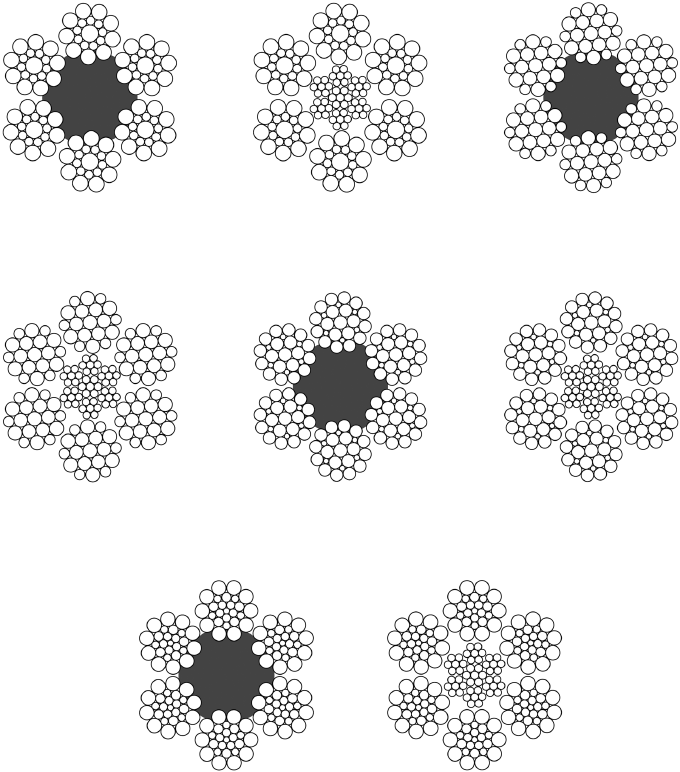
rotation-resistant range covers 35WXK7 (35W× K7), 8XK26WS (8× K26WS), 6XK36WS (6× K36WS), 19X7
(19×7), 15XK7 (15× K7) and 4V×39W, in hot-dip galvanized and plastic-impregnated (EPIWRC) finishes,
from 3 mm to 300 mm, with fused, ferrule, thimble and socketed terminations built to
order. Certification covers EN 12385-4, ISO 9001, BV, ABS, DNV, RMRS and CE, and third-party
testing can be arranged before shipment — including residual stress determination under
YB/T 6449-2026 where a buyer specifies it.
Website: www.wireropes.net Email: info@wireropes.net
Frequently Asked Questions
Does YB/T 6449-2026 replace EN 12385-4 or API 9A?
No. It covers a different property entirely. EN 12385-4 and API 9A define the design,
manufacturing, testing and discard requirements for wire rope for lifting appliances and
drilling lines. YB/T 6449-2026 defines how to measure residual stress. A crane rope still has
to comply with the standard that applies to its use; the new Chinese standard tells you
something about the rope that those standards do not.
Does a low residual stress mean a better rope?
Not on its own. The standard states that measured values are for reference only and are
intended for prediction. Residual stress is one variable among many, alongside construction,
core, lay, grade, lubrication and service condition. What a residual stress value does is
confirm that the variable was measured, under a defined method, and is under control in
production.
Can a crane rope over 30 mm be tested under this standard?
Not with the macro rope-end observation method, which is limited to rope of 30 mm nominal
diameter and below in coil state. Larger diameters are covered by the micro full release strain
method, or by X-ray diffraction on separated strands. Steel cord, steel strand, wire and wire
rod may also refer to the method.
What is the difference between macro and micro residual stress?
Macro residual stress is the stress that makes a rope or a long section of it bend or twist as
a whole, and it is read as a rotation of the released rope end. Micro residual stress is the
stress inside the crystal structure of a single wire, caused by lattice distortion and
dislocations, and it is read as a stress value in MPa from the strain a wire releases when it
is cut.
Does the standard set an acceptance limit?
No. It sets methods, specimen preparation, instruments, test procedure, data handling,
application guidance and reporting requirements. It deliberately stops short of a pass or fail
threshold, because the appropriate value depends on the construction and the duty.
How does this relate to the EU Machinery Regulation?
They address different things but land in the same period. Regulation (EU) 2023/1230 becomes
mandatory on 20 January 2027 and explicitly brings chains, ropes and webbing within scope,
with a wider notified-body list and stricter documentation. YB/T 6449-2026 gives the
manufacturing side a measured variable to report. One is a compliance route, the other is a
quality variable, and a supplier that handles both is easier to buy from.