Marine Towing Wire Rope: A Practical Guide to Towlines, MBL Ratios and Pendants for Tugs
By Andri — Technical Writer & Crane Rope Specialist, Aulone (www.wireropes.net)
The short answer: for most harbour, coastal and terminal towing the workhorse is a galvanized 6×36WS+IWRC in right-hand ordinary lay, sized so the rope’s minimum breaking load (MBL) is at least 3.0× the tug’s continuous bollard pull when BP is under 40 tonnes — the baseline set by the IMO Guidelines for Safe Ocean Towing. Powerful ocean-going tugs work to progressively lower ratios (about 2:1 above 90 tonnes BP), but must compensate with tougher constructions, better corrosion protection and disciplined inspection. Terminations are hard eyes — spelter sockets or reinforced thimbles — all hardware is rated at least 50% above the rope’s MBL, and a complete spare towline travels on board. In this guide I’ll walk through how I size and specify towing rope for tug operators, what the constructions actually cost and deliver, and the inspection rules that keep a towline legal and alive.
What a Towing Rope Endures That a Crane Rope Never Sees
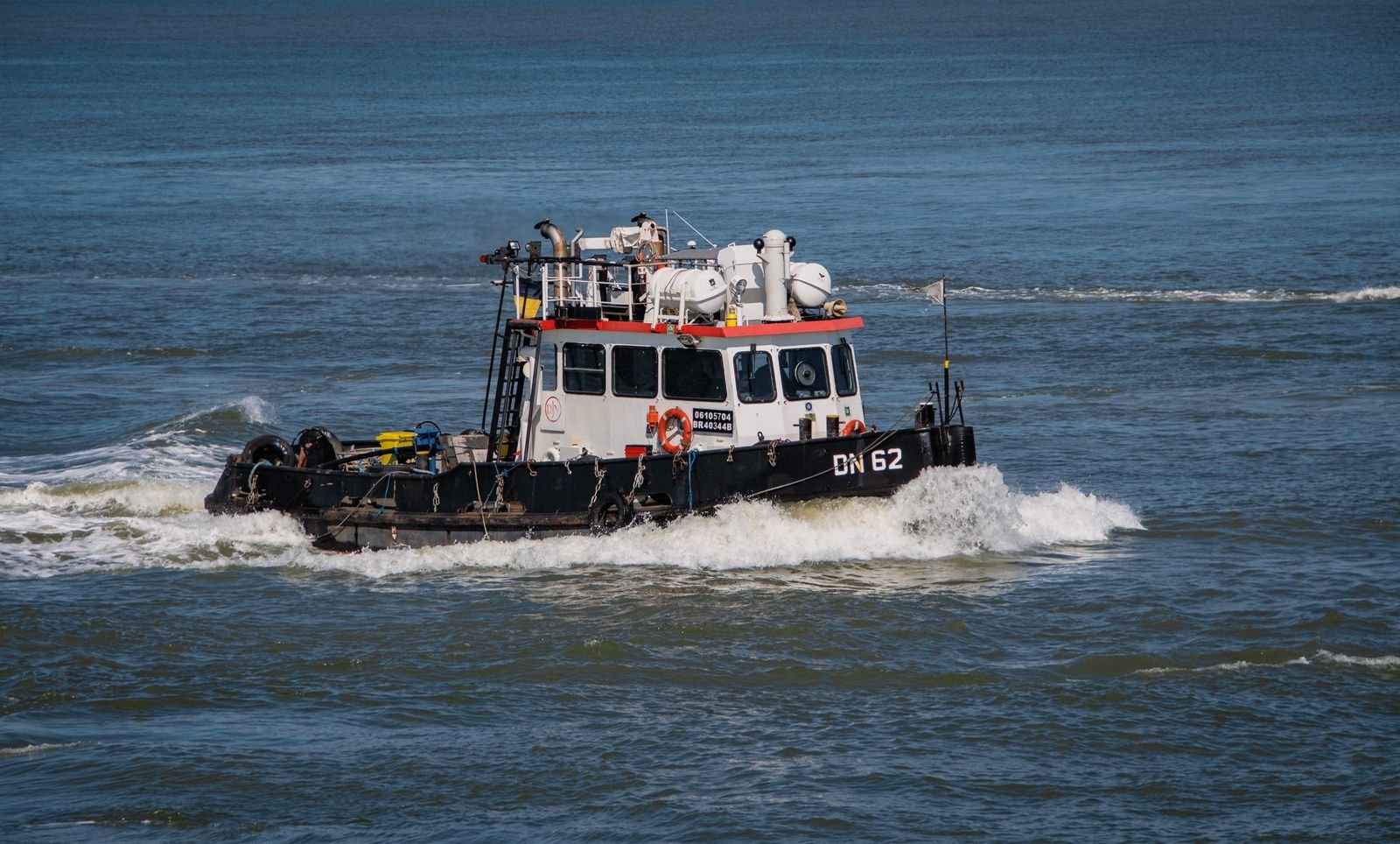
I supply ropes into both markets, and the duty profiles barely overlap. A crane rope bends over sheaves under a load the operator controls. A towing rope spends its life somewhere between slack and snap: snatch loads when the tow surges in a following sea, chafe at the stern roller, fairleads and staple, saltwater corrosion working into the core, and long static periods under tension that let sea water wick into any imperfect termination. The towline is also, quite literally, the link between a multi-million-dollar tug and the vessel in her care — when a towing wire parts under load, the stored energy in the line makes the recoil itself dangerous, which is why personnel stay clear of the working deck while the line is loaded.
A complete towing system is more than one rope: the main towline on the winch drum, a towing pennant (pendant) at the working end that takes the worst chafe and is treated as a consumable, connecting hardware, and on many tugs a gog rope to control athwartship pull and help retrieve the line. Every component should be specified together — a mismatched shackle or a soft eye at the wrong place will retire an otherwise healthy rope early.
Sizing the Rope: Bollard Pull, the IMO MBL Ratios and Towline Length
The industry’s common reference is the IMO Guidelines for Safe Ocean Towing, which ties the towline’s minimum breaking load directly to the tug’s certified continuous bollard pull. The ratios step down as tugs get more powerful, because absolute line loads grow faster than practical rope sizes:
| Tug bollard pull (BP) | Minimum towline MBL (IMO guideline) | Worked example |
|---|---|---|
| Under 40 t | 3.0 × BP | 40 t BP → MBL ≥ 120 t |
| 40–90 t | (3.8 − BP/50) × BP | 50 t BP → (3.8 − 1.0) × 50 = 140 t MBL |
| Over 90 t | 2.0 × BP | 150 t BP → MBL ≥ 300 t |
Length matters as much as strength: a longer line absorbs surge, keeps snatch loads off the winch, and gives room to manoeuvre. Where no project-specific criterion exists, the IMO baseline for main towline length is L = (BP / BL) × 1800 m, with BP in tonnes of continuous bollard pull and BL the rope’s documented breaking load. Practical note from my side: harbour tugs often work far shorter lines for ship assist, while an ocean tow of a barge or rig routinely runs 600–1000 m of wire — and every metre must spool properly on the drum, which brings us to construction.
Two connected rules from the same guidelines: every connecting item — shackles, rings, bridles — must have an ultimate load capacity at least 50% above the towline MBL, and a complete spare towline must be carried, preferably spooled on the winch’s second drum. If you want the full background on how MBL, safety factor and working load limit fit together, I cover it in my wire rope breaking strength and MBL guide.
Choosing the Construction: 6×36 Class, Compacted Rope and Grommets
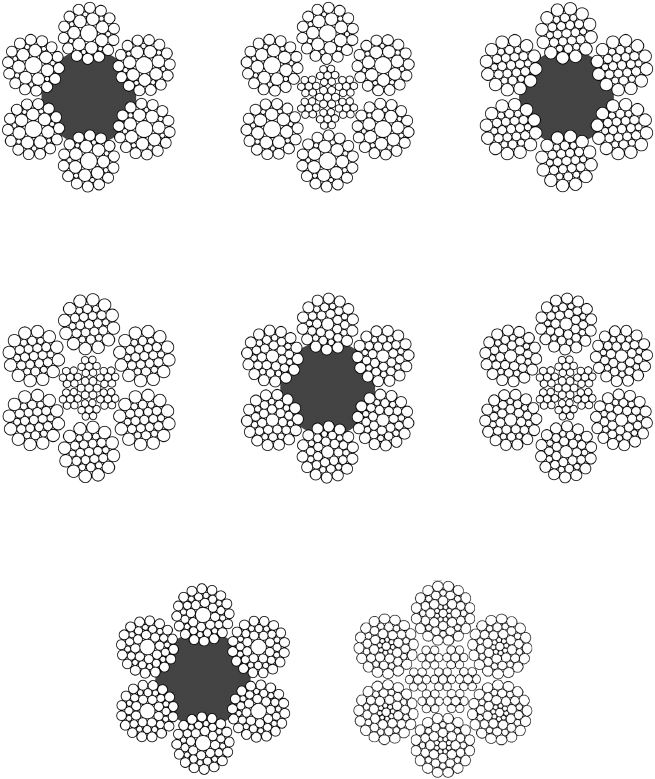
Towing does not reward exotic choices; it rewards the right balance of fatigue resistance, abrasion resistance and crush behaviour on the drum. The constructions I specify most often:
| Construction | Best suited to | Why I specify it |
|---|---|---|
| 6×36WS + IWRC, galvanized, right-hand ordinary lay | Harbour, terminal and coastal tugs; general ocean towing | The balanced all-rounder: filler/Seale/Warrington layout gives good bending fatigue on sheaves and rollers, IWRC resists crushing on multi-layer drums |
| Compacted 6×K36 with plastic-impregnated IWRC | Ocean tows, AHTS winch lines, deep-water projects | Compaction raises breaking force and wear life in the same diameter; the plastic-impregnated core seals out sea water and kills internal fretting |
| 6×19W + IWRC, galvanized | Small harbour tugs and workboats on a budget | Cheaper and stiffer; acceptable where bending cycles are few — but the 6×36 class lasts measurably longer in real service |
| Grommet (endless) rope | Heavy-lift and long-distance ocean tows needing 300 t+ MBL | Spliced endless construction carries no termination efficiency loss — the whole rope works at full strength |

Where Compaction and Plastic-Impregnated Cores Earn Their Money
For customers running long, high-value tows I almost always move them up one step: a compacted rope with a plastic-impregnated core. Compaction flattens the outer wires, which raises metallic area and breaking force by roughly 10–15% in the same diameter, increases the contact surface against rollers and drum (less point pressure, less wear), and leaves less room for sea water and grit. The plastic layer between core and strands does the invisible work: it blocks internal corrosion and stops strand-on-core fretting — the failure mode you can’t see until it’s too late. On a line worth hundreds of metres of wire, the premium repays itself in the first re-roping cycle it saves.

Galvanized or Bright, and the Core Decision
On salt water the finish question answers itself: galvanized, always. Bright rope will begin to corrode from the first wet tow, and corrosion is the towing rope’s silent MBL thief — pitting in the wire valleys hides below lubricant until the next inspection surprises everyone. The zinc layer sacrifices itself to protect the steel; heavier galvanizing (thicker coating class) is worth specifying for ocean and AHTS service. The only argument for bright finish is cost on short-lifetime, sheltered-water work, and even then I rarely recommend it. I compare all three finishes in my galvanized vs bright vs stainless steel guide.
On the core, an IWRC is effectively mandatory for towing: fibre core crushes on multi-layer winch drums, absorbs sea water, and adds permanent stretch. If the crush and rotation behaviour allow it, a plastic-impregnated IWRC is the better IWRC. The mechanics of core choice are laid out in my FC, IWRC and WSC core guide.
Winch, Spooling and Termination Practice
Most premature towing-rope deaths happen in the last two metres or on the drum. The details I insist on: one lay direction throughout the system — the IMO guidelines require all wire ropes in use on the tow to have the same lay, so left-hand spare lines don’t get mixed onto a right-hand winch; proper spooling tension at fleet angles within about 2 degrees, because a loosely wound drum lets the line cut down through lower layers under snatch load; and drum and sheave diameters in proportion — as a working minimum, D/d of 20–25 or better for the 6×36 class on the tug’s stern roller and fairleads.
On terminations, the standard is explicit: hard eyes only — spelter sockets or reinforced thimbles — at every towing end connection, with the sole exception of the drum-end termination on the winch. A soft eye fattens and crushes under the pennant shackle and starts breaking wires at exactly the point you can’t easily inspect. Spelter sockets develop close to 100% of rope breaking strength when poured correctly; check my 6×36 specifications guide for termination efficiency numbers. And keep the rope’s lubrication topped up through its life — the factory lubricant protects the core, but towing service washes it out faster than any crane application.
One more word on pendants: many tug operators now run HMPE pennants against wire mainlines for handling weight and float-off safety. I compare the two materials honestly in my HMPE rope vs wire rope guide — the short version is that HMPE wins on deck handling, wire still wins on cut, chafe and heat resistance, and the two often make sense in the same system at different points.
Inspection and When to Retire a Towing Rope
The IMO guidelines require the towline to be inspected after every towing operation, with results recorded as the basis for future inspection programmes. The retirement thresholds combine those guidelines with ISO 4309 practice — my ISO 4309 discard criteria guide covers the counting method in detail:
| Indicator | Retirement threshold | Practical note |
|---|---|---|
| Cross-section loss from wear, abrasion, corrosion and broken wires | Exceeds 10% of the rope’s cross-sectional area | The IMO hard limit for towlines in service |
| Broken wires | Per ISO 4309 factor-based limits; any cluster within one lay length | Count at the worst section — usually the stern roller or the drum landing zone |
| Structural distortion | Any kink, crushing, bird-caging or waviness | No evaluation tolerance — a kinked towline is finished |
| Terminations | Damaged, deformed or significantly corroded sockets, thimbles or pins | Check spelter cones and shackle pins at every hook-up |
| Diameter reduction | Trending measurably below nominal at fixed reference points | Log diameter at marked positions each inspection — the trend outranks any single reading |
The Bottom Line From a Rope Specialist
A towing rope is sized from bollard pull, built for corrosion and chafe, terminated in hard eyes, and retired on recorded measurements — not on appearances. Get the IMO MBL ratio right for your tug, choose the 6×36 class (compacted and plastic-impregnated for serious tow work), insist on mill certificates with actual tested breaking forces, and treat the pennant as the sacrificial part it is. Aulone is a professional manufacturer and supplier of steel wire ropes, wire rope slings, synthetic ropes and rigging hardware for lifting, marine, mining, construction and industrial applications. With more than 20 years in the industry, an annual capacity of 200,000 tons, EN 12385-4 compliant production, ISO 9001 quality management and class certifications including BV, ABS, DNV and RMRS with CE marking, we supply certified galvanized towing ropes from stock or as custom assemblies with spelter sockets, pendants and third-party testing on request. Send your tug’s bollard pull, winch drum dimensions and required length to info@wireropes.net and I will size the towline and spare for you.
FAQ: Marine Towing Wire Rope
What size wire rope do I need for a tug with a given bollard pull?
Apply the IMO guideline ratios: minimum towline MBL = 3.0 × bollard pull for tugs under 40 t BP, (3.8 − BP/50) × BP between 40 and 90 t, and 2.0 × BP above 90 t. A 50-tonne-BP tug therefore needs a rope with a documented MBL of at least about 140 tonnes — for a 1960 N/mm² galvanized 6×36WS+IWRC that lands around a 32–34 mm rope. Class and warranty surveyors may impose stricter ratios.
What is the best wire rope construction for towing?
For most tugs: galvanized 6×36WS+IWRC in right-hand ordinary lay — the best balance of bending fatigue life, abrasion resistance and drum crush behaviour. For ocean tows and AHTS service, step up to a compacted 6×K36 with a plastic-impregnated core for higher breaking force and corrosion protection. Heavy-lift tows above roughly 300 t MBL justify grommet constructions.
Should towing wire rope be galvanized or bright?
Galvanized, without exception for salt-water service. Bright rope corrodes quickly at sea, and corrosion pitting consumes MBL invisibly beneath the surface. The small price premium for galvanizing buys the entire service life of the rope; I use bright rope only indoors or on short-lived sheltered-water applications.
What is a towing pennant and how strong must it be?
A pennant (or pendant) is the sacrificial rope section at the working end of the towline, ahead of the connection to the towed vessel, where chafe and handling wear concentrate. Wire pennants are matched to the mainline; fibre pennants under the IMO guidelines need an MBL of at least 2.0× the towline MBL for tugs under 50 t BP, easing to 1.5× above 100 t BP, in grommet construction with hard eyes. Inspect pennants before every job and retire them on evidence, not optimism.
How long should a towline be?
The IMO baseline formula is L = (BP / BL) × 1800 m for the main towline where no project criterion exists. In practice, harbour ship-assist tugs work with much shorter lines, while ocean tows commonly run 600–1000 m of wire. More length means more shock absorption and lower peak loads — but every metre must spool correctly on the drum, so check drum capacity before upsizing.
When should a towing wire rope be replaced?
Retire the rope when wear, abrasion, corrosion and broken wires together remove more than 10% of its cross-sectional area (the IMO limit), when broken wires cluster within a lay length, on any kink or structural distortion, or when sockets and thimbles are deformed or corroded. Inspect after every towing operation and record the results — a documented trend line is the most reliable replacement trigger you will ever have.