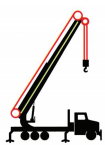
The short answer: the drilling line on a rotary rig is, in most cases, a 6×19 or 6×26WS class rope with an independent wire rope core in EIPS/EEIPS grade (1960–2160 N/mm²) — and what actually decides its cost per metre drilled is not the construction you buy but the ton-mile slip-and-cut program you run it on. Sand lines are the smaller, usually galvanized 6×19S ropes on the utility winch, and well-servicing rigs that hang the load on a single line take a rotation-resistant 19×7 or 35×7. Oilfield rope lives a harder life than almost any other application: it bends over the crown and traveling block sheaves on every trip, crushes against itself at the drum crossovers, sits under full tension at the deadline, and works in mud, dust and salt. This guide covers each rope on the rig, the construction and grade decisions, how the API RP 9B cutoff program works with a worked example, and the discard limits I inspect against.
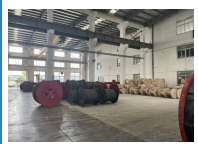
The Rope Systems on a Drilling Rig
A rig is not running one rope — it is running a small fleet of them, each with its own duty profile. Before ordering, walk the rig and list what is actually reeved on it:
| Rope circuit | What it does | Main duty | Typical construction |
|---|---|---|---|
| Drilling line (drawworks reeving: fast line, deadline, traveling block sheaves) | Hoists and lowers drill string, bottom hole assembly and casing on every trip | Repeated sheave bending, drum crossover crushing, static deadline tension, ton-mile accumulation | 6×19S, 6×25FW or 6×26WS + IWRC, EIPS/EEIPS (1960–2160), bright or galvanized |
| Sand line | Utility winch rope for bailers, swabbing and light downhole tools | Small sheaves, high speed, abrasive mud, long static hangs | 6×19S + IWRC (fiber core on the smallest sizes), hot-dip galvanized |
| Well servicing / workover lines | Runs tubing and rods on service rigs, often single-line hook | Free-hanging load that can spin, frequent reeving changes | 19×7 or 35×7 rotation-resistant on single-line; 6×36WS+IWRC on multi-fall |
| Riser tensioner and guideline lines (offshore) | Station-keeping and riser support on floaters | Continuous saltwater exposure, near-constant tension | 6×36WS+IWRC, heavily galvanized or plastic-impregnated |
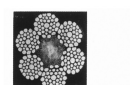
Why Drilling Line Duty Destroys Ordinary Rope
Sheave bending on every trip
Each round trip runs the whole drill string up and down, and every metre of line between the deadline anchor and the drum bends over the crown block and traveling block sheaves as it goes. Bending fatigue accumulates fastest where the D/d ratio — sheave diameter to rope diameter — is smallest, and where the same rope section passes a sheave most often. On a rig, that hot zone is predictable: the sections that work the sheaves at typical string position, and the deadline end, which sits nearly static under the highest sustained tension of the whole reeving system.
Drum crossovers
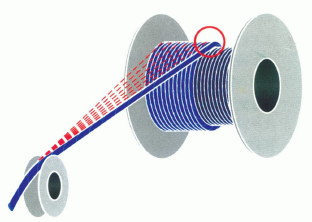
Where the rope climbs from one drum layer to the next, it presses a hard diagonal edge into the wrap beneath. Those crossover points produce the worst crushing and internal abrasion a drilling line ever sees — and they repeat at fixed intervals along the rope. This is the single most important thing to understand before the cutoff section below: the damage is not uniform, it concentrates at known points.
Shock and ton-miles
Sticking pipe, sudden slips and hard casing landings load the line well above static weight. Add it all up and a drilling line accumulates work — measured in ton-miles — and it is ton-miles, not calendar time, that decide when the rope must be moved and cut.
Choosing Construction and Grade
| Construction | Where I specify it | Strengths | Trade-offs |
|---|---|---|---|
| 6×19S + IWRC (Seale) | Standard drilling lines, sand lines; the oilfield workhorse | Larger outer wires = best abrasion resistance; simple, economical | Less bending-fatigue tolerant than 6×26 class |
| 6×25FW / 6×26WS + IWRC | Larger drilling lines on deeper rigs | Better fatigue life, smoother spooling, higher fill factor | Slightly softer outer wires than Seale |
| 6×31WS + IWRC | Big-diameter lines where flexibility matters more | Best fatigue tolerance of the 6-strand family | Lower abrasion resistance; costs more |
| Plastic-impregnated (EPIWRC) versions | Premium drilling lines, offshore service | Locks factory lubricant in, seals mud and moisture out; measurably more ton-miles per rope | Higher purchase price — usually repaid by longer cutoff intervals |
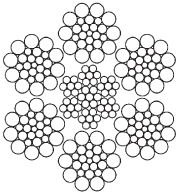
Core and lay: IWRC is mandatory on any main load line — it resists drum crushing and adds roughly 7% breaking force over a fiber core. Right regular lay is the default for drilling lines spooled on a drum; Lang’s lay (wires laid parallel to the rope axis) gives superior fatigue on long sheave runs but must never be used where one end can rotate freely. Grade: the oilfield shorthand is IPS / EIPS / EEIPS — EIPS corresponds to roughly grade 1960 and EEIPS to 2160. Most modern rig lines are bought in EIPS or EEIPS: the extra strength either buys safety factor or lets you run the same working load on a smaller drum package.
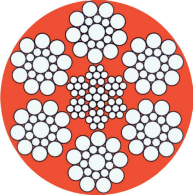
Finish: bright rope is acceptable for many onshore land rigs with disciplined lubrication; hot-dip galvanized is the default for sand lines (which sit idle and damp between jobs), for offshore and for corrosive field conditions. If you are unsure how finishes compare, my galvanized vs bright vs stainless guide covers the decision in detail.
Sizing: Design Factor Against Real Line Pull
Drilling line is sized by design factor — minimum breaking force divided by the maximum line pull — and API practice targets around 5:1 for normal rotary operations. Divide by the line pull in the rope, not the hook load: with 8 lines reeved, each part carries an eighth of the string weight, plus the deadline and fast-line carry their share. The full arithmetic of MBL and design factors is in my breaking strength and safety factor guide; for drilling lines the practical check is: maximum static load per part of line × 5 must be below the certified MBL, with the shock allowance coming from your ton-mile goal discipline rather than upsizing the rope for every worst case.
The Ton-Mile Slip-and-Cut Program (API RP 9B)
This is the heart of drilling line management, and the part most operators get wrong. The logic: because damage concentrates at the deadline, at crossover points and at the most-used sheave positions, you periodically slip a length of rope through the system — moving the worn sections to new positions — and then cut that length from the drum (fast-line) end. Wear gets distributed over the whole rope instead of destroying the same few metres, and you use nearly all of the rope you paid for.
How the cutoff length is calculated
API RP 9B defines a service goal in ton-miles per foot of rope, sized to the rope diameter and the drawworks drum diameter. The length to cut is simply:
Cutoff length = ton-miles accumulated since the last cut ÷ service goal
Two refinements matter: add about 1/8 of a drum circumference to the calculated cut so the new crossover points do not land on the old ones, and never make a cut that is a whole multiple of the distance between sheave pick-up points — otherwise the same rope sections keep landing in the same sheaves and you have achieved nothing. The slip is taken from the deadline side; the cut comes off the drum end.
| Step | Worked example |
|---|---|
| Line | 1-1/4 in (32 mm) 6×26WS + IWRC, EEIPS |
| Drawworks drum diameter | 28 in (711 mm) |
| Service goal (API RP 9B, Table 8) | ≈18 ton-miles per foot of rope |
| Ton-miles accumulated since last cut | 400 TM |
| Cutoff length | 400 ÷ 18 ≈ 22 ft (≈6.7 m) + 1/8 drum circumference |
| Where | Slip at the deadline, cut at the fast-line (drum) end; log both in the ton-mile report |
Goals are adjusted from your rig’s own records and the rope supplier’s recommendation; premium ropes such as plastic-impregnated lines typically justify a higher goal. Keep the slip-and-cut record in the driller’s report — it is auditable, and it is also your best evidence when a rope underperforms.
Changing the Line: Spooling the New Rope On Properly
A third of the life of a new drilling line is decided in the first hour it goes on the drum. The routine I insist on (the full checklist is in my installation and maintenance guide):
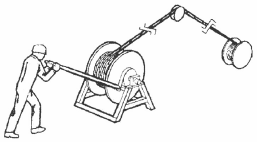
- Reel to drum in the same direction the rope will spool — unreel the shipping reel on a spindle, never pull coil off the flank, or you will put a permanent twist in the line before it has done a metre of work.
- Spool under 2–5% of MBL back tension — a slack first layer buries loose wraps that crush and cut themselves under load.
- Seize both sides of every cut — an unseized 32 mm line will unravel its lay the moment the saw clears.
- Keep fleet angle near 1.5° and follow the drum’s lay-direction marking; wrong-direction spooling shows up as crossovers and crushed valleys within the first few trips.
- Log the starting position of every pick-up point so your cutoff lengths never duplicate crossovers.
Inspection and Discard Criteria for Oilfield Rope
Inspect visually at every slip-and-cut, and check the three hot zones deliberately: the deadline end, the crossovers, and the sections riding the sheaves most often. API RP 9B gives the retirement limits; the ones I actually enforce:
| What to check | Discard / action |
|---|---|
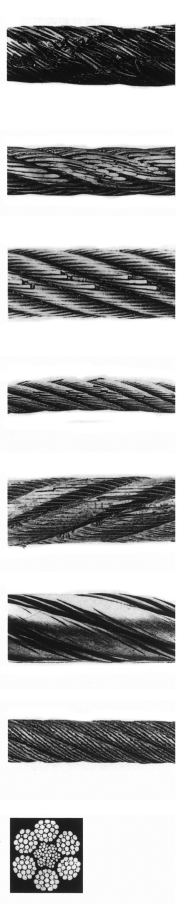
| Broken wires (6-strand drilling line) | Retire at 6 randomly distributed broken wires in one lay length, or 3 broken wires in one strand in one lay length — regardless of remaining ton-mile budget |
| Broken wires (rotation-resistant 19×7 / 35×7 service line) | Stricter: retire at 2 breaks in 6 rope diameters or 4 in 30 — act at the first valley breaks |
| Diameter loss | Retire at roughly 7% loss of nominal diameter, or marked flat spots from crossover crushing |
| Corrosion | Pitting or rust between strands = internal attack; retire even if the wire count passes |
| Kinks, birdcaging, shock damage | Retire immediately — usually slack line pulled tight or a severe overload event |
| Cut or crushed strand, core protrusion | Retire immediately |
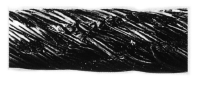
Lubrication is the cheapest ton-miles you will ever buy: clean the rope and apply a penetrating lubricant that reaches the core at every service — more often in mud, rain or coastal salt. The damage signatures behind these rules are described in my article on why wire ropes fail, and the inspection method itself in my ISO 4309 inspection guide, which applies to the auxiliary and crane ropes around the rig site.
Final Word: Buy the Rope, Then Manage It
Almost every premature drilling line failure I have investigated came down to management, not metallurgy: no ton-mile log, cutoff lengths that duplicated crossovers, a slack first layer, or a lubrication habit that stopped when the drilling got busy. Pick a sound 6-strand IWRC construction in EIPS/EEIPS, set a service goal with your supplier, and then run the slip-and-cut program with the discipline of a safety system — because that is exactly what it is. The same selection logic for the foundation side of the industry is in my rotary drilling rig (35WXK7) guide.
Aulone is a professional manufacturer and supplier of steel wire ropes, wire rope slings, synthetic ropes and rigging hardware for lifting, marine, mining, construction and industrial applications. With more than 20 years in the industry, 200,000 tons of annual capacity and production to EN 12385-4 under ISO 9001 — certified by BV, ABS, DNV, RMRS and CE — we supply drilling lines, sand lines and rotation-resistant service ropes with lot-specific breaking-force certificates, keep common oilfield sizes in stock, build custom assemblies with sockets or pressed terminations, and arrange third-party testing on request. For help speccing your next drilling line, write to me at info@wireropes.net.
Frequently Asked Questions
What is the difference between a drilling line and a sand line?
The drilling line is the main reeved system on the drawworks — fast line, deadline and traveling block — that hoists the drill string, typically 6×19S/6×26WS with IWRC in large diameters (25–52 mm / 1–2 in). A sand line is a much smaller auxiliary winch rope (commonly 6×19S, often galvanized) used for bailing, swabbing and light tool work. Different loads, different diameters, different inspection intensity.
What exactly is a ton-mile?
One ton-mile is the work done raising or lowering one ton through one mile. Each drilling operation — rotary drilling, coring, running casing, cementing — contributes ton-miles based on load and depth. Because the rope’s fatigue damage accumulates with that work rather than with time, ton-miles are the currency in which drilling line life is measured and cutoff schedules are set.
How do I calculate the cutoff length for my drilling line?
Cutoff length = ton-miles accumulated since the last cut ÷ service goal (ton-miles per foot, from API RP 9B Table 8 or your rig’s own history). Add about 1/8 drum circumference to avoid duplicating crossover points, and never cut a whole multiple of the sheave pick-up spacing. Slip from the deadline side, cut from the drum end, and log it.
Should my drilling line be 6×19 or 6×26?
For most land rig lines, 6×19S + IWRC in EIPS is the economical default with the best abrasion resistance. Step up to 6×25FW or 6×26WS + IWRC on larger-diameter lines and deeper rigs, where better bending fatigue over big sheaves and smoother multi-layer spooling repay the premium in extra ton-miles.
How long should the drilling line be for my derrick?
Enough for the reeving (number of falls × distance from drum to traveling block at full extension), plus 3–4 dead wraps on the drum, the deadline anchor length, and a reserve so you can keep slipping and cutting for the life of the line. Undersizing the original line cuts the rope’s usable ton-mile life more than any construction choice.
When must drilling line be replaced immediately?
Immediately — regardless of ton-miles remaining — when you find 6 randomly distributed broken wires in one lay length or 3 in one strand in one lay length, a kink or birdcage, crushed or cut strands, core protrusion, or corrosion pitting between strands. Also treat any severe overload or sticking-pipe shock as an immediate full-line inspection trigger.