Elevator Wire Rope Explained: Constructions, Safety Factors, Standards and When to Replace
By Andri — Technical Writer & Crane Rope Specialist, Aulone (www.wireropes.net)
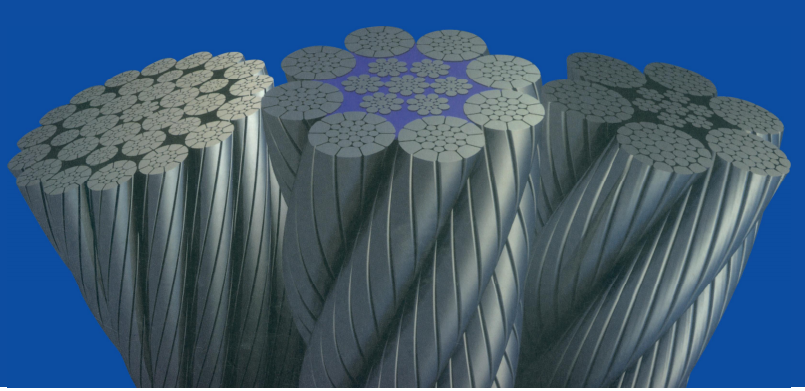
The short answer: the standard hoist rope for a modern traction elevator is an 8×19 Seale construction with a fibre core (8×19S+FC), in traction or extra-high-strength traction grade, and it is engineered to a safety factor of at least 12 — roughly two to three times the design factor of a general lifting sling. Low-rise, slower elevators stay with the fibre-core 8×19; high-speed and high-rise machines move up to 8×19S or 9×21F with an independent wire rope core (IWRC) for lower stretch and higher breaking force. In this guide I’ll walk through the three ropes every traction elevator carries, how to choose the construction for speed and travel height, what the codes actually require, and the inspection criteria that tell you when a rope is finished.
What an Elevator Rope Must Do That a Crane Rope Doesn’t
I spend most of my days on crane ropes, and the elevator duty cycle humbles them. A high-rise hoist rope runs over its traction sheave and deflector sheaves hundreds of thousands of bending cycles per year, at D/d ratios that cranes rarely see, carrying people. It must also hold traction precisely — the drive depends on friction between rope and sheave groove, so the rope’s diameter and surface must stay stable within tight tolerances over its whole life. And it must stay quiet: a fibre-core 8-strand rope cushions vibration in a way a stiff 6×36 crane rope never could.
That combination — enormous bending fatigue, stable diameter, smooth running, and a huge built-in strength reserve — is why elevator ropes are a distinct product family governed by their own standards: EN 12385-5 and ISO 4344 for the rope itself, and EN 81-20/50 or ASME A17.1 for the installation. Elevator rope is not simply “a crane rope with a good haircut”; the wire drawing, preforming, lubrication and manufacturing tolerances are all tighter.
The Three Ropes in Every Traction Elevator
A traction elevator doesn’t use one rope type — it uses three, each with a different job. Getting them mixed up is a classic ordering mistake, so here is how I separate them:
| Rope | Function | Typical constructions | Typical diameters |
|---|---|---|---|
| Hoist (traction) rope | Supports car and counterweight, transmits drive force from the traction sheave | 8×19S+FC, 8×19S+IWRC, 8×25F+FC, 9×21F+IWRC; 6×25F+FC on older machines | 8–13 mm (commonly 10, 12, 13 mm) |
| Governor (safety) rope | Drives the overspeed governor and trips the safety gear if the car over-speeds | 6×19S+FC, 8×19S+FC with synthetic fibre core | 6–8 mm, never below 6 mm |
| Compensation rope | Balances the weight of the hoist ropes themselves between car and counterweight | 6×29F+FC, 6×37+FC flexible constructions (compensating chain on low-rise) | 8–16 mm |
The hoist rope carries the load and dominates the specification conversation, so the rest of this article focuses there — but note that governor and compensation ropes have their own flexibility-first constructions, because they spend their lives on small sheaves at low tension.
Choosing the Construction: Speed and Travel Height Decide
The 8×19 Seale with natural fibre core became the industry default for good reason: the Seale layout puts thick outer wires over thinner inner wires, giving a rope that resists external abrasion from the sheave groove while staying flexible enough for high bending frequencies, and the sisal core stores lubricant and damps vibration. From there, the choice is driven by how fast the car travels and how far it travels — because rope self-weight and stretch grow with travel height:
| Application | My recommended construction | Why |
|---|---|---|
| Low-rise, ≤ 2.0 m/s (residential, low commercial) | 8×19S+FC (natural fibre core) | Quiet, flexible, lubricant-storing core; lowest cost |
| Mid-rise, 2.0–3.0 m/s | 8×19S+FC or 8×19S+IWRC | Steel core option controls stretch as travel grows |
| High-rise, 3.0–5.0 m/s (offices, hotels) | 8×19S+IWRC or 8×25F+IWRC | Higher breaking force, minimal permanent stretch, better crush resistance |
| Super high-speed, > 5.0 m/s (skyscrapers) | 9×21F+IWRC or 9×19S+IWRC | 9 strands share the bending work; filler wire adds fatigue life |
| Heavy freight / hospital bed lifts | 8×19S+IWRC or 8×25F+IWRC | Steel core resists crushing under high, sustained load |

A quick reality check before anyone swaps a construction: the elevator manufacturer’s data plate and original specification always govern. The rope diameter, grade, construction and rope count were chosen together with the sheave grooves and the traction calculation. If the data plate is missing, count the strands at the shackles (6, 8 or 9), measure the diameter crown-to-crown with a caliper, and identify the construction — most modern 8-strand machines are 8×19 Seale, most pre-1970 six-strand machines are 6×25 filler wire.
Grades, Standards and Certification
Elevator rope grades are quoted as minimum wire tensile strength. Traction grades sit between the general engineering grades and the very high strengths used on compacted crane ropes — you can compare those families in my 6×36 wire rope specifications guide:
| Grade | Approx. tensile strength | Where it is used |
|---|---|---|
| Traction (1180 class) | ≥ 1180 N/mm² outer wires | Governor and compensation ropes; older installations |
| 1570 N/mm² | Standard European/Chinese grade | Low and mid-rise passenger elevators, 8×19S+FC |
| 1620 N/mm² | Japanese/Korean convention | Equivalent duty to 1570, common in Asian OEM specifications |
| 1770 N/mm² | High strength | High-rise and high-speed hoist ropes, IWRC constructions |
| 1960 N/mm² | Very high strength | Super high-speed and super high-rise machines where rope count is limited |
On standards: the rope must comply with EN 12385-5 or ISO 4344 (elevator rope product standards), and the installation with EN 81-20/50 in Europe or ASME A17.1 in North America. When I buy rope for customers I insist on mill certificates with actual breaking-force results, not just nominal values — the same discipline I describe in my guide to wire rope breaking strength and MBL.
The Safety Factor: Why 12:1 Is the Elevator Norm
Here is the number that surprises crane people. A general lifting sling is designed at a 5:1 factor; a crane hoist rope typically works around 4.5–5:1. EN 81-20 requires a minimum safety factor of 12 for traction elevators with three or more hoist ropes, and 16 when only two ropes are fitted — and the calculation method in the code often pushes the effective figure higher still, because it accounts for sheave ratio, traction conditions and the number of bends. The logic is straightforward: multiple independent ropes each able to hold the car on its own, plus margins for the enormous number of bending cycles. For a typical passenger elevator with four ropes, that means three ropes in almost new condition can carry the full rated load with the code factor still respected.
This margin is also why elevator rope is never chosen on price per metre. The rope is a small fraction of the machine’s cost and the entire basis of its safety case — which is also why substitution with non-elevator-grade rope is both a code violation and, in my view, indefensible.
Stretch, Installation and the Details That Decide Service Life
Every new elevator rope stretches in two phases, and installers who understand them avoid the classic call-backs. Constructional stretch happens first: the core and strands settle and compact under load, and most of it occurs in the first weeks of service — roughly 0.25–0.5% of length for fibre-core ropes and markedly less for IWRC, which is exactly why tall machines specify steel core. Elastic stretch continues gently with load changes throughout the rope’s life. Manufacturers can pre-stretch rope to remove most constructional stretch before delivery; what no manufacturer can remove is the elongation caused by re-using worn sheave grooves.
Three installation rules I never negotiate: re-groove or replace worn sheaves before re-roping (a new rope in an old groove wears to the groove’s mistakes); prevent untwisting during handling and tensioning — rotate the reel, never pull rope off the side; and tension the ropes equally, because a 10% imbalance between ropes makes the tight one carry a disproportionate share of the bending work and the loose one fret in its groove. Bright (ungalvanized) pre-lubricated rope is the standard finish for indoor shafts; for outdoor, mine or humid installations, galvanized rope is worth the premium — I compare the finishes in my galvanized vs bright vs stainless steel wire rope guide.
Inspection and Replacement Criteria
Elevator rope inspection is a specialist maintenance task, typically performed at regular service intervals with a thorough examination at least every six months — more often on ropes more than three years into service. The criteria below combine common practice with the thresholds used in ISO 4344, EN 12385-5 and EN 81-20 maintenance requirements; the code in your jurisdiction and the OEM manual always take precedence. If you come from a general lifting background, my ISO 4309 discard criteria guide is the closest crane-side framework, and the elevator rules are broadly similar in spirit:
| Indicator | Typical replacement threshold | Note |
|---|---|---|
| Diameter reduction | ≥ 7% below nominal (fibre core); ≥ 6% for steel core | Measure crown to crown at several points; a 10 mm rope replaced below 9.3 mm |
| Broken wires | More than a few broken wires in one lay length; any clustering in one strand | Count within a lay length at the worst section, usually at sheave contact zones |
| Corrosion | Visible pitting, rust product in the valleys, or internal corrosion signs | Surface flash rust can be cleaned and lubricated; pitting cannot |
| Deformation | Kinks, waviness, bird-caging, flattened or protruding strands | Any kink is immediate replacement — no evaluation tolerance |
| Wear flat on outer wires | Wear exceeding a large fraction of outer wire diameter with fatigue signs | Judge together with diameter loss and broken wires |
| Rope age / usage | Many OEMs plan replacement at 3–5 years or per ride count | High-traffic buildings reach the limits sooner than the calendar suggests |
Two practical tips from inspection work. First, the worst section is almost always at the traction sheave or in the section that sits on it with the car at the top landing — inspect that zone first, every time. Second, keep records of diameter measurements per rope and per position from day one: a trend line tells you far more than a single reading, and it turns replacement planning from guesswork into scheduling.
The Bottom Line From a Rope Specialist
Elevator rope looks unremarkable — a thin, quiet rope in a machine room — but it is among the most highly engineered wire ropes made: tight-tolerance 8×19 Seale constructions, traction grades up to 1960 N/mm², a 12:1 code safety factor, and standards (EN 12385-5, ISO 4344, EN 81-20, ASME A17.1) that treat it as a safety component, not a commodity. Specify by speed and travel height, insist on mill certificates, respect the sheave and tensioning details during installation, and inspect against measurable thresholds rather than impressions. Aulone is a professional manufacturer and supplier of steel wire ropes, wire rope slings, synthetic ropes and rigging hardware for lifting, marine, mining, construction and industrial applications. With more than 20 years in the industry, an annual capacity of 200,000 tons, EN 12385-4 and elevator-rope production to EN 12385-5/ISO 4344, ISO 9001 quality management, class and third-party certifications including BV, ABS, DNV and RMRS, and CE marking, we supply certified elevator, crane and industrial wire ropes from stock or as custom-cut assemblies with third-party testing on request. For a quotation or help matching an existing rope’s specification, send the data plate details to info@wireropes.net and I will help you identify it.
FAQ: Elevator Wire Rope
What construction is the most common elevator wire rope?
The 8×19 Seale with natural fibre core (8×19S+FC) is the default hoist rope for low and mid-rise passenger elevators. High-rise, high-speed and heavy freight machines typically use 8×19S, 8×25F or 9×21F with an independent wire rope core (IWRC) for lower stretch and higher breaking force. Older pre-1970 installations often carry 6×25 filler wire rope.
What safety factor does elevator wire rope use?
EN 81-20 requires a minimum safety factor of 12 between rope breaking force and working load for elevators with three or more hoist ropes, and 16 with two ropes. The code calculation — which factors in sheave diameter, traction conditions and bending cycles — often raises the effective figure. For comparison, general lifting slings use 5:1.
How long does elevator wire rope last?
Typically several years to well over a decade depending on traffic, rise and maintenance quality. Many maintenance programmes plan rope replacement at 3–5 years for high-traffic buildings, while lightly used installations run longer. Age alone doesn’t retire a rope — diameter loss, broken wires, corrosion and deformation do.
When should elevator hoist rope be replaced?
Common thresholds: diameter reduction of 7% or more below nominal (6% for steel-core rope), more than a few broken wires within one lay length or clustered in one strand, corrosion pitting, and any kink, waviness or bird-caging. The exact limits follow your jurisdiction’s code and the OEM manual — and the section at the traction sheave always deserves the closest look.
Can I use ordinary crane wire rope in an elevator?
No. Elevator rope is produced to EN 12385-5 / ISO 4344 with tighter tolerances, preforming, specific grades and lubrication, and it must satisfy the EN 81-20 / ASME A17.1 safety-factor and traction calculations. Substituting general engineering rope voids the machine’s compliance and compromises the entire safety case.
Fibre core or steel core for elevator hoist rope — which is better?
Neither is universally better; it’s a stretch-versus-quietness trade-off. Natural fibre core (FC) runs quieter, stores lubricant and suits low and mid-rise machines. IWRC gives higher breaking force, resists crushing and dramatically reduces constructional stretch, which is why tall, fast and freight elevators specify it. Match the original specification unless the OEM approves a change.