The short answer: a wire rope grommet is an endless sling closed from one continuous length of strand — six strands laid around a strand core, with no eye, no sleeve and no fitting anywhere in the loop — and because both sides of the loop carry the load, it delivers the highest capacity per millimetre of diameter of any wire rope sling. Its bigger brother, the cable-laid grommet, closes six complete ropes around a rope core and takes single-sling capacities into the hundreds of tonnes. That is why grommets carry module lifts offshore, hook blocks on port cranes and ladle movements in steel mills. In this guide I will explain how grommets are made, how EN 13414-3 turns their breaking force into a safe working load, what bending over a small hook really costs you, and how I inspect them so they retire on their own terms instead of failing mid-lift.
What Exactly Is a Wire Rope Grommet?
EN 13414-3, the European standard for grommets and cable-laid slings, draws a precise line between the two families:
- Grommet (endless grommet) — an endless sling made from one continuous length of strand, formed into a body of six strands laid around a strand core. Think of it as a single oversized strand closed into a loop.
- Cable-laid grommet — an endless sling made from one or two continuous lengths of complete wire rope, formed into a body of six ropes laid around a rope core. Six ropes act together like the strands of one huge rope.
There is no mechanical splice and no pressed fitting in either type. The loop is closed by tucking the continuous ends back through the body in a hand splice, so the cross-section stays essentially unbroken around the whole circumference. In a straight, direct pull, both sides of the loop share the load, so a grommet develops roughly twice the minimum breaking force (MBL) of its parent rope. That single fact explains most of why riggers choose them.

Why Lift With a Grommet Instead of an Eye Sling?
I get this question from buyers moving into heavy-lift work, and the answer is always the same four points:
1. No termination losses. A ferrule-secured eye keeps roughly 90–95% of rope strength and a hand-spliced eye less, and every fitting has a maximum rope diameter it can accept. A grommet has no fitting at all — and it can be manufactured at diameters where eyes and sockets stop being practical, well beyond 200 mm.
2. Two parts carry the load. In a direct hitch both legs of the loop take the force, so the grommet’s MBL is about double the parent rope’s certificate value. Per kilogram of sling weight, nothing else in the rigging locker comes close.
3. Wear can be moved around. An eye sling always wears in the same bowl of the thimble. A grommet is a full circle: between lifts you can shift the bearing point to a fresh section of the loop, multiplying working life in choke and pinch applications.
4. It fits where slings do not. Compact, flexible and endless, a grommet threads through tight trunnions, sits neatly in hook blocks and reeves through sheaves where a stiff socketed eye simply will not go. My terminations and fittings guide shows why large spliced eyes become so bulky by comparison.
| Sling type | Termination efficiency | Capacity vs parent rope MBL (direct hitch) | Practical diameter range | Best suited to |
|---|---|---|---|---|
| Eye sling, ferrule-secured | ~90–95% | ~1× | Up to ~60–80 mm | General lifting, repeated hook work |
| Eye sling, spelter socketed | ~100% | ~1× | Up to ~120 mm | Semi-permanent, high-capacity legs |
| Grommet (endless) | No fitting — splice tuck only | ~2× | Roughly 20–150 mm | Heavy lifts, choke work, tight spaces |
| Cable-laid grommet | No fitting — splice tuck only | ~2× (six ropes share) | Roughly 60–300+ mm | Offshore modules, tandem lifts, salvage |
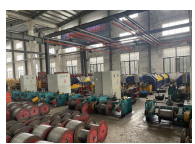
Manufacturing matters, too. The strand or rope is closed into its loop on purpose-built machines under controlled tension, the splice is tucked by hand to EN 13414-3 Annex D, and the finished loop is pre-stretched so it settles before it ever sees a load.
How EN 13414-3 Turns Breaking Force Into WLL
Grommet ratings follow a straightforward formula. For a grommet in a direct (vertical) hitch:
WLL = (2 × Fmin × KB) / Zp
where Fmin is the minimum breaking force of the parent rope from its EN 12385-4 certificate, the factor 2 reflects both sides of the loop carrying load, KB is a bending efficiency factor (more on that below) and Zp is the design factor. For a cable-laid grommet the same logic applies six times over, with an experimental factor k = 0.9 for the spinning losses of cabling the ropes together:
WLL = (12 × Fmin × KB × 0.9) / Zp
The design factor is not one number across all sizes — EN 13414-3 graduates it:
| Grommet diameter | Design factor Zp (EN 13414-3) | What it means in practice |
|---|---|---|
| ≤ 60 mm | 5 : 1 | WLL = MBL / 5 — the familiar rule of thumb |
| 60–150 mm | 6.33 − 0.022 × d | Graduated from about 5.2 : 1 down to 3 : 1 as diameter grows |
| > 150 mm | Not less than 3 : 1 | Very large grommets, typically engineered per project |
Worked example, kept simple: take a cable-laid grommet whose certificate shows an MBL of 330 tonnes. At the standard 5 : 1 design factor its direct WLL is 330 / 5 = 66 tonnes. Put the same grommet into a choke hitch and apply the 0.8 choke factor and it is rated at about 52.8 tonnes. Use it as a basket under a load at 0–45° to vertical and the two bearing legs give roughly 92 tonnes (2 × 66 × 0.7). One loop, three very different ratings — which is why the tag on the grommet must state the hitch it is certified for.
Typical catalogue figures for cable-laid grommets to EN 13414-3 look like this (always verify against the actual lot certificate):
| Grommet diameter | MBL (t) | Single-leg WLL, direct (t) | Two-leg WLL, legs ≤ 45° to vertical (t) | Two-leg WLL, 45–60° (t) |
|---|---|---|---|---|
| 66 mm | 317 | 63.4 | 88.8 | 63.4 |
| 72 mm | 378 | 75.5 | 105.7 | 75.5 |
| 84 mm | 514 | 102.8 | 143.9 | 102.8 |
| 96 mm | 671 | 134.2 | 187.9 | 134.2 |
| 108 mm | 849 | 169.9 | 237.8 | 169.9 |
| 120 mm | 1,049 | 209.8 | 293.6 | 209.8 |
| 132 mm | 1,269 | 253.8 | 355.3 | 253.8 |
| 144 mm | 1,510 | 302 | 422.8 | 302 |
If you need a refresher on how MBL itself is defined and tested, my article on breaking strength, MBL and safety factors walks through the arithmetic; and the reasoning behind the 5 : 1 figure is covered in the sling safety factor guide.
The D/d Bending Loss Most Riggers Miss
Here is the trap. A grommet’s rating assumes it works over bearing points large enough not to deform it. Bend the same grommet over a small pin or hook and the flattened cross-section loses wire engagement long before anything visibly breaks. As a working rule I ask for a bearing-point diameter at least 4 × the grommet diameter; below that, apply a bending efficiency correction:
EB = 1 − 0.5 / √(D/d)
| D/d ratio (bearing point ÷ grommet diameter) | Bending efficiency EB | Effective capacity of a 66 t WLL grommet |
|---|---|---|
| ≥ 4.0 : 1 | 1.00 — full rating | 66 t |
| 3.0 : 1 | 0.71 | 46.9 t |
| 2.5 : 1 | 0.69 | 45.5 t |
| 2.0 : 1 | 0.65 | 42.9 t |
A quick worked example from a job I reviewed: a 78 mm grommet, certificate WLL 112.6 t, slung over 200 mm trunnion pins. D/d = 200/78 = 2.56, so EB = 1 − 0.5/√2.56 = 0.688. Effective capacity: 112.6 × 0.688 ≈ 77.5 t — a third of the nameplate gone because of the pins. Where both bearing points differ in size, calculate with the smaller one. And mind the loop geometry as well: as a minimum, keep the grommet circumference no shorter than about 50 × its diameter, or the two legs pinch against each other and the internal wires can no longer move under load.
Where Grommets Earn Their Keep
In the enquiries we handle, the same application patterns return again and again:
- Offshore heavy lifts — module, jacket and manifold lifts where sling weight itself is a cost and capacities run into hundreds of tonnes per sling.
- Subsea work — lowering heads, spool frames and templates; galvanized or stainless-fitted assemblies that tolerate full seawater immersion.
- Crane hook blocks and sheave reeving — the endless loop reeves through block sheaves without any socket to jam.
- Port and heavy industrial lifting — quayside lifting beams, spreader rigs and tandem crane lifts where every millimetre of headroom counts.
- Salvage and steel mills — abrasive, high-temperature environments where a sacrificial, evenly-wearing loop outlives any eyed sling.

Specifying a Grommet: the Details That Decide the Quotation
A grommet is a made-to-order product, and the specification sheet decides whether you get the sling you need or a surprise at the quay. Before I ask for a quotation I fix these points:
- Diameter and target MBL — calculated backwards from the load, the hitch and the smallest bearing point, including the D/d correction.
- Length — grommet length is measured as circumference, on pins of a defined size under defined tension (EN 13414-3 Annexes B and C). State the working circumference you need; tolerance matters when a spreader is involved.
- Finish and steel — galvanized for marine, offshore and any wet duty; bright for dry inland work. For cable-laid grommets I specify IWRC parent rope for crush resistance, and higher grades (1770/1960 MPa) where tonnage per diameter is tight. The galvanized vs bright vs stainless guide covers the finish trade-offs.
- Pre-stretch and proof load — pre-stretching stabilises the loop; a proof load test at a defined multiple of WLL gives an extra verification step for critical lifts.
- Documentation — the EN 13414-3 certificate must carry the actual breaking force of the parent rope lot, the measured circumference, the WLL for each hitch and full traceability. For offshore projects I add third-party witness testing and class acceptance (BV, ABS, DNV, RMRS) at the order stage, not after.

Inspecting and Retiring a Grommet
Grommet inspection follows ISO 4309 principles, but the endless shape shifts where the damage appears:
- Bearing points first. Walk the whole loop and examine every section that has sat on a hook, pin or edge — crown wire wear, flattened areas and wire breaks concentrate there.
- Rotate the wear points. Because the loop is continuous, deliberately re-position the contact zone between lifts; a grommet used in the same spot for its whole life is a wasted grommet.
- Watch the splice tuck. The tucked zone is the one place where the cross-section deviates; broken wires clustering at the tuck retire the sling early.
- Apply the standard limits. Retire on broken wires exceeding the ISO 4309 group limits for the construction, on diameter loss approaching 10% of cross-section from wear and corrosion, on severe pitting, a kink, a birdcage, heat damage or a flattened section that will not spring back.
- Log every examination. A grommet often outlives several generations of eyebolts on the same project — its history is your only defence in an audit.
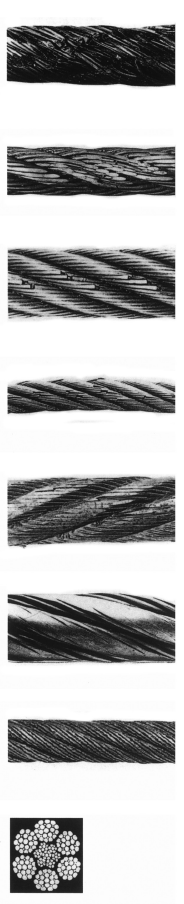
And when a grommet does fail or come off hire, read the damage before scrapping it — the wear pattern names its cause, the same way it does for any rope. My article on wire rope failure causes gives the diagnostic signatures.
Frequently Asked Questions
What is the difference between a grommet and a cable-laid grommet?
A grommet is closed from one continuous length of strand — six strands around a strand core. A cable-laid grommet is closed from one or two continuous lengths of complete rope — six ropes around a rope core. The cable-laid type scales to much larger diameters and capacities, into the thousands of tonnes of MBL, while the strand grommet covers the smaller, more flexible end of the range.
How is the WLL of a wire rope grommet calculated?
Under EN 13414-3, the direct-pull WLL equals twice the parent rope’s minimum breaking force, times a bending efficiency factor, divided by the design factor Zp. Zp is 5 for grommets up to 60 mm, graduates downward between 60 and 150 mm, and is at least 3 above 150 mm. In daily practice, WLL = MBL / 5 is the figure stamped for the direct hitch on standard-size grommets.
Can a grommet be used in a choke hitch?
Yes — chokes are one of its best applications because the wear point can be shifted around the loop. Apply the 0.8 choke factor to the direct WLL, make sure the grommet sits properly in the choke rather than pinching itself, and check the bearing point D/d ratio on the bight.
Why does bending over a small hook reduce capacity so much?
Bending flattens the cross-section, the wires lose mutual support and the load concentrates on fewer contact points, so the effective breaking force drops — down to roughly 65% of rating at a 2 : 1 D/d ratio. Keep bearing points at least 4 × the grommet diameter, or apply the EB correction before you rig.
How long should a wire rope grommet be?
Length is specified as the working circumference, measured on standard pins under tension. As a minimum, keep the circumference no shorter than about 50 × the grommet diameter so the two legs do not pinch together under load. For spreader and trunnion work, state the exact pin diameter and target circumference on the enquiry.
When must a grommet sling be discarded?
Retire it when broken wires exceed the ISO 4309 limits for the construction, when wear and corrosion approach 10% cross-section loss, at the splice tuck if breaks cluster there, or immediately for a kink, birdcage, heat damage or severe flattening. Between examinations, rotate the bearing points — it is the cheapest way to add safe life to the sling.
Final Word: Match the Grommet to the Hitch, Not Just the Load
A grommet is the strongest sling you can hang on a hook per kilogram of steel — but only if you respect the arithmetic: direct, choke and basket ratings differ; small bearing points claw back a third of the nameplate; and the endless loop deserves a walking inspection around its full circumference. Get those habits right and a grommet will outwork any eyed sling on the job.
Aulone is a professional manufacturer and supplier of steel wire ropes, wire rope slings, synthetic ropes and rigging hardware for lifting, marine, mining, construction and industrial applications. With more than 20 years in the industry, 200,000 tons of annual capacity and production to EN 12385-4 under ISO 9001 — certified by BV, ABS, DNV, RMRS and CE — we supply grommets and cable-laid grommets to EN 13414-3 with lot-specific certificates, keep common sizes in stock for fast shipment, build custom assemblies with proof load testing, and arrange third-party inspection on request. For a quotation or help sizing a grommet for your lift, write to me at info@wireropes.net.