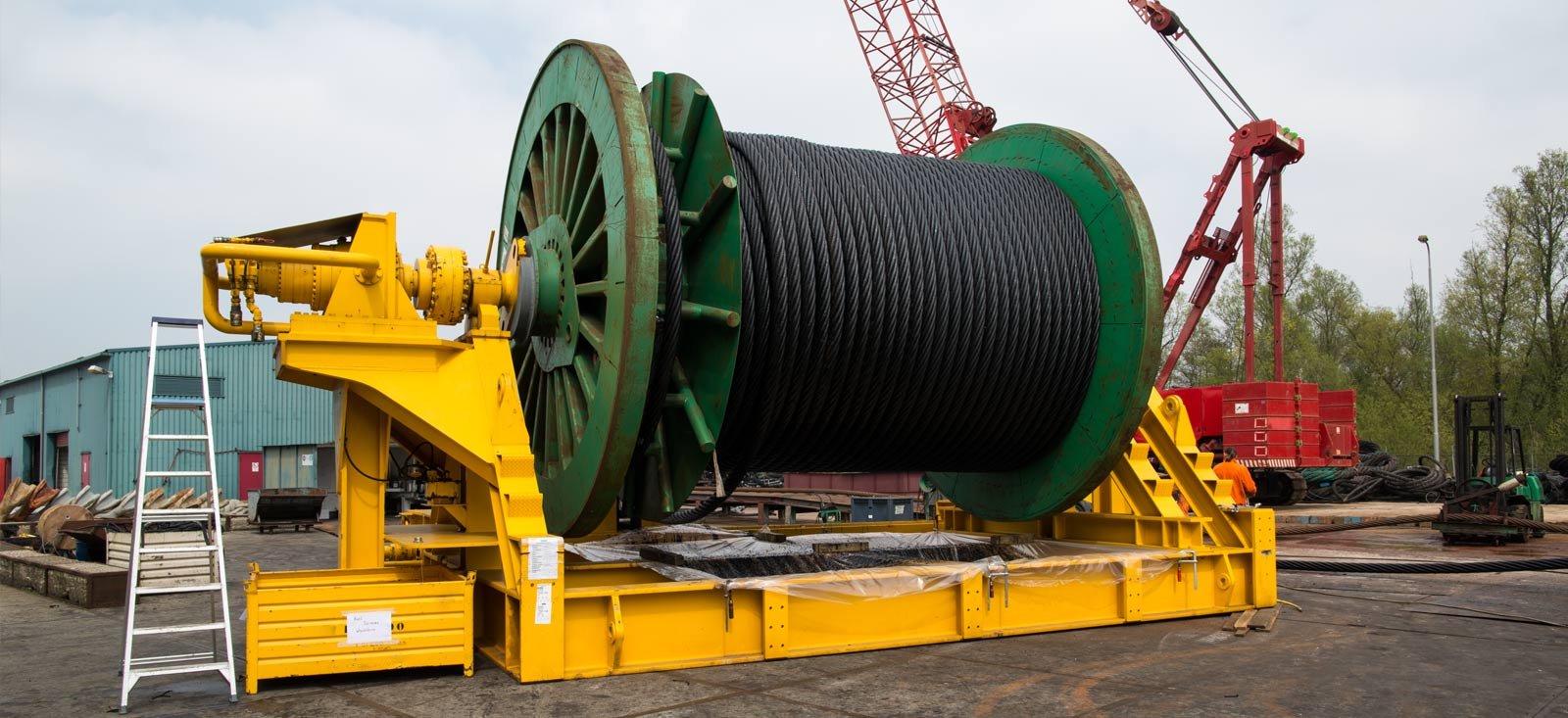
The short answer: for rope-suspended diaphragm wall grabs and hydromills, the default choice is a compacted rotation-resistant rope — 35WXK7 class for grab hoist and cutter winch lines, with 6×K36WS-EPIWRC (or 8×K26WS-EPIWRC on heavy rigs) as the heavy-duty alternative — sized to a minimum 4:1 design factor, preferably 5:1 because of shock loading, and with a plastic-impregnated core wherever the rope runs deep in bentonite slurry. A diaphragm wall rope does not fail from one big overload. It fails from ten thousand small ones: the grab biting into gravel, the cutter stalling on a boulder, panel break-out suction, and a drum full of rope crushed layer upon layer — all while the rope spends its working life bathed in slurry. Here is how I select, size and care for these ropes, based on two decades of specifying rope for grab rigs and cutter machines.

First, Know the Machines and Their Rope Circuits
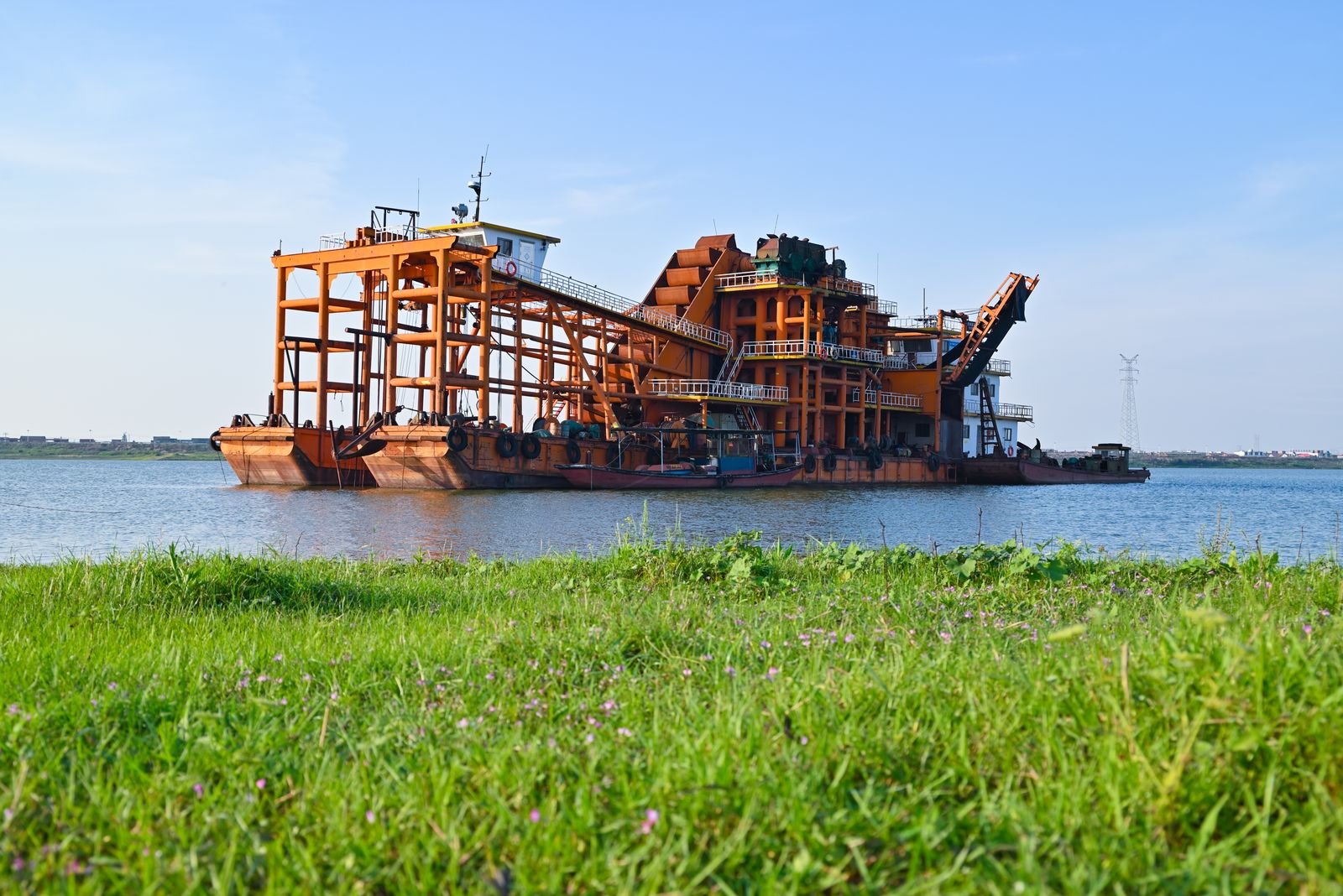
A diaphragm wall is a deep, reinforced concrete wall built panel by panel underground: the panel is excavated under a stabilising bentonite or polymer slurry, a steel cage is lowered in, and tremie concrete displaces the slurry. Metro stations, deep basements, cut-off walls and dam foundations all rely on the method. The machines that excavate those panels hang their tools on wire rope, and the rope circuits differ by machine type:
- Rope-suspended hydraulic grabs — the workhorse for most walls. A heavy grab body with hydraulic jaws hangs on two hoist ropes from a twin-drum winch on a duty-cycle crawler or dedicated rig. Depth typically 20–80 m, diameters up to 1,200 mm and beyond.
- Mechanical 4-rope grabs — older but still common: two holding ropes carry the grab, two closing ropes operate the jaws through sheave blocks. Closing duty is extremely high-cycle.
- Hydromills and hydraulic cutters — for hard soils, rock and very deep panels (100 m+). Two cutter wheels on a heavy frame are suspended on two or four hoist ropes; the frame itself can weigh 20–40 tonnes, so the ropes see enormous static load plus shock when the cutters stall.
- Base machine circuits — boom hoist and auxiliary winch ropes on the duty-cycle crawler itself, plus chaser and service lines.
| Rope circuit | What it does | Typical recommended construction | Watch out for |
|---|---|---|---|
| Grab hoist ropes (2 falls) | Suspend, lower and raise the hydraulic grab; the full panel depth, every cycle | 35WXK7 or 35×K7, grade 1960–2160, EPIWRC for slurry work | Shock on bite and break-out; free-hanging load rotation |
| Closing / holding ropes (4-rope grabs) | Jaw closing through sheave blocks; extremely high cycle count | 6×K36WS-EPIWRC compacted; 6×36WS-IWRC on smaller machines | Bending fatigue over small sheaves; crushing |
| Hydromill / cutter hoist (2–4 falls) | Lower, hold and raise a 20–40 t cutter frame; precise depth control | 35WXK7 or 6×K36WS-EPIWRC, grade 1960–2160 | Static load dominance; cutter stall shock loads |
| Boom hoist (duty-cycle crawler) | Raises and holds the lattice boom | 6×36WS-IWRC or compacted 6×K36WS | Mostly static; inspect for corrosion and diameter loss |
| Auxiliary / service winch | Chaser lines, cage handling, tremie support | 6×36WS-IWRC | Abuse, dragging, kinking on site |
Why Diaphragm Wall Duty Kills Ropes
Foundation contractors who run both rotary drilling rigs and wall grabs often ask me why the grab ropes wear out faster on similar depths. Five reasons, all specific to wall duty:
1. Shock loading on every cycle. When the grab bites into dense sand, gravel or weathered rock, line tension spikes far above the static weight. When a filled grab or the cutter frame breaks free of the panel — slurry and soil hold suction surprisingly well — the load releases with a snatch. A snatch can momentarily double the static load, and it is applied thousands of times per panel, not once in the rope’s life.
2. Full immersion in slurry. Below the guide frame, the rope runs bathed in bentonite or polymer slurry carrying sand and rock fines. The slurry washes the manufacturer’s lubricant out of the core and replaces it with an abrasive paste — the worst possible trade. When the machine stands idle, the wet rope on the drum starts corroding.
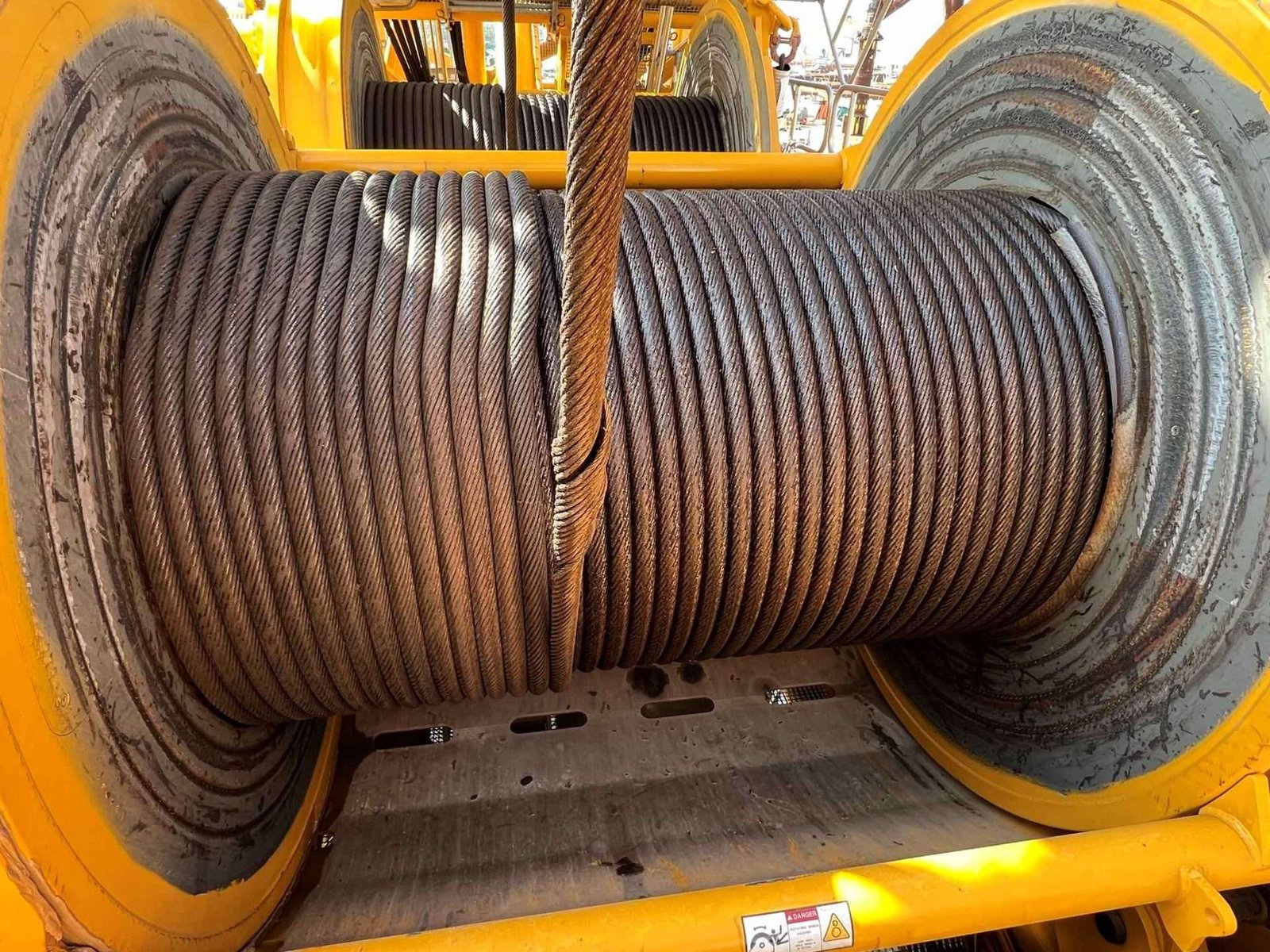
3. Multi-layer drum spooling. A 60 m panel with two falls needs well over 130 m of rope per drum including dead wraps. That means four, five, sometimes six layers on the winch, with all the crushing and cross-over rope bite that deep multi-layer winding implies — the same physics I described for crawler crane hoist ropes, but at higher cycle counts.
4. Free-hanging, torque-sensitive loads. The grab or cutter frame hangs with nothing to stop it rotating. A conventional 6-strand rope under load untwists and spins the tool; grab bodies shear pins, hoses twist, and the rope itself unlays. Rotation resistance is not a nicety here — it is a functional requirement.
5. Obstructions. Boulders, old foundations and reinforcement from previous works stall cutters and jam jaws. Every stall is a shock event delivered straight through the rope.
Choosing the Construction: Rotation-Resistant and Compacted
Because the load hangs free, I start from rotation-resistant constructions. The naming tells you what you are buying: 35WXK7 means 35 strands in multiple counter-laid layers around a core, Warrington wire pattern in the strands (W), compacted strands (K), laid in alternating directions (rotation-resistant class). The outer layers of strands are laid opposite to the inner ones, so the torques cancel and the load barely spins. The compaction — strands drawn through dies after stranding — flattens the wires against each other, raising the fill factor and delivering roughly 10–15% more breaking force for the same diameter, plus a smooth, dense surface that resists abrasion from sandy slurry and crush damage on the drum far better than a round-strand rope.
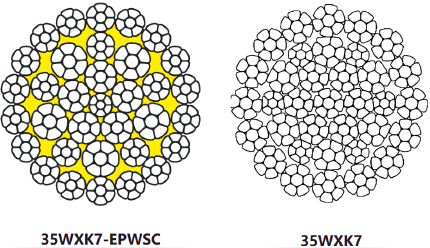
For the heaviest machines I step up to 6×K36WS-EPIWRC — six compacted 36-wire Warrington-Seale strands over an independent wire rope core with a plastic impregnation — and on heavy rigs 8×K26WS-EPIWRC for extra bending fatigue life. The EPIWRC part matters more on wall machines than anywhere else: the polymer layer between core and strands locks the lubricant in and seals the core against slurry ingress, which directly attacks failure cause number two above. It also cushions internal steel-on-steel contact under shock loads.
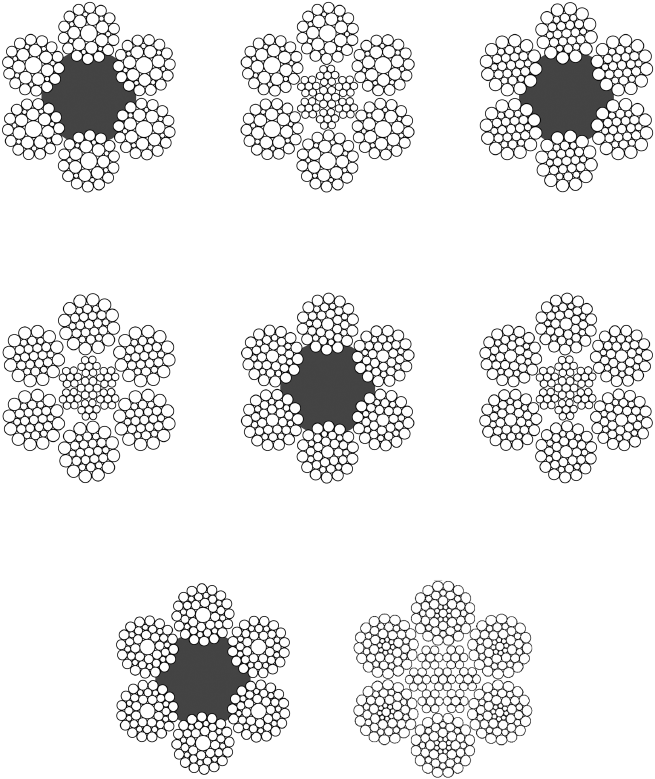
My article on compacted and plastic-impregnated rope covers the manufacturing side in detail.
| Construction | Rotation resistance | Breaking force | Crush / abrasion | Best for |
|---|---|---|---|---|
| 35WXK7 (35-strand, compacted, RR) | Excellent — near zero rotation | Highest per diameter | Very good | Grab hoist and cutter hoist lines, single or twin fall |
| 35×K7 (compact parallel-closed) | Excellent | Very high | Very good | Alternative where slightly stiffer rope is acceptable |
| 6×K36WS-EPIWRC | Moderate — not for single free-hung loads | High (+10–15% vs round) | Very good; core sealed | Heavy cutter hoists, 4-rope grabs, multi-fall reeving |
| 8×K26WS-EPIWRC | Moderate | High | Good fatigue life | Heavy rigs with smaller sheaves, high-cycle closing duty |
| 6×36WS-IWRC (round strand) | Low — twin fall with swivel-free reeving only on guided loads | Baseline | Adequate | Boom hoist, auxiliary and service winches |
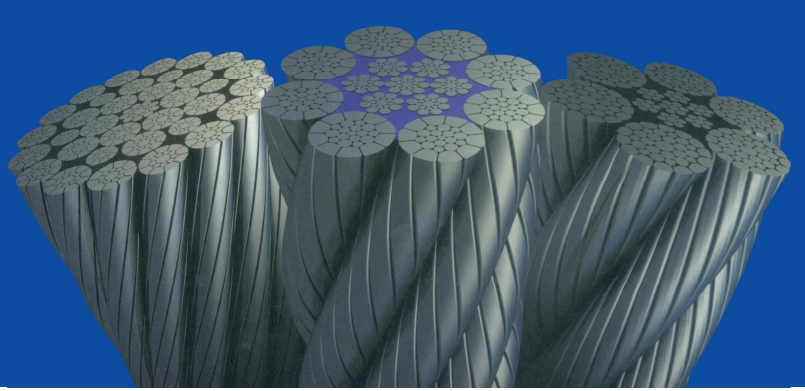
One caution I give every contractor: never fit a swivel to a rotation-resistant rope on these machines. The rope’s torque balance depends on the strands being free to share load internally; a swivel lets the rope untwist itself, the outer strands lose tension, the core takes the load alone, and the rope develops hidden internal breaks. The counter-intuitive rule — the more rotation-resistant the rope, the less you swivel it — is explained in depth in my rotary drilling rig rope guide.
Sizing: MBL and Design Factor for Shock Duty
Sizing follows the same arithmetic as any hoisting rope: take the maximum line pull per fall, apply a design factor, and pick the diameter whose minimum breaking force (MBL) covers it with room to spare. What differs on wall machines is the factor. Because of the bite shocks, break-out snatches and stall events, I recommend 4:1 as the absolute minimum and 5:1 as the working norm for grab and cutter hoist lines, and I know several OEMs who specify more. A 3.5:1 factor borrowed from general crane practice will pass the calculation and still disappoint you in the field.
Worked example: a hydraulic grab with battery, slurry-filled body and cuttings totals 40 tonnes suspended — 20 tonnes (196 kN) per fall on a twin-drum machine. A 32 mm 35WXK7 at grade 1960 has an MBL of about 903 kN (from our own test-verified tables). That gives 903 / 196 = 4.6:1 — acceptable. At grade 2160 (MBL 995 kN) it rises to 5.1:1, which is where I would want to be for rock duty. The table below shows typical diameters:
| Rope diameter | MBL 35WXK7, 1960 MPa | MBL 35WXK7, 2160 MPa | Permissible line pull at 5:1 (1960) | Typical use |
|---|---|---|---|---|
| 26 mm | 596 kN | 657 kN | 119 kN (12.1 t) | Small grabs, shallow panels |
| 28 mm | 691 kN | 762 kN | 138 kN (14.1 t) | Standard grab rigs to ~50 m |
| 32 mm | 903 kN | 995 kN | 181 kN (18.4 t) | Large grabs, medium cutters |
| 36 mm | 1,143 kN | 1,260 kN | 229 kN (23.3 t) | Heavy cutter hoists, deep panels |
| 40 mm | 1,411 kN | 1,555 kN | 282 kN (28.8 t) | Very heavy cutters, 4-fall suspension |
Two sizing mistakes I see repeatedly. First, sizing on grab empty weight instead of grab + jaws full of soil + suction on break-out — the break-out moment, not the crane chart, sets the real peak. Second, ignoring drum capacity: check drum capacity first. A worked-out length formula for deep machines: working length = panel depth × falls + 3 dead wraps on the drum + 10–15% allowance for re-reeving and end-for-ending.
Installation Notes That Pay Back
Wall machines change ropes rarely but painfully — usually at night, before an important panel. A few installation habits extend the new rope’s life dramatically:
- Unreel correctly. The reel must rotate as the rope leaves it, on a spindle or roller stand — never spin rope off a fixed reel or drag it off a coil. That is how most kinks are born, and a kinked rope is scrap before its first panel.
- Wind on with back tension. Keep 2–5% of the rope’s breaking force on the rope as it spools, so the first layer sits tight and every layer above nests neatly. A loose first layer guarantees crushing damage in the layers below within weeks.
- Seize before cutting — bindings on both sides of the cut, tight enough to hold the lay — or the rope ends will loosen permanently.
- Break in gently. Run the first dozen cycles at reduced load and speed; this seats the rope on the drum and in the sheaves and lets the constructional stretch (about 0.25% on IWRC-class ropes, less on compacted) settle before full-depth panels begin.
- Check sheave grooves and the boom point at every rope change. A sheave that wore in with the old rope will eat the new one at an accelerated rate.
Inspection and Maintenance in Slurry Duty
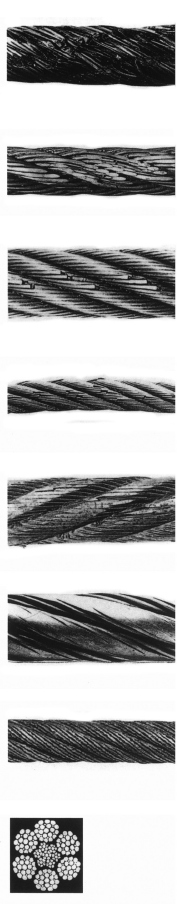
Inspection follows ISO 4309, but slurry duty shifts the emphasis. The three things that retire wall-machine ropes earliest are broken wires from bending and shock fatigue, diameter loss from abrasion and crushing, and corrosion where the lubricant has been washed out. Because the rope spends most of its working length hidden — in the panel and on the drum — the visible section near the boom point tells you less than usual. I train crews to also feel the rope: run it slowly at no load and note stiffness, crackling, or flats passing through the sheave.
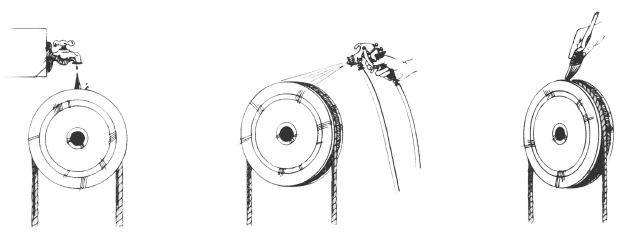
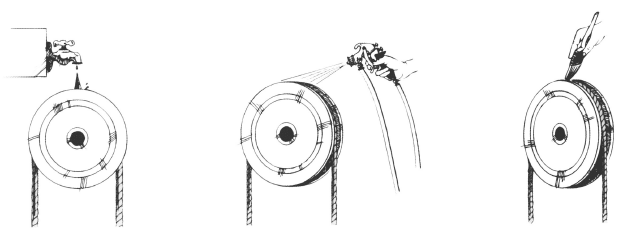
Lubrication discipline is the single highest-return habit on these machines. My practical schedule for grab and cutter ropes: clean and relubricate every 40–80 running hours — more often in sandy ground — using a lubricant that penetrates to the core rather than coating the outside. If the rope runs deep in slurry all day, treat the EPIWRC option as the default, not an upgrade; the polymer layer is what keeps the core lubricated and dry while the outside of the rope is underwater. The full routine, including storage and handling, is in my installation and maintenance guide.
| Interval | Action | Why it matters on wall machines |
|---|---|---|
| Every shift | Visual check of visible rope at boom point and drum; listen for abnormal running noise | Catches fresh break clusters and kinks before the next deep panel |
| Weekly | Slow-motion feel test; measure diameter at 3–4 points; check grab sheaves and guide rollers | Diameter loss tracks abrasion and internal damage the eye misses |
| Every 40–80 h | Clean and relubricate; log it | Slurry strips lubricant faster than any other foundation duty |
| Monthly / per ISO 4309 | Documented thorough examination: broken wire count per lay, corrosion, crush damage, terminations | Rotation-resistant ropes have stricter discard limits — e.g. 2 broken wires in 6d or 4 in 30d |
| After any stall or jam | Inspect before return to service | Cutter stalls and jaw jams are exactly the shock events that break wires internally |
Frequently Asked Questions
What is the best wire rope for a diaphragm wall grab?
For most rope-suspended hydraulic grabs, a compacted rotation-resistant 35WXK7 rope in grade 1960 or 2160, sized to at least 4:1 design factor — 5:1 in hard ground. If the machine works deep in slurry or the rope life is dominated by internal damage, choose the EPIWRC (plastic-impregnated core) version. Heavy hydromills often run 6×K36WS-EPIWRC on their hoists instead, especially with multi-fall reeving.
Why does my grab rope keep failing long before the calculated life?
In order of likelihood: shock loading beyond the design assumption (bite and break-out), crushing on a poorly spooled multi-layer drum, slurry-contaminated core from lapsed lubrication, or worn sheave grooves that punish every cycle. The damage pattern on the retired rope usually names the cause — my article on wire rope failure causes gives you the diagnostic signatures.
Does bentonite slurry lubricate the wire rope?
No — this is a persistent myth. Bentonite slurry is a water-based clay suspension carrying sand and rock fines. It washes the rope’s lubricant out and deposits abrasive particles into the strands. It may make the rope look wet and slick, but underneath, the core is drying out and corroding. Relubricate on a strict schedule and prefer a sealed EPIWRC core for machines working fully submerged.
How much rope do I need for a deep panel machine?
Working length = panel depth × number of falls, plus three dead wraps on the drum, plus a 10–15% allowance for end-for-ending and re-reeving. For a 60 m panel on a twin-fall grab that means roughly 135–145 m per drum — and confirm the drum actually holds that many layers, because added layers increase crushing on the lower wraps.
Can I use a cheaper 6-strand rope on the grab hoist?
On a free-hanging grab, no. A conventional 6-strand rope will spin the tool under load, twisting hoses and working fittings loose, and its round strands crush faster on the multi-layer drum. It is the right rope for boom hoist and auxiliary circuits, but the main hoist lines earn their premium back in machine availability — a grab stopped mid-panel costs far more than the rope difference.
When must I replace a diaphragm wall rope?
Per ISO 4309 and machine-specific rules: when broken wires exceed the limits for the construction class (rotation-resistant ropes are retired at 2 broken wires in 6 rope diameters or 4 in 30), when measured diameter has dropped about 7% on 6-strand ropes or 10% on rotation-resistant ones, or immediately on corrosion pitting, kinking, birdcaging or any deformation.
Final Word: Buy the Rope Like It Is a Wear Part
Wall machines monetise availability: every hour a grab sits on the surface is an hour the panel is not progressing. Treat the hoist ropes as engineered wear parts — specified by construction and grade, sized for shock, installed with back tension, lubricated on schedule and inspected with a logbook — and they will retire on your terms instead of failing mid-panel. If you want a second opinion on a rope that keeps under-performing, or a quotation with full certification, write to me at info@wireropes.net with the machine model, panel depths and the old rope’s certificate.
Aulone is a professional manufacturer and supplier of steel wire ropes, wire rope slings, synthetic ropes and rigging hardware for lifting, marine, mining, construction and industrial applications. With over 20 years in the industry, 200,000 tons of annual capacity and manufacturing to EN 12385-4 under ISO 9001 — certified by BV, ABS, DNV, RMRS and CE — we keep rotation-resistant and compacted constructions in stock for fast shipment, supply custom assemblies with fitted terminations, and arrange third-party testing on request. We have supplied hoist ropes for wall grabs and cutter machines worldwide, and we are happy to review your duty cycle before you order.