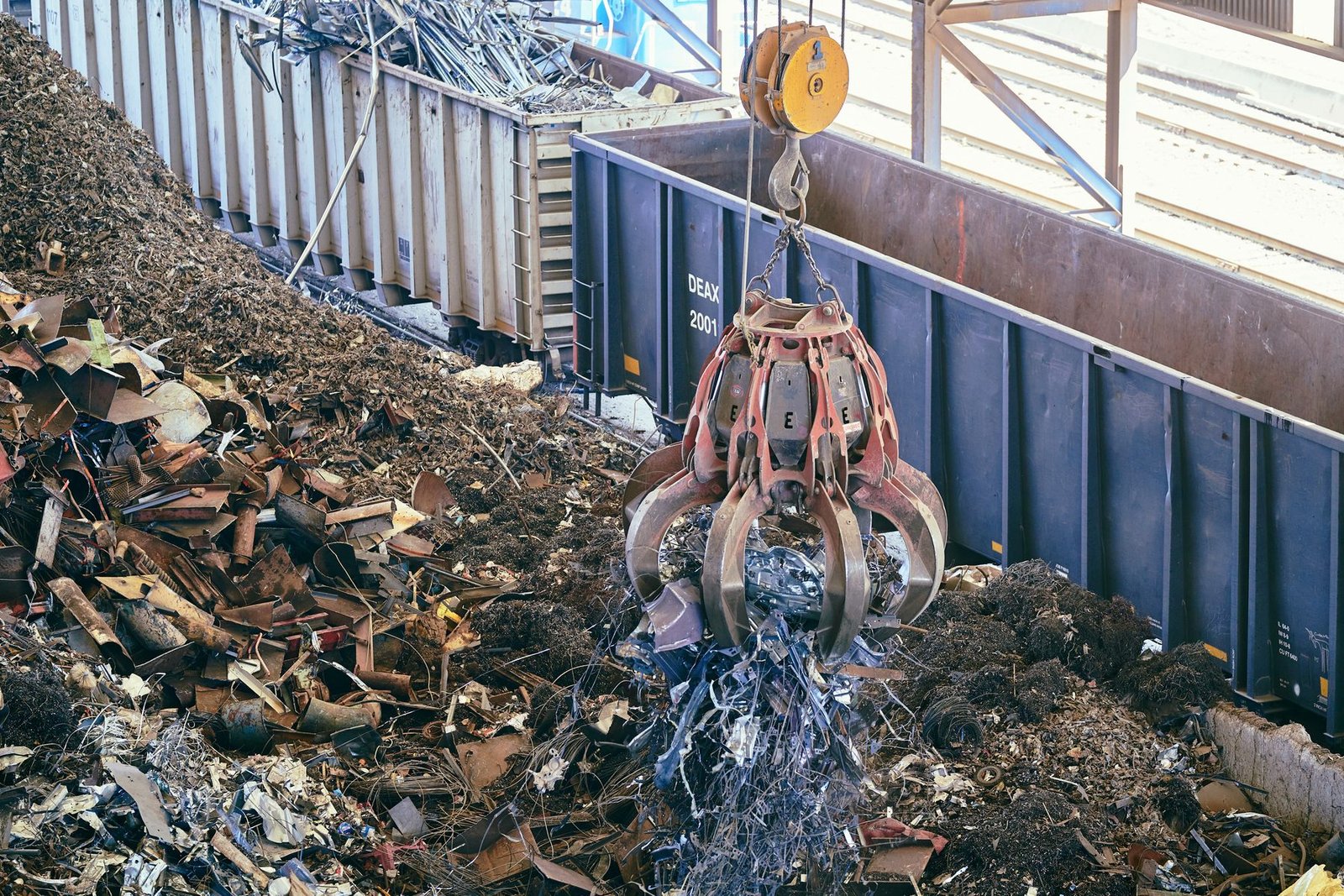
Short answer: for anything that lives near salt water — yacht rigging, coastal architecture, harbor equipment, offshore gear — choose 316 (A4 / EN 1.4401) stainless steel wire rope. For indoor, dry or mildly corrosive service such as architectural cable indoors, gym equipment, machinery controls and display systems, 304 (A2 / EN 1.4301) does the job at a noticeably lower cost. Mechanically, the two grades are almost identical at the same diameter and construction; the decision is almost always about the environment, not the strength.
I have spent most of my career around crane ropes, and stainless steel is the segment where customers ask the fewest questions and regret the most purchases. The failure mode I see again and again is simple: somebody buys a bright, shiny stainless rope, assumes “stainless” means “indestructible”, and puts it where the chloride ions can get at it. Six months later the rope is covered in tea-colored staining or, worse, pitted through. So let me walk you through the whole picture the way I would explain it across the workshop table.

What Exactly Is Stainless Steel Wire Rope?
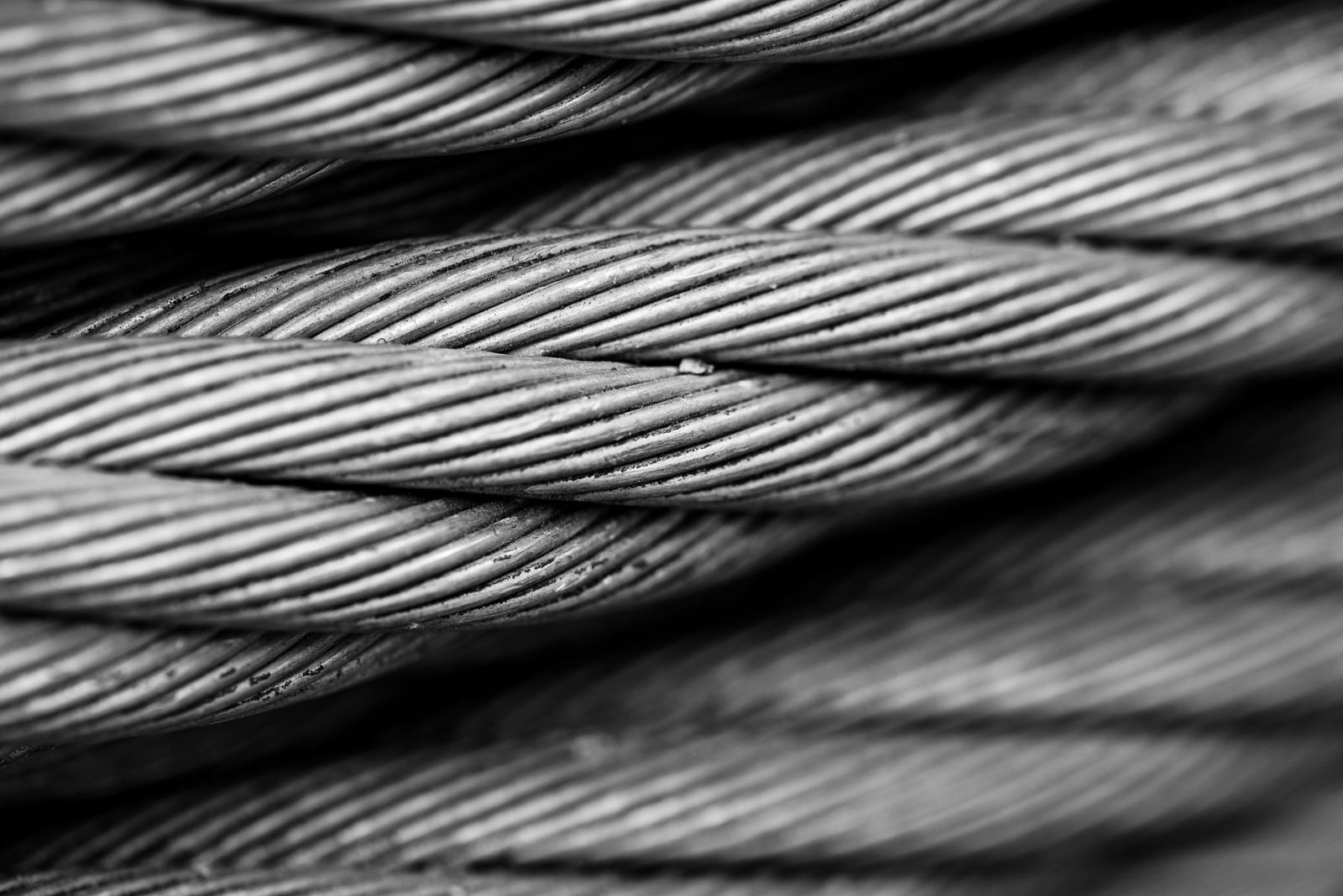
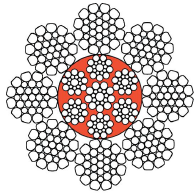
Structurally, a stainless wire rope is built exactly like any other rope: wires are twisted into strands, strands are twisted around a core. What changes is the raw material. Instead of high-carbon steel that gets its corrosion protection from zinc coating (galvanized) or from grease, every wire in a stainless rope is an austenitic stainless steel — usually AISI 304 or AISI 316. The corrosion resistance comes from chromium in the alloy, which forms a thin, self-repairing chromium-oxide passive layer on the surface. Scratch it, and it re-passivates in the presence of oxygen.
Because the protection is through the whole cross-section rather than a coating, a stainless rope keeps resisting corrosion as it wears, bends and rubs. That is a real advantage over galvanized rope, whose zinc layer thins and eventually disappears at the points of highest wear. The trade-offs are a somewhat lower breaking strength per diameter and a significantly higher price, which is exactly why the 304-or-316 decision matters — you should not be paying for corrosion resistance you do not need, nor under-buying for an environment that will eat your rope.
304 vs 316: Composition and Corrosion Chemistry
Both grades are austenitic stainless steels from the same family, and on a spec sheet they look like close cousins. The single most important difference is molybdenum: 316 contains 2–3% Mo, 304 contains essentially none. Molybdenum stabilizes the passive layer and dramatically improves resistance to localized corrosion — pitting and crevice corrosion — which is precisely the kind of attack chlorides cause.
A handy field metric is the PREN value (Pitting Resistance Equivalent Number), calculated as %Cr + 3.3 × %Mo. For 304 it sits around 18–20; for 316 it rises to roughly 23–28. Higher PREN does not mean “immune”, it means “more tolerant”, and in chloride environments that tolerance is everything.
| Property | AISI 304 (EN 1.4301, A2) | AISI 316 (EN 1.4401, A4) |
|---|---|---|
| Chromium | 18–20% | 16–18% |
| Nickel | 8–10.5% | 10–14% |
| Molybdenum | Not added | 2–3% |
| Carbon (max) | ≤ 0.08% (≤ 0.03% for 304L) | ≤ 0.08% (≤ 0.03% for 316L) |
| PREN (approx.) | 18–20 | 23–28 |
| Chloride / salt spray resistance | Moderate — fails early in marine service | Good — the marine standard |
| Relative price | Lower (baseline) | Roughly 20–40% higher |
| Typical rope applications | Indoor architecture, machinery, gym cable, controls | Yacht rigging, coastal structures, offshore, pools, chemical plants |
One more grade you will see quoted is 316L (EN 1.4404), the low-carbon variant. For wire rope it matters mainly for welded assemblies: lower carbon reduces carbide precipitation at weld zones, so terminations and edge details keep their corrosion resistance after fabrication.
Why 316 Wins in Marine and Chloride Environments
Here is the mechanism, because once you understand it you will never mix the grades up again. Chloride ions are small, aggressive and they love to attack the chromium-oxide passive layer at weak points. On a 304 rope hanging near the coast, chlorides concentrate in microscopic crevices — under a clip, between strands, in the crown of a wire — and break the passive film locally. The metal underneath dissolves, the local chloride concentration rises even further, and you get a pit. Pits act as stress concentrators, wires crack earlier in bending, and the process runs happily under a surface that still looks almost clean from a distance.
The molybdenum in 316 makes the passive layer far more stable against this attack, which is why 316 is the default for:
- Standing rigging, lifelines and running gear on yachts and workboats
- Coastal and waterfront architectural cable — railings, facades, safety barriers within a few kilometers of the shore
- Harbor equipment, davits, winches and marine lifting gear
- Swimming pool surroundings — chlorinated water vapor is surprisingly aggressive
- Chemical and food-processing plants with chloride-bearing media
- De-icing salt exposure — roadside structures and winter salt spray zones
If a 304 rope is continuously exposed to salt spray or splashed with seawater, expect visible tea staining within months and meaningful section loss well before a year. A 316 rope in the same service, rinsed occasionally with fresh water, can go for years. That is the practical gap you are paying the 20–40% premium to close — and in most marine cases it is the cheap option once you count rope replacements and downtime.
Is Stainless Wire Rope Strong Enough?
This is the second-biggest worry after corrosion, and it is mostly misplaced. Stainless ropes are made from wire with nominal tensile strengths of typically 1570 N/mm² or 1770 N/mm², so a stainless rope gives up roughly 10–15% of breaking force compared with the strongest bright/galvanized crane ropes. Between 304 and 316, the difference at the same diameter and construction is minor — a few percent at most — so grade selection should never be a strength decision.
Typical minimum breaking loads for 7×19 stainless rope at 1770 N/mm² look like this (values are indicative; always confirm against the manufacturer’s certificate):
| Diameter | Construction | Weight (kg/100 m) | Min. breaking load (kN) | Typical working load at 5:1 |
|---|---|---|---|---|
| 2 mm | 7×19 | 1.6 | 2.3 | 0.46 kN |
| 3 mm | 7×19 | 3.6 | 5.2 | 1.04 kN |
| 4 mm | 7×19 | 6.4 | 9.2 | 1.84 kN |
| 5 mm | 7×19 | 10.0 | 14.4 | 2.88 kN |
| 6 mm | 7×19 | 14.4 | 20.8 | 4.16 kN |
| 8 mm | 7×19 | 25.6 | 37.0 | 7.40 kN |
| 10 mm | 7×19 | 40.0 | 57.7 | 11.5 kN |
| 12 mm | 7×19 | 57.6 | 83.2 | 16.6 kN |
If you are sizing rope for an actual lifting application, keep the design factor honest — the same 5:1 logic that governs general-purpose ropes applies here, and I explain the full method in our wire rope breaking strength, MBL and safety factor guide. For heavy lifting you will rarely choose stainless anyway; it earns its keep in corrosion, hygiene and appearance.
Choosing the Right Construction: 1×19, 7×7, 7×19 and 6×36
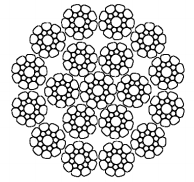
Grade is half the decision; construction is the other half. Stainless rope comes in the same families as carbon steel rope, and each has a distinct personality:
| Construction | Flexibility | Min. sheave D/d (practical) | Best for |
|---|---|---|---|
| 1×19 | Very stiff | ≈ 40:1 | Guys, stays, structural tension members, sailboat standing rigging |
| 7×7 | Semi-flexible | ≈ 30:1 | Lighter static lines, push-pull controls, small guard rails |
| 7×19 | Flexible | ≈ 20–25:1 | Cable railing, gym equipment, winch lines on small drums, fall-arrest, general marine running gear |
| 6×36 IWRC | Flexible, high strength | ≈ 20:1 | Larger diameters, heavier marine and industrial loads, cranes in corrosive settings |

My rule of thumb, learned from the railing projects that keep coming back to us: if the rope runs over sheaves or pulleys, go 7×19 as the baseline. If it is a straight tension member, 1×19 gives you the cleanest look and the highest strength per diameter. If the diameter exceeds roughly 12–16 mm or the load is serious, move to 6×36 with an IWRC — the core matters here, and we explain why in our IWRC vs fiber core comparison. More detail on the large-diameter option is in our 6×36 wire rope specifications guide.
Matching the Grade to the Application
When a customer sends me an inquiry, the first thing I ask is not the diameter — it is the postcode, effectively. Indoor or outdoor? Salt air within sight of the sea? Pool or chemical plant nearby? The grade follows almost mechanically from the answers:
| Environment / Application | Recommended grade | Why | |
|---|---|---|---|
| Indoor architectural cable, balustrades | 304 | No chloride exposure; 304 looks good for decades | |
| Inland outdoor railing, gates, green walls | 304 (316 if near roads salted in winter) | Rain and de-icing salt decide it | |
| Gym and fitness cable | 304 / 316 | Sweat is salty — humid gyms justify 316 | |
| Coastal buildings, marinas, boats | 316 | Continuous salt spray | |
| Swimming pools, water treatment | 316 | Chlorinated media attack 304 quickly | |
| Chemical / food processing | 316 / 316L | Chlorides and washdown chemicals; L grade for welded parts | |
| Offshore and continuous seawater | 316 minimum, inspect frequently | Even 316 needs cleaning and monitoring when submerged |
Mistakes I See With Stainless Wire Rope
“Stainless means it can’t rust”
It can and it will, given chlorides and neglect. The classic is tea staining — brown streaks caused by surface contamination and salt concentration. It usually starts where chlorides sit: under rope clips, at swage fittings, anywhere water pools. A 316 rope rinsed with fresh water occasionally stays clean for years; the same rope ignored in a marina will stain. And if carbon steel debris or free iron gets burnished into the surface (from a wire brush used on carbon steel, a contaminated roller, or contact with a grinding wheel), the embedded iron rusts and drags the surface down with it.
Mixing metals in the assembly
Pair a stainless rope with galvanized clips and thimbles and you create a galvanic couple: the zinc sacrifices itself, the protection disappears and the assembly corrodes at the interface. Match your terminations to the rope — stainless 316 fittings for 316 rope, and if you must mix, isolate the contact surfaces. Our galvanized vs bright vs stainless comparison goes deeper into where each finish belongs.
Underestimating D/d ratios
Stainless wire work-hardens when it bends, and fatigue failures follow small sheaves. Respect the D/d ratios in the construction table above — a 7×19 rope bent around a D/d of 10 loses most of its fatigue life no matter how good the alloy is. Bent-over-sheave stainless ropes also grow slightly magnetic as they work-harden, which is normal and not a defect.
Sizing by breaking load alone
Corrosion-resistant does not mean fatigue-proof or wear-proof. Abrasion, drum crushing and shock loads kill stainless ropes just as they kill any rope. Apply the proper design factor for the application, not just “it holds the static load”.
Inspection and Maintenance of Stainless Wire Rope
Stainless rope does not get an exemption from inspection discipline. The same ISO 4309 discard criteria that govern crane ropes — broken wire counts, valley break rules, diameter reduction, corrosion states — apply to stainless ropes in lifting service. What changes is the baseline appearance: light surface staining is cosmetic, but any visible pitting is a red flag, because pits hide section loss that a casual glance misses.
A maintenance routine that works in practice:
- Rinse with fresh water in marine or salt-spray service — periodically for atmospheric exposure, more often for splash-zone rope
- Clean, don’t abrade — mild soap and a soft brush; never a carbon-steel wire brush
- Lubricate running ropes with a lubricant compatible with stainless rope; our wire rope lubrication guide covers the options
- Inspect terminations — crevices under clips and swage sleeves are where corrosion starts
- Keep records — diameter at fixed points, wire breaks, date and environment, so trends are visible before failure
Frequently Asked Questions
Is 316 stainless steel wire rope rust-proof?
No grade is rust-proof. 316 is highly resistant to chlorides, but salt deposits left on the surface can still cause tea staining and, in crevices, pitting. Regular fresh-water rinsing and matching stainless fittings keep it looking and performing like new.
Can I use 304 stainless wire rope outdoors?
Yes, in inland and urban environments 304 performs well for years — railings, gates, green walls, garden structures. Within a few kilometers of the coast, or wherever de-icing salt spray reaches the rope, step up to 316.
Is stainless steel wire rope weaker than galvanized?
Slightly, at the same diameter — typically 10–15% lower minimum breaking load, because the alloy trades a little tensile strength for corrosion resistance. Between 304 and 316 the strength difference is negligible; choose by environment.
What construction is best for cable railing?
3–6 mm 7×19 is the workhorse: flexible enough to tension cleanly, smooth in appearance. Use 1×19 only for straight, low-flex runs where maximum stiffness and a tidy look matter more than bendability.
Why has my stainless rope become magnetic?
Cold working — drawing, twisting, and repeated bending over sheaves — transforms some austenite into martensite, which is magnetic. It is a normal sign of work-hardening, not a defect. Extreme magnetism plus visible fatigue breaks, however, means the rope is telling you it is tired.
How long does 316 stainless rope last in seawater?
It depends on exposure and care. In full-time seawater immersion no stainless rope is a long-life solution — that is a job for planned replacement and inspection. In splash and atmospheric marine zones, a rinsed 316 rope commonly delivers many times the service life of 304 in the same spot.
The Bottom Line
Pick the grade by the environment, pick the construction by the bending duty, and treat “stainless” as “lower maintenance”, never “no maintenance”. Get those three things right and a stainless rope is one of the most satisfying products in the wire rope business — quiet, clean and dependable for years.

Aulone is a professional manufacturer and supplier of steel wire ropes, wire rope slings, synthetic ropes and rigging hardware for lifting, marine, mining, construction and industrial applications. With more than 20 years of manufacturing experience and an annual capacity of 200,000 tons, we produce stainless and carbon steel wire ropes to EN 12385-4 under an ISO 9001 quality system certified by BV, ABS, DNV and RMRS, with CE marking available. Common constructions are in stock for fast delivery, and we supply custom assemblies — cut to length, terminations fitted, and third-party testing on request — for customers worldwide.
Questions about a stainless rope application? Send us your environment, diameter and duty cycle and we will recommend the right grade and construction: info@wireropes.net