The short answer: lay describes two things — the direction the strands spiral around the rope (right or left) and the relationship between the wire twist in the strand and the strand twist in the rope (regular lay vs Lang’s lay). Right-hand regular lay, code sZ, is the default for roughly 90% of the rope sold worldwide. Lang’s lay, code zZ, lays the wires nearly parallel to the rope axis, which buys you 15–20% longer fatigue life and far better wear resistance — but it also wants to spin like a released spring, so it only belongs where both rope ends are fixed or the torque is balanced by a second, opposite-lay rope. Breaking strength is identical either way. After twenty years of matching ropes to machines, I can tell you lay is one of the cheapest specifications to get right at the order stage and one of the most expensive to discover wrong in service. Here is the whole picture.
What “Lay” Actually Means: Two Separate Descriptors
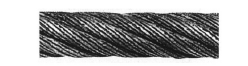
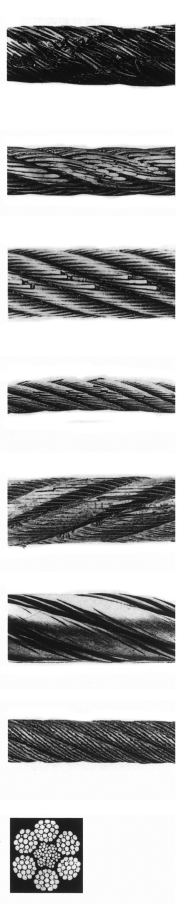
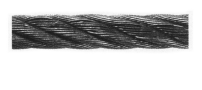
Buyers mix these up constantly, so let us split them cleanly. Lay direction is simply the handedness of the strand helix: look along the rope axis and if the strands spiral away from you like a standard screw thread, that is right-hand lay (Z); if they spiral the opposite way, left-hand lay (S). Lay type is the relationship between the two levels of twist: in regular lay (also called ordinary lay), the wires are twisted into the strand in the opposite direction to the strands-around-the-core twist; in Lang’s lay, both twists run in the same direction. The two descriptors are independent, which gives four possible combinations.
EN 12385-2 writes the combination as a two-letter code: the lowercase letter is the wire lay direction in the outer strand layer, the uppercase letter is the strand lay direction in the rope.
| EN 12385-2 code | Common name | Wires vs strands | Where you meet it |
|---|---|---|---|
| sZ | Right-hand regular lay (RHOL) | Opposite directions | The universal default — crane hoists, slings, general engineering |
| zS | Left-hand regular lay (LHOL) | Opposite directions | Pairs with sZ to balance torque; oilfield rod and tubing lines |
| zZ | Right-hand Lang’s lay (RHLL) | Same direction | Mining hoists, draglines, dredge lines, chairlifts — always with controlled rotation |
| sS | Left-hand Lang’s lay (LHLL) | Same direction | Paired against zZ in matched-pair systems (trawl warps, gate hoists) |
If an order does not state the lay, the presumption in every standard and every mill is right-hand regular lay, sZ. Everything else is a deliberate engineering choice that should appear in writing on the purchase order.
Regular Lay: Why It Is the Default
In regular lay rope the counter-twist between wires and strands self-cancels. The outer wires run almost parallel to the rope axis and appear to lie in neat, short crowns across the surface. That geometry produces three properties that made regular lay the industry workhorse:
- Structural stability. The rope resists kinking, does not try to untwist when the load hangs free, and tolerates rough handling on the reel and in the workshop.
- Crush resistance. On multi-layer drums, regular lay strands interlock and support each other better under the crushing pressure of the wraps above.
- Inspectability. Broken wires stand proud of the crown and are easy to see and count — one reason ISO 4309 allows more broken wires for ordinary lay than for Lang’s lay.
The price is wear concentration. Because each outer wire presents only a short exposed length at a steep angle to the sheave groove, contact pressure concentrates on small spots, and abrasion and bending fatigue eat through those spots first.
Lang’s Lay: Built for Wear and Bending Fatigue
Lang’s lay twists wires and strands in the same direction, so the outer wires come to rest nearly parallel to the rope axis, presenting long, continuous bearing surfaces to the groove. The consequences are exactly what a fatigue-limited application wants:
- Better groove contact. Longer wire exposure spreads contact pressure, which sharply reduces abrasive wear on wires, sheaves and drums alike.
- Longer fatigue life. Bending a Lang’s lay rope over a sheave flexes the outer wires less severely. The US Army Corps of Engineers wire rope manual credits Lang’s lay with a 15–20% service-life advantage over regular lay when bending is the dominant failure mode.
- Considerably better spooling behaviour on multi-layer drums, as rope makers note in their technical literature — the rope seats into the layer below more cleanly.
Now the bill. Lang’s lay rope has a strong tendency to rotate and untwist under load: with one end free, a tensioned Lang’s lay rope will spin toward laying itself out straight, and with a free end and no tension it can literally open up (unlay). It is more prone to kinking during handling, less tolerant of crushing, and harder to inspect — its broken wires tend to break flush inside the valleys where you cannot see them, which is why discard criteria for Lang’s lay are stricter. And it is explicitly not recommended for slings (Australian standard AS 1666.1 is the usual citation): a sling has both ends free, and a Lang’s lay sling relaxes and loosens when the load comes off.
Head to Head
| Property | Regular lay (sZ / zS) | Lang’s lay (zZ / sS) |
|---|---|---|
| Rotation / torque under load | Low — stable with one end free | High — wants to untwist; both ends must be fixed or balanced |
| Abrasion resistance | Good; wear concentrated on short wire crowns | Excellent; long wire exposure spreads the load |
| Bending fatigue life | Good | 15–20% better when bending governs |
| Crush resistance on drums | Excellent | Moderate |
| Kink resistance in handling | Excellent | Poor — handle with care, no loose coils |
| Broken wire visibility | Stand proud of crowns, easy to count | Break flush in valleys, harder to see |
| Minimum breaking force | Identical — lay does not change MBL for the same construction, grade and core | |

The Rotation Rule: Both Ends Fixed or Torque Balanced
Everything about where Lang’s lay belongs follows from one rule: never let a Lang’s lay rope rotate freely under load. In practice that means one of three system designs:
- Both rope ends secured against rotation — socketed or effectively fixed at the drum and at the attachment. Mining drum hoists and Koepe friction winders, dragline bucket hoists, and many excavator and dredge winches work this way. Luffing systems and passenger ropeways (chairlifts) are classic Lang’s lay users for exactly this reason.
- Multi-part reeving — several falls through a hook block, where the falls can counter-rotate against each other and the hook swivel absorbs residual torque.
- Matched opposite-lay pairs — run one right-lay and one left-lay rope so their torques cancel. Trawl warps and dredge side wires are supplied as matched RH/LH pairs for this reason (and never splice opposite lays into each other), and the same logic balances counterweighted gate hoists on dam structures.
A related piece of oilfield trivia explains left-hand lay’s niche: on rod and tubing lines, the rotation of a right-lay rope would loosen right-hand threaded couplings, so left-lay rope is specified because its rotation tightens them.
One absolute prohibition: no swivels on Lang’s lay rope — or on any rope, honestly, but especially here. A swivel deliberately allows the untwisting that Lang’s lay construction is fighting against; let it spin and you will watch the rope unlay itself into scrap. The same rule applies to rotation-resistant ropes, which we will separate out in a moment because they get confused with Lang’s lay constantly.
Where Each Lay Belongs
| Application | Usual lay | Why |
|---|---|---|
| Crane hoist lines (single fall) | Rotation-resistant rope, never plain Lang’s lay | Free-hanging load with one effective rope — torque would spin the hook |
| Crane hoist lines (multi-part) | Regular lay sZ | Stability, crush resistance, easy inspection |
| Mining drum hoists / Koepe winders | Lang’s lay zZ (or sS) | Both ends fixed; bending fatigue is the life limiter |
| Dragline and electric shovel ropes | Lang’s lay | Abrasion plus bending fatigue, guided systems |
| Dredge side wires / trawl warps | Matched Lang’s lay pairs (zZ + sS) | Torque balance between paired lines |
| Passenger ropeways / chairlifts | Lang’s lay | Fixed terminations, long fatigue life demanded |
| Wire rope slings | Regular lay only | Both ends free to rotate; Lang’s lay loosens when unloaded (AS 1666.1) |
| Oilfield rod / tubing lines | Left-hand regular lay zS | Rotation tightens rather than loosens the string |
If your application sits in the first row and you are weighing rotation-resistant constructions in detail, our 35xK7 vs 19×7 guide covers that family separately. For the deep mine-hoist and dragline picture, see the mining wire rope guide; for matched-pair marine lines, the dredger rope guide and trawl rope guide.
Do Not Confuse Lang’s Lay with Rotation-Resistant Rope
This is the most common mix-up in purchase orders, and it is worth a section of its own. Lang’s lay is a lay type within a conventional 6- or 8-strand rope. Rotation-resistant ropes (18×7, 19×7, 35×7 class, and layered constructions like 35WXK7) are an entirely different concept: they build the rope in two or more layers with opposite lay directions, so the torque of the outer layer counteracts the torque of the inner one. Under ISO 21669 and EN 12385-3 definitions, a semi rotation-resistant rope rotates between one and four turns over 1000×d at 20% of minimum breaking force — a measured, bounded amount of spin, not the free untwisting of a Lang’s lay rope with a loose end.

Practical consequence: a 35WXK7 rotation-resistant rope is itself manufactured in regular lay, and it must never be fitted with a swivel and must never be spliced or re-terminated casually — the counter-laid layers slip relative to each other if you do. Rotation resistance solves the spinning-hook problem; Lang’s lay solves the wear-and-fatigue problem. They are answers to different questions.
Lay Length: The Third Variable Most Buyers Ignore
Besides direction and type, there is lay length — the axial distance a strand travels to complete one full helix around the rope, written h in the standards. On a 6-strand rope it typically runs 6.5 to 7.5 times the rope diameter. You care about it for two reasons:
- Inspection arithmetic. Broken-wire discard limits in ISO 4309 are counted per lay length, so your inspectors need to know the actual lay length of the rope on the machine — mark it off with tape rather than guessing.
- Feel and life. Within the designer’s band, a longer lay length runs a little stiffer and gives marginally more strength and abrasion resistance; a shorter lay length bends more easily and can improve sheave fatigue behaviour. This is one reason two brands of the “same” rope can feel different in service. The lay length is a design value fixed at manufacture (EN 12385-2 lists it as a manufacturer’s design value) — it is not a field adjustment, and you should not try to make it one.
How to Order the Right Lay
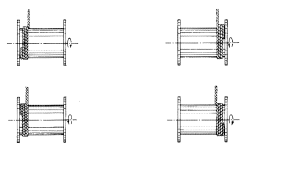
Lay is part of the full rope designation, and it costs nothing to specify. A complete order line to EN 12385-2 / ISO 17893 reads for example: 22 mm 6×36WS-IWRC 1960 B sZ — diameter, construction and core, grade, galvanizing class, lay. If you need a matched pair for a dredge or gate system, order it explicitly as one zZ and one sS rope, or one sZ and one zS, and state that they are a pair — mills plan production around opposite-lay pairing.
For replacements, the standing rule is like-for-like: put the same lay back that came off unless an engineer has deliberately re-specified. Swapping a regular lay hoist rope for Lang’s lay “because it lasts longer” on a machine with a free-hanging single fall is not an upgrade, it is a hook that spins. If you are unsure what is on the drum, read it off the certificate or the reel tag — the sZ/zZ code is always there on compliant paperwork — or send me a photo of the tag.
Aulone is a professional manufacturer and supplier of steel wire ropes, wire rope slings, synthetic ropes and rigging hardware for lifting, marine, mining, construction and industrial applications. We produce right- and left-hand lay in regular and Lang’s lay across our 6×36, 8×36, 18×7/19×7, 35×7 and 35WXK7 ranges, with over 20 years in the industry, 200,000 tons of annual capacity, EN 12385-4 manufacturing under ISO 9001 and BV, ABS, DNV, RMRS and CE certification. Common constructions are in stock for fast shipment, and we supply custom assemblies — matched lay pairs included — with third-party testing on request. Write to me at info@wireropes.net and tell me the machine and duty; I will confirm the lay, construction and length before you commit the order.
Handling Lang’s Lay Rope Without Ruining It
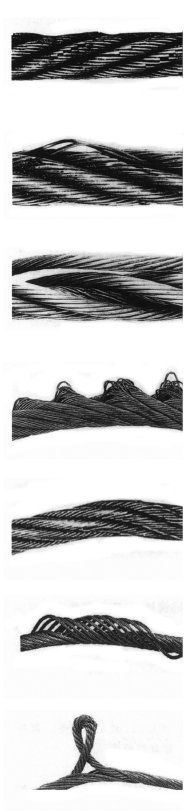
If you do end up with Lang’s lay on a drum, a few handling habits protect it. Unreel it under control — never let the end whip, and never roll a loose coil off the floor, because Lang’s lay kinks more readily than regular lay. Seize the rope tightly on both sides before cutting; even preformed Lang’s lay opens up more eagerly than regular lay when cut. Keep it away from small-diameter sheaves and undersized grooves, which pinch and distort the longer-exposure wires it depends on. And train your inspector on the flush-breaking-wire behaviour: run a spike gently through the valleys when checking for breaks, and apply the stricter Lang’s lay discard numbers from ISO 4309 rather than the regular-lay ones. A kink in Lang’s lay is just as final as in any other rope — the section below is a retirement, not a repair candidate.
Frequently Asked Questions
Does lay direction affect wire rope breaking strength?
No. For the same diameter, construction, grade and core, regular lay and Lang’s lay ropes have the same minimum breaking force — the standards calculate it identically. Lay changes rotation behaviour, wear distribution, fatigue life and inspectability, not strength.
Can I replace a regular lay rope with Lang’s lay to get longer life?
Only if the system controls rotation — both ends fixed against spinning, or torque balanced through multi-part reeving or an opposite-lay partner rope — and only after an engineering review of drum crushing and sheave groove condition, which Lang’s lay tolerates less well. On a free-hanging single fall, never.
Why is Lang’s lay not used for wire rope slings?
A sling has both ends free. Under load a Lang’s lay sling tries to untwist, and when the load releases it can relax and unlay, kinking and damaging itself. Standards such as AS 1666.1 therefore specify regular lay for slings. Regular lay also makes broken wires easier to see during sling inspection.
What does the sZ on my rope certificate mean?
It is the EN 12385-2 lay code: the lowercase letter is the wire lay direction in the outer strands, the uppercase letter the strand lay direction in the rope. sZ means left-laid wires in right-laid strands — right-hand regular lay. The four codes are sZ, zS (regular lay), zZ and sS (Lang’s lay).
What is lay length and why does it matter for inspection?
Lay length (h) is the distance a strand needs to make one full turn around the rope axis — typically 6.5–7.5 rope diameters on a 6-strand rope. ISO 4309 discard limits count broken wires per lay length, so measuring one lay correctly is the basis of every inspection. It is fixed by the manufacturer; you only measure it, never adjust it.
Can Lang’s lay rope be used with a swivel?
No. A swivel allows exactly the rotation Lang’s lay must be protected from. With one end free to spin, a tensioned Lang’s lay rope will rotate and can unlay permanently. This also applies to rotation-resistant ropes such as 18×7, 35×7 and 35WXK7: swivels are prohibited there too.